AI. Nadia Marchetti1 month ago
Three New Studies Complicate the Case Against Free Will
The Libet experiments claimed your brain decides before you know it. Three new papers argue the measurements were fine but the interpretation never was.

What's Breaking Through
How the brain actively constructs our perception of reality, time, and consciousness through neural processes.
15 articles in this topic
About this topic
The human brain is not a passive receiver of information but an active architect of our conscious experience. Recent neuroscience research reveals that our perception of reality—including our sense of time, the distinction between imagination and hallucination, and our understanding of what is real—emerges from complex neural processes that are far more malleable and subjective than we typically assume. This cluster explores the cutting edge of cognitive neuroscience, examining how the brain constructs these fundamental aspects of human experience.
The brain's role in time perception demonstrates this active construction clearly. Rather than passively experiencing time as it objectively passes, our neural systems constantly distort temporal perception based on attention, emotion, and memory. Similarly, the question of how we distinguish between what is real and what is not—a distinction that seems fundamental yet remains poorly understood—involves multiple brain systems evaluating sensory input against expectations and stored knowledge. The phenomenon of synesthesia, where stimulation of one sense triggers perceptions in another, exemplifies how individual brains can fundamentally construct reality differently, suggesting that perception is deeply rooted in neural architecture rather than objective external facts.
These investigations bridge cognitive neuroscience, behavioral science, and emerging AI research, as understanding how human brains construct reality informs both neuroscience and artificial intelligence development. The intersection of sleep and dreaming, emotional responses, and neuroplasticity reveals that our brains continuously remodel themselves and their interpretations of reality. Some human behaviors related to these processes—such as certain aspects of imagination, dreaming, and conscious perception—still elude complete scientific explanation, representing genuine frontiers in neuroscience. As researchers develop new tools and frameworks, including computational approaches borrowed from AI, they continue uncovering the remarkable sophistication of how brains transform raw neural signals into our lived experience of a coherent, meaningful world.
BuzzRAG Coverage
The Libet experiments claimed your brain decides before you know it. Three new papers argue the measurements were fine but the interpretation never was.
Fields Medalist Terence Tao breaks down six core mathematical ideas, explains why math keeps predicting reality, and asks what AI might cost science.
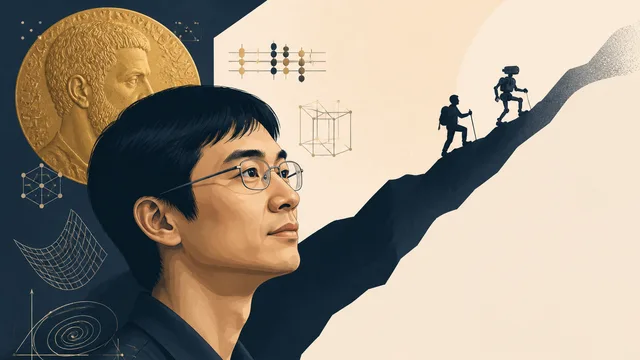
Neuroscientist David Eagleman explains why time warps in emergencies, why childhood summers felt endless, and what all of it reveals about consciousness.
Sam Harris, Roger Penrose, and Sophie Scott debate free will, consciousness, and whether neuroscience should reshape how we assign moral responsibility.
Duke researcher Kafui Dzirasa is building an electrical map of the brain to find new treatments for schizophrenia and depression—beyond dopamine and serotonin.
Emory neuroscientist Gregory Berns argues the unified self is an illusion—a narrative we constantly rewrite. What does that mean for identity, memory, and change?

Cognitive scientist Donald Hoffman claims DMT entities may be real alien minds. The math is real. Whether it proves anything about consciousness is a different question.
From yawning to déjà vu, the human body runs on mechanisms science can measure but not fully explain. Here's what researchers actually know—and don't.
UCL neuroscientist Nadine Dijkstra explains how the brain constructs reality, why imagination isn't hallucination, and what breaks when the system fails.
Curt Jaimungal's latest video unpacks "the nature of reality" across physics, philosophy, and math — and the distinctions hit differently when you cover CRISPR for a living.
Biologist Michael Levin argues intelligence exists on a continuum reaching down to cells and molecules. Here's what the evidence actually supports—and where it gets murky.
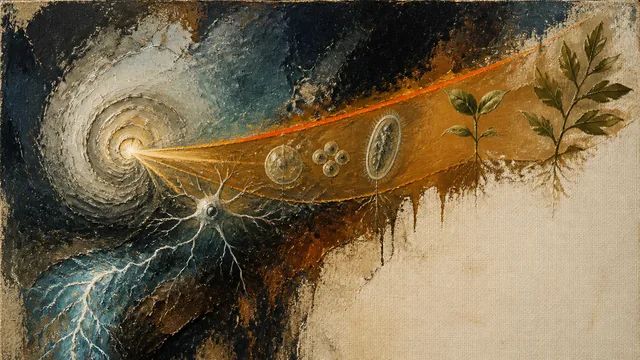
Mathematician John Lennox tells physicist Brian Greene that transhumanists are solving a problem Christianity cracked 2,000 years ago. My generation might actually find out who's right.
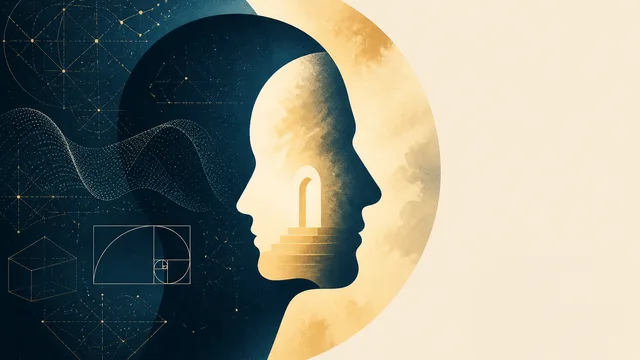
Game developer and MIT scientist Rizwan Virk argues quantum physics, mysticism, and video game design all point to the same unsettling conclusion about reality.
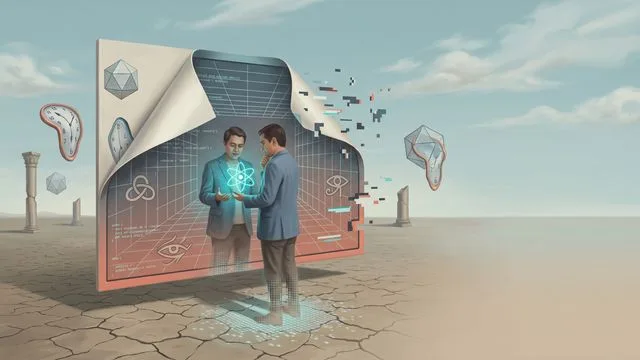
Joscha Bach says neuroscience is mapping the telegraph network and calling it civilization. A 302-neuron worm is the uncomfortable proof.

George Ellis argues physics doesn't decide outcomes—context does. Here's why his debate with Sean Carroll's reductionism is more consequential than it sounds.