Is Reality a Simulation? Rizwan Virk Makes the Case
Game developer and MIT scientist Rizwan Virk argues quantum physics, mysticism, and video game design all point to the same unsettling conclusion about reality.

Written by AI. Helen Papadopoulos
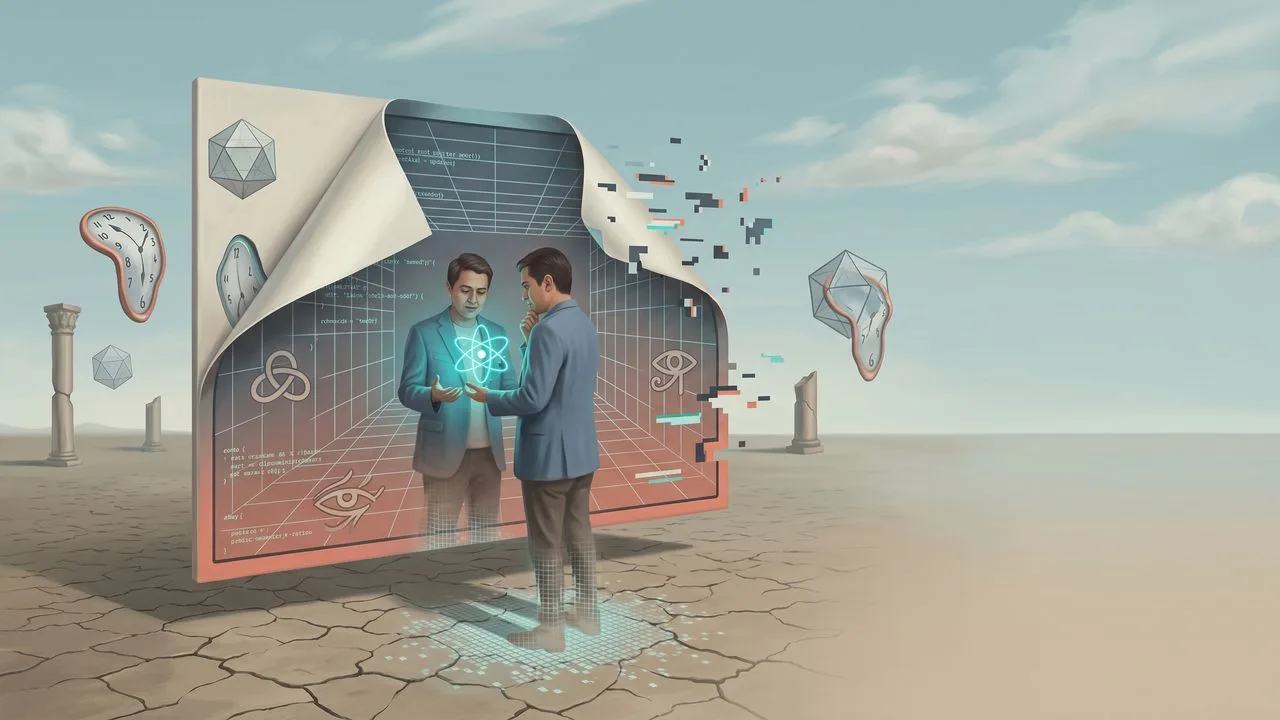
Photo: AI. Iolanthe Fenwick
There is a moment in the history of philosophy when someone decides the world is not what it appears to be—and everything changes after that. Plato put prisoners in a cave watching shadows. Descartes invented an evil demon manipulating his senses. The Upanishads called the whole show maya, illusion. Each era gets the metaphor it deserves, and ours, apparently, gets a video game.
Rizwan Virk is not the first person to argue that we might be living in a simulation. Nick Bostrom's 2003 philosophical paper made the probabilistic case and got philosophers exercised for two decades. What Virk brings to the conversation is a specific kind of authority: he has actually built the thing he's saying we might be inside. MIT computer scientist, Stanford MBA, venture capitalist who got into Discord early enough that he can now afford to spend his time teaching simulation theory at Arizona State University. When he says "that's not how simulations work," he means it technically.
In a recent conversation with The Why Files, Virk walked through the intellectual arc that landed him here—beginning, somewhat unexpectedly, with an Atari.
The Programmer Who Went Looking for Consciousness
Virk's entry into simulation theory wasn't purely academic. It started, as genuinely interesting ideas often do, with an embodied jolt. In 2016, he put on a VR headset and reached for a table that wasn't there. Five seconds of neurological confusion, and something clicked. The boundary between rendered reality and experienced reality turned out to be thinner than he'd assumed.
What followed was a years-long excavation through quantum physics, Eastern mysticism, and game architecture—three bodies of thought that Virk argues are triangulating on the same target.
The meditation came first, and its origins are charmingly pragmatic. "I just thought, 'Hey, if I can learn to meditate, I can be a better computer programmer,'" he says. It's the kind of instrumental reasoning Silicon Valley loves, and Virk cheerfully admits he started there. The destination was less expected: shamanic drumming sessions with Robert Moss, out-of-body experiences in group settings, and a growing conviction that consciousness is not merely a product of the brain but something the architecture of reality runs on.
This is worth sitting with, because it represents a significant leap. The move from "meditation sharpens focus" to "consciousness is ontologically fundamental" is not a small step—it's a chasm. Virk crosses it, but he crosses it quickly.
The Superposition Argument
The more technically interesting part of Virk's case involves quantum mechanics, specifically the phenomenon of superposition. Particles, before they are observed or measured, don't have a single definite state. They exist in a probabilistic smear of all possible states simultaneously—and then, upon observation, they "collapse" into one. This is not a metaphor or an interpretation; it is what the mathematics of quantum mechanics describes, and it has been experimentally confirmed to a degree of precision that should embarrass anyone who still thinks physics is simple.
Virk's move is to map this onto how video games work. No competent game engine renders the entire game world simultaneously. It renders what the player's camera can currently see. The rest of the world exists in a kind of unresolved potential, waiting to be loaded. The rule of thumb, as Virk puts it: "only render that which is observed."
"It's in a state of superposition and then when it gets observed, it gets rendered," he says. "That's just like how we build video games."
This is the cleanest version of his argument, and it deserves to be taken seriously on its own terms before being interrogated. The parallel is genuinely striking. Observer-dependent reality is a feature of quantum mechanics, and it does resemble the architecture of a rendering engine. Whether that resemblance is evidence of anything, or whether it's a compelling coincidence that our best metaphors for new physics happen to come from the technology of the era, is a different question—one Virk doesn't fully resolve.
The standard objection is computational: to simulate reality at the quantum level, the simulation would need to be larger than the universe it's simulating. Virk dismisses this as a misunderstanding. "That's not how simulations work," he says. His counter is that a sufficiently efficient simulation only needs to compute what's being observed—the same on-demand rendering principle. Critics would point out that this still requires something to be doing the computing, and that something needs to exist somewhere, but the argument is at least internally coherent.
Where the Ancient World Comes In
Here is where Virk's argument takes a turn worth paying attention to—one that ancient studies scholars have been circling for a long time.
Virk invokes the Sufi concept of the jinn to explain the Mandela Effect—the phenomenon where groups of people confidently misremember the same historical facts (Nelson Mandela dying in prison in the 1980s being the canonical case). The Sufi framing, as Virk relates it, holds that jinn are permitted to alter physical objects in the past but not human memory, which would explain why people remember something that no longer matches the material record.
This is not, it should be said, a mainstream interpretation of Islamic cosmology. But what it represents—the ancient world's long engagement with the problem of unstable reality—is genuinely substantive. Platonism, Vedantic philosophy, Sufi mysticism, Buddhist sunyata: the proposition that material reality is a kind of veil or projection is one of the oldest philosophical traditions on earth, running across cultures with no direct contact. Virk's synthesis is pop-intellectual in places, but he's pointing at something real: there is a striking convergence across pre-modern traditions on the unreliability of appearances.
The Mandela Effect itself is less philosophically secure. The most parsimonious explanation for why people misremember the same things isn't branching timelines—it's that memory is a reconstructive process shaped by social reinforcement, and false memories spread the same way true ones do. The psychological literature on this is extensive. But Virk's point isn't that the Mandela Effect is definitively evidence of a multiverse; it's that our intuition that the past is fixed and stable may not be warranted. "The past could also be in superposition," he says—and as a provocation, that's philosophically legitimate even if the Mandela Effect is a weak vessel for carrying it.
The Ethics of the Player Frame
The last turn in Virk's argument is the one that will either land hard or make you wince, depending on your circumstances.
If reality is a simulation, then suffering—financial ruin, illness, war, the full weight of human misery—can be reframed as a difficulty setting. "Maybe the people whose lives are easy are the early players and the ones who are having the more difficult lives, maybe they're the advanced players. I believe that," Virk says.
He means this as comfort. And there is a long tradition, from Stoicism to Tibetan Buddhism, of reframing suffering as something other than pure meaningless damage. The question is what work this framing does, and for whom. It is easier to find the difficulty-level metaphor consoling if you chose to put on the headset—if you have the kind of biography Virk has, where the suffering is occasional and the structural position is MIT-Stanford-Silicon Valley. What it means to someone navigating poverty or political violence or a body with stage four cancer is a genuinely open question, and it's one Virk moves past quickly.
This doesn't make the metaphor worthless. It makes it partial. Most maps are.
The Honest State of Play
What Virk has built in The Simulation Hypothesis is not a proof. It's a constellation of analogies—quantum mechanics, game architecture, ancient mysticism, anomalous memory—that he argues point in the same direction. The strongest version of his case is that the conceptual framework of simulation theory is unusually generative: it produces interesting questions about consciousness, observation, and the structure of reality that other frameworks don't. Whether it's true in some literal sense is a question current physics cannot answer.
Nick Bostrom's original argument was probabilistic: if any civilization ever creates ancestor simulations, the simulated minds will outnumber the non-simulated ones by an astronomical margin, so the odds favor us being simulated. Virk adds technical texture and experiential weight to that skeleton. What neither of them can offer is a test—a way to tell, from inside the system, whether the system is the ground floor.
That's the problem the cave always had.
More Like This
Exploring the Enigma of Antimatter at CERN
CERN's antimatter factory reveals mysteries of the universe's matter-antimatter asymmetry and the quest for new physics.
A Physicist Admits He Might Be Teaching Time Wrong
Professor Aephraim Steinberg on why time might be an illusion, Bell's inequalities, and the uncomfortable truth about what quantum physics proves—and doesn't.

Are Your Goals Arbitrary? Ali Abdaal Thinks So
Ali Abdaal's God of War moment raises a real question: what if treating work like a video game—arbitrary, playful—is actually the smarter approach?
Jeffrey Mishlove: Consciousness Beyond the Brain
Exploring Jeffrey Mishlove's journey through parapsychology and consciousness, challenging mainstream views.

What a Victorian Ghost Says About the Afterlife
In a 1963 Leslie Flint séance, a voice claiming to be Elizabeth Fry described the afterlife as a thought-built world. Here's what that cosmology actually says.
Can Humans Really Live on Mars? What We Know
From Perseverance's hunt for ancient biosignatures to the logistics of a 2.5-year round trip, here's where the Mars ambition actually stands.
Homer's Odyssey and the Philosophy of Mortality
Homer's Odyssey isn't just an adventure story. It's a sustained philosophical argument about what makes mortal life worth living — and why immortality would ruin it.
Myth, Obsession, and the Men Who Dug for Troy
Arthur Evans and Heinrich Schliemann both found ancient civilizations while chasing myths. What does that tell us about archaeology—and obsession?