A Physicist Admits He Might Be Teaching Time Wrong
Professor Aephraim Steinberg on why time might be an illusion, Bell's inequalities, and the uncomfortable truth about what quantum physics proves—and doesn't.

Written by AI. Nadia Marchetti
St. Augustine had it right: we all know what time is until someone asks us to explain it. Professor Aephraim Steinberg, a quantum physicist who's spent decades teaching graduate courses on the subject, recently admitted something most scientists won't say out loud—he's not entirely sure he's been teaching it correctly.
This is what happens when you actually try to answer the question "what is time?" instead of just moving past it.
The Mathematical Answer Nobody Likes
Mathematically, Steinberg explains, time is simple: it's a parameter. In both classical and quantum physics, things exist at all times, and you can ask what the value of any quantity is at any given moment. Relativity adds some complexity with spacetime, but it doesn't fundamentally change the picture.
Except that picture doesn't explain the thing we most want to know: why time only goes one direction.
"We inexorably travel in one direction in time and we don't know why," Steinberg says. We might discover a new law of physics that explains it. We might find it's just boundary conditions—the universe could have gone the other way, but ours happens to move forward. Or—and this is where it gets strange—quantum mechanics might suggest something even weirder.
There's a quantum mechanical description of the universe where nothing is changing in time at all. Where time itself might be an illusion generated by correlations between uncertain states.
Steinberg describes it like this: part of his wave function is sitting in the interview, and part is still back in bed that morning. That's fine, because if the part still in bed suddenly woke up and called the interviewer, it would find the interviewer also still in bed. Each conscious part perceives a consistent moment. Different formalisms describe how this might work, but he's clear: "It remains one of the deep mysteries of physics."
This isn't fringe speculation. This is a physicist explaining that one of our most basic experiences—the flow of time—might not be fundamental to reality.
The Question That Changed Everything
The conversation shifts when Steinberg talks about questions that expose what we don't actually understand. It happens constantly with technical details, he says—things he's taught for decades until someone asks the right question and he has to stop.
But the big one, the question that keeps pulling him back, concerns Bell's inequalities.
For context: Bell's inequalities are mathematical tests that distinguish between quantum mechanics and local realism—the idea that objects have definite properties independent of observation, and that influences can't travel faster than light. Experiments have repeatedly violated Bell's inequalities, which most physicists interpret to mean the universe is fundamentally non-local.
Steinberg used to teach it that way: "What we learn from Bell's inequalities is that the world we live in is not local. That you cannot describe what happens to you and what happens to me independently and still have a complete description of reality."
Then J Preskill, recent winner of the Turing Medal, gave a talk explaining why Steinberg and most other physicists are wrong.
Preskill argues you can prove the world is local—that Bell's inequalities only disprove a much more stringent notion of locality than Einstein actually proposed. This goes back to papers by David Deutsch and Patrick Hayden showing you can understand quantum correlations without information traveling faster than light. Mathematically, it's elegant. Interpretationally?
"Every few years I have to go back and try again to see what are they really saying about the nature of reality?" Steinberg admits. "And I don't know. I don't know if when I teach students about Bell's inequalities, I'm giving them the right picture or not."
This is a physicist who has spent his career on experimentally testable questions about quantum foundations—the exact kind of work that made him stay in physics. And he's saying he doesn't know if he understands what the experiments actually prove.
What Weak Measurement Really Shows
The interviewer pushes: has Steinberg's work on weak measurement shown that quantum objects have definite positions before measurement?
"No," he says flatly.
Weak measurement reveals averages. His team has shown you can track average positions and correlations in ways that agree with certain interpretations of quantum mechanics—specifically Bohmian mechanics, which treats particles as having definite trajectories. But that's not proof.
"The fact that those quantities are equal does not prove that you should think of this one as real or that one is real," Steinberg explains. Since they're averaging over distributions, many different theories with different underlying trajectories could produce the same results.
"I certainly don't think we have an experiment that proves that anything is real," he says. "I think what we're trying to do is keep reminding people that the jury is out."
This is the careful honesty that makes me trust physicists more than I trust most fields. Steinberg isn't hedging because he's uncertain about his measurements. He's hedging because he's genuinely uncertain about what reality is, and he knows the difference between those two uncertainties.
His work shows measurable quantities that seem universal enough to point toward something deeper. "Maybe it's something that reflects some of these quantities and that's what we should be looking for," he suggests. "But those are hints. Those aren't rigorous proofs of anything."
The Terrain We're Actually Standing On
Here's what we know: the mathematics works. Quantum mechanics makes predictions, we test them, they're confirmed to absurd precision. Bell's inequalities are violated in experiments. Weak measurements reveal consistent patterns.
Here's what we don't know: what any of it means about the nature of reality. Whether time is fundamental or emergent. Whether locality is violated or just differently defined. Whether particles have properties before measurement or only in relationship to measurement.
And here's what's uncomfortable: some of the smartest people working on these questions disagree fundamentally about what the evidence shows. Not because the evidence is unclear, but because the gap between mathematical formalism and physical interpretation is wider than we usually admit.
Steinberg teaches this stuff for a living. He's built experiments that probe quantum behavior at scales most of us can't imagine. And he's willing to say: I might be teaching this wrong. We might all be thinking about this wrong. The jury is genuinely out.
That's not failure. That's what the edge of knowledge actually looks like—not a clean boundary but a contested space where brilliant people examine the same data and see different implications for what's real.
More Like This
Exploring the Enigma of Negative Time in Quantum Physics
Dive into the perplexing world of negative time in quantum physics with insights from Prof. Aephraim Steinberg.
We've Been Teaching Heisenberg's Uncertainty Principle Wrong
The story we tell about Heisenberg's Uncertainty Principle is misleading. Professor Aephraim Steinberg explains what the textbooks got wrong—and what's right.
Are Subatomic Particles Just Convenient Fictions?
Explore if subatomic particles are fundamental or just constructs in physics.
Physicists Just Caught Virtual Particles Becoming Real
New experiment at Brookhaven Lab allegedly proves virtual particles exist—challenging how we understand empty space and quantum reality itself.
Why Quantum Uncertainty Keeps Atoms From Collapsing
The Heisenberg Uncertainty Principle isn't a bug in reality—it's what prevents atoms from imploding. Here's why quantum blur is structural, not optional.
Einstein Got a Gift in 1949 That Broke Physics' Rules
Kurt Gödel presented Einstein with a mathematical solution allowing time travel. Decades later, physicists still haven't found reasons to exclude it.
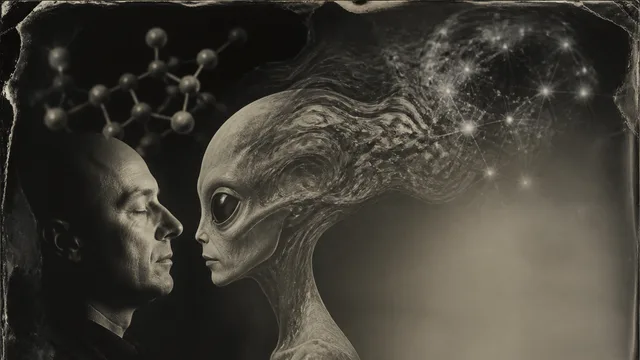
Do DMT Entities Point to Alien Consciousness?
Cognitive scientist Donald Hoffman claims DMT entities may be real alien minds. The math is real. Whether it proves anything about consciousness is a different question.

Viking Landers and the Unsolved Mars Life Debate
Fifty years after Viking landed on Mars, one experiment's positive result remains unexplained. Here's what the science actually shows—and what we've learned since.