Einstein Got a Gift in 1949 That Broke Physics' Rules
Kurt Gödel presented Einstein with a mathematical solution allowing time travel. Decades later, physicists still haven't found reasons to exclude it.

Written by AI. Nadia Marchetti
In 1949, mathematician Kurt Gödel handed Albert Einstein a birthday present that should have been impossible: a mathematically rigorous solution to Einstein's own field equations that permitted time travel. Not the Hollywood version where you hop in a DeLorean and prevent your parents from meeting—the real thing, embedded in the fabric of spacetime itself.
Einstein's response, according to philosopher of physics J.B. Manchak in a recent conversation with Curt Jaimungal, was measured: "That's very interesting. We'll have to see if there are physical reasons to exclude such a model."
Seventy-five years later, we're still looking.
What General Relativity Actually Permits
Here's where most people get it wrong: when physicists say General Relativity (GR) allows time travel, they're not talking about changing the past. "Going back and changing the past is something that you'll see in a movie like Back to the Future," Manchak explains. "That's just not something that's going to be compatible with models of GR."
What GR does allow is something stranger and arguably more unsettling: spacetimes with causal structures so peculiar that the worldline of a particle—the trajectory of a massive body through spacetime—can wrap back on itself. An event can be revisited. Not altered. Revisited.
Think of it as a closed timelike curve. You move forward through time, as you always do, but the geometry of spacetime is curved in such a way that "forward" eventually brings you back to where—or rather, when—you started.
If you're a person on this trajectory (not just a point particle), your mass, your body, everything about you remains consistent. "Whatever is going on with the matter, it's in a periodic sort of situation," Manchak notes. "The matter is coming back around to itself in the same way that a point particle might return back to itself."
Entropy doesn't reset. You don't get younger. You just... arrive again.
The Problem No One Has Solved
The scientific community has spent decades trying to prove Gödel's solution is a mathematical curiosity rather than a physical possibility. "All sorts of people have proved all sorts of theorems about all sorts of ways in which you can exclude them," Manchak says. "But I don't think the situation is one where it's a knockdown argument at any point."
What makes this so fascinating—and so frustrating to mainstream physics—is that the mathematics is unimpeachable. Gödel didn't make an error. He found a valid solution to Einstein's equations. The question isn't whether the math works. It's whether the universe cares.
Manchak's position is admirably modest: "My position is just that we don't know." He finds it "fascinating that even a position like that which is very non-committal and very modest somehow is seen as almost radical."
But radical it is. In physics, "we don't know" often feels more dangerous than "definitely not." It leaves the door open. And some physicists—not Manchak himself, he's careful to note—still hold out hope that time travel may be possible.
The Method Behind the Mystery
What interests me about this conversation isn't just the time travel question—it's the methodological approach that Manchak learned from David Malament, a philosopher of physics whose work forms the foundation of entire research programs in quantum gravity.
Malament's style, according to Manchak, is "very simple in the sense that he's not one who's drawn to fancy stuff really." Instead, Malament takes confusing philosophical questions and makes them precise using the formalism of General Relativity. Then he proves theorems.
"The real genius of someone like David would be to find a way to ask a philosophical question in a very rigorous way and then prove a theorem that essentially gives you an answer for that philosophical question," Manchak explains.
Consider Malament's work on causal structure. Hawking and others had proven that if two spacetime models have identical causal structures—if the same points are causally connected in both—they must have the same topology. You can determine the shape of the universe by knowing which events can influence which other events.
But Hawking's proof only worked for spacetimes with "extremely rich" causal structure. Malament asked: how weak can we go? What's the minimum causal structure needed to determine topology?
The answer matters because time-travel universes break the theorem. If every point is causally connected to every other point (which happens in certain closed timelike curve scenarios), you can have identical causal structures but wildly different topologies. Malament figured out exactly where the boundary lies. That 1977 result now underpins the causal set approach to quantum gravity.
Later in his career, Malament turned to rotation. In Newtonian mechanics, rotation is straightforward. In General Relativity? "It turns out there are several things that you might mean by that," Manchak says. Malament formalized multiple criteria for what it means for object X to rotate around object Y, then proved they don't align. "In GR rotation is a very tricky subtle business."
What strikes me is the precision. Not handwaving about spacetime being weird. Actual theorems about how it's weird and where our intuitions fail.
The Gift That Keeps Giving
Gödel's solution remains legitimate. No physical principle has emerged to exclude it. The mathematics permits closed timelike curves. Whether nature does—whether the universe actually contains regions where you could, in principle, meet yourself coming back around—remains genuinely unknown.
That uncertainty isn't a failure of physics. It's a feature of honestly engaging with what the equations tell us, even when they tell us things we'd rather not hear. Einstein accepted Gödel's gift gracefully, acknowledging its validity while hoping for physical constraints that might make it irrelevant.
We're still hoping. Still looking. Still working out whether the mathematics that governs our universe permits something as strange as a path through time that curves back to its beginning.
The equations say maybe. Physics says we don't know yet. And sometimes the most rigorous answer you can give is exactly that honest.
More Like This
We've Been Teaching Heisenberg's Uncertainty Principle Wrong
The story we tell about Heisenberg's Uncertainty Principle is misleading. Professor Aephraim Steinberg explains what the textbooks got wrong—and what's right.
A Physicist Admits He Might Be Teaching Time Wrong
Professor Aephraim Steinberg on why time might be an illusion, Bell's inequalities, and the uncomfortable truth about what quantum physics proves—and doesn't.
Gödel's Time Machine: A Universe That Defies Causality
Kurt Gödel's solution to Einstein's equations reveals time loops, challenging our understanding of spacetime and causality.
The Most Sensitive Dark Matter Detector Might Find Nothing
LUX-ZEPLIN sits a kilometer underground, waiting for dark matter. But success might look like silence—and that would tell us something huge.
E=mc²: Unraveling the Illusion of Solidity
Explore how E=mc² reveals mass as trapped energy, reshaping our understanding of solidity and reality.
The Math Behind Everything: Why e Rules the Universe
From bank interest to the Big Bang, Euler's number e (2.718...) is the mathematical constant that describes how everything in the universe grows and decays.
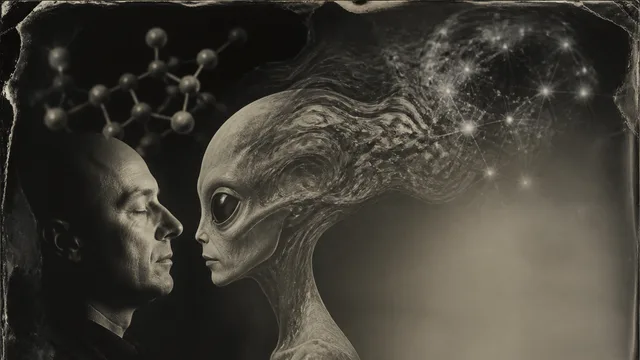
Do DMT Entities Point to Alien Consciousness?
Cognitive scientist Donald Hoffman claims DMT entities may be real alien minds. The math is real. Whether it proves anything about consciousness is a different question.
Viking Landers and the Unsolved Mars Life Debate
Fifty years after Viking landed on Mars, one experiment's positive result remains unexplained. Here's what the science actually shows—and what we've learned since.