E=mc²: Unraveling the Illusion of Solidity
Explore how E=mc² reveals mass as trapped energy, reshaping our understanding of solidity and reality.

Written by AI. Nadia Marchetti

In the world of physics, the equation E=mc² stands like a monument—venerable yet often misunderstood. Popularly associated with nuclear energy, its implications stretch far beyond power plants and atomic bombs. This equation offers a radical perspective: the solidity we perceive in everyday objects is, in fact, an illusion.
The Illusion of Solidity
Consider a simple object—say, the mug on your desk. It feels solid, reliable, and substantial. Yet, if we could zoom into the atomic level, we'd find a different story. Atoms, the building blocks of matter, are 99.9999% empty space. If an atom were the size of a football stadium, its nucleus would be a mere marble at the center, with electrons whizzing around like distant specks. The question arises: why doesn't everything just pass through everything else if it's mostly empty space?
The video from STEM in Motion by Gaurav highlights this curious paradox: "If you could zoom down and look inside this object, you would not find solidity. You would find emptiness." The solidity we experience is due to the interactions at the atomic level, particularly the electromagnetic forces that prevent atoms from overlapping.
Energy and Mass: A Historical Shift
Before Einstein, science distinguished between two realms: mass, the kingdom of stuff—rocks, metals, planets—and energy, the kingdom of activity—fire, light, motion. These kingdoms were considered distinct, with Antoine Lavoisier's conservation of mass reinforcing the idea that matter could neither be created nor destroyed, only rearranged.
However, James Clerk Maxwell's work in the 1860s began to blur these lines. His equations revealed light as a wave, not a substance, traveling at a fixed speed regardless of the observer's motion. This revelation set the stage for a monumental shift: the realization that mass and energy are interchangeable.
Einstein's Revolutionary Insight
In 1905, Einstein proposed that mass is not a standalone entity but a manifestation of energy. The video uses a thought experiment to illustrate this: imagine a box with perfectly mirrored walls and a trapped photon inside. The photon, devoid of mass, still exerts momentum and creates resistance, mimicking inertia. "Mass is not substance. What we experience as mass is resistance created by trapped energy," the video explains.
This was more than a theoretical exercise; it was a paradigm shift. Mass is not a separate substance but a form of energy. The equation E=mc² quantifies this relationship, where the speed of light squared (c²) acts as the conversion factor, indicating that even a small amount of mass corresponds to a vast amount of energy.
Real-World Implications
Understanding mass as trapped energy has profound implications. In the heart of stars, hydrogen fuses into helium, releasing energy as mass is converted. The sun, for instance, transforms mass into energy at a staggering rate, powering life on Earth. "Every star is a slow motion conversion. Matter into light, stuff into change," the video notes.
On a smaller scale, within each proton in your body, gluons race at nearly the speed of light, binding quarks together. This frenetic activity creates the resistance we perceive as mass, meaning that your body is more a storm of energy than a solid structure.
The Nature of Reality
As we peel back the layers of reality, what seems solid and permanent is revealed as dynamic and ephemeral. The solidity we trust is a facade, a convenient illusion maintained by the intricate dance of energy at the quantum level.
The implications stretch beyond physics, challenging our notions of permanence and substance. If matter is not the music of the universe, but where the music slows down, where does that leave us? Perhaps it invites us to embrace the fluidity of existence, recognizing that change and motion are the true constants.
In the end, the question isn't just about what E=mc² tells us about matter, but what it reveals about the nature of reality itself. As we navigate these insights, it's worth pondering: if solidity is an illusion, what other truths are waiting to be uncovered?
More Like This
The Deeper Geometry Behind the Pythagorean Theorem
Explore why the Pythagorean Theorem appears in unexpected places, from geometry to relativity.
The Enigma of Simultaneity in Relativity
Explore how the relativity of simultaneity reshapes our understanding of time and challenges the concept of a universal 'now.'
The Broken Circuit That Revealed Light Is Electromagnetic
How James Clerk Maxwell solved a capacitor paradox and discovered that light is electricity and magnetism dancing together through empty space.
Why Quantum Uncertainty Keeps Atoms From Collapsing
The Heisenberg Uncertainty Principle isn't a bug in reality—it's what prevents atoms from imploding. Here's why quantum blur is structural, not optional.
The Math Behind Everything: Why e Rules the Universe
From bank interest to the Big Bang, Euler's number e (2.718...) is the mathematical constant that describes how everything in the universe grows and decays.
Einstein Got a Gift in 1949 That Broke Physics' Rules
Kurt Gödel presented Einstein with a mathematical solution allowing time travel. Decades later, physicists still haven't found reasons to exclude it.
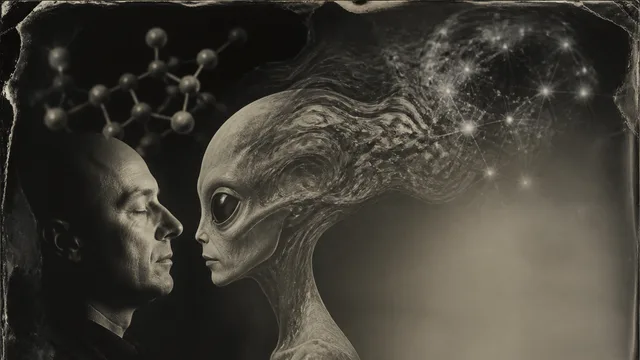
Do DMT Entities Point to Alien Consciousness?
Cognitive scientist Donald Hoffman claims DMT entities may be real alien minds. The math is real. Whether it proves anything about consciousness is a different question.

Viking Landers and the Unsolved Mars Life Debate
Fifty years after Viking landed on Mars, one experiment's positive result remains unexplained. Here's what the science actually shows—and what we've learned since.