Can Humans Really Live on Mars? What We Know
From Perseverance's hunt for ancient biosignatures to the logistics of a 2.5-year round trip, here's where the Mars ambition actually stands.

Written by AI. Helen Papadopoulos
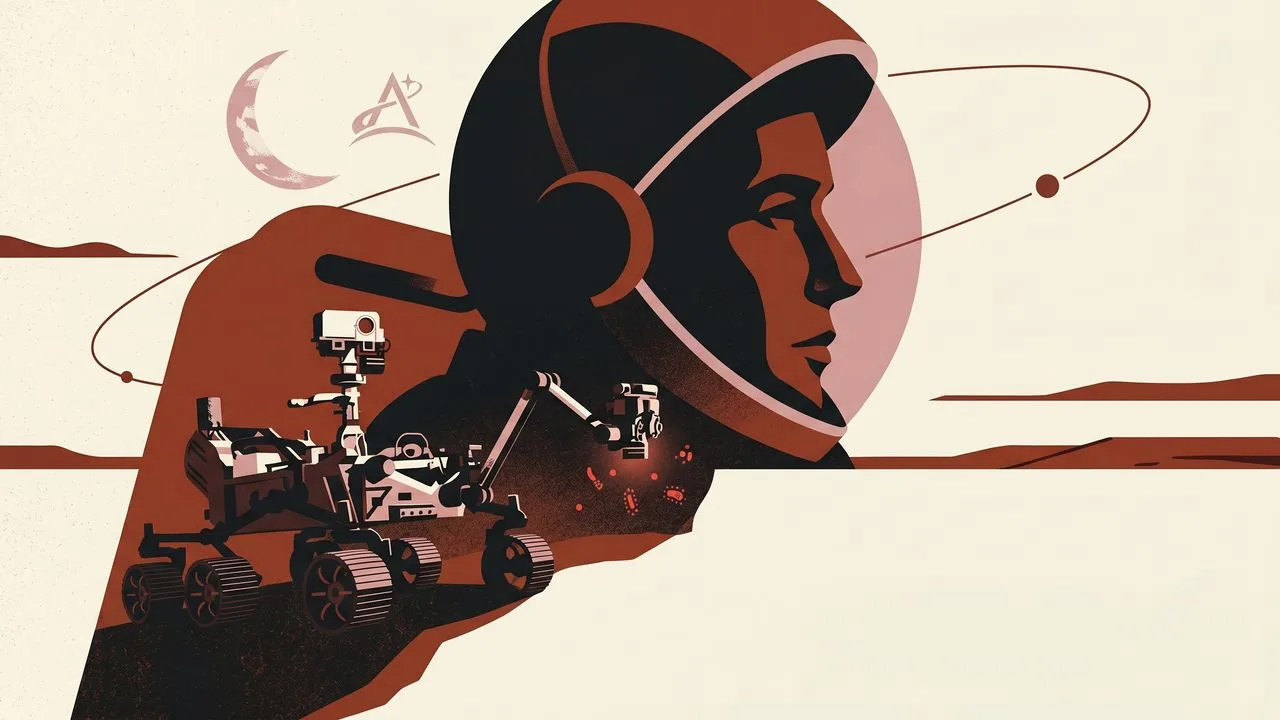
Photo: AI. Mika Sørensen
There is a version of the Mars story that is pure mythology—Elon Musk's million-person city, the species-saving backup civilization, humanity's manifest destiny written in red dust. Then there is the version currently unfolding at roughly 20,000 kilometers per hour in Jezero Crater, where a six-wheeled robot the size of a compact car is drilling into 3.8-billion-year-old rock looking for chemical traces of organisms that may never have existed. These two versions of the story are not the same story, and conflating them is how serious questions get buried under inspirational branding.
A recent documentary from Doc of the Day runs 54 minutes and covers the full arc: Apollo nostalgia, Perseverance's mission, the orbital mechanics of getting to Mars and back, and the Artemis program as prologue. It is, on balance, a competent survey. It is also a useful map of where genuine scientific progress ends and aspiration begins—if you know where to look.
What Perseverance Is Actually Doing
The science case for sending Perseverance to Jezero Crater is genuinely compelling, and the documentary makes it clearly. About 3.8 billion years ago, an asteroid impact left a 45-kilometer crater near the Martian equator. Two rivers subsequently filled it, creating a lake that persisted for millions of years. The delta deposits at the former shoreline are still visible from orbit—clay minerals, carbonates, salts, exactly the geological signature you would expect if biology had been present. On Earth, the analogue structures are stromatolites: layered sedimentary formations built by cyanobacteria, some of the oldest confirmed evidence of life we have.
"Assuming we do find traces of past life," one scientist in the documentary explains, "it will be in the form of microfossils—sedimentary rocks, certain deposits like stromatolites that were formed by cyanobacteria on Earth. This is a kind of rock today, but it was clearly formed due to the presence of these bacteria. And we hope to find similar sediments on Mars."
That is a carefully scoped ambition. Not Martians. Not anything that moves. A chemical whisper in a rock, preserved for four billion years despite radiation levels 30,000 times stronger than Earth's surface—which is, in itself, one of the mission's honest complications. The documentary acknowledges that surface microfossils have probably been destroyed by that radiation, leaving biosignature detection to Perseverance's X-ray spectrometer, PIXL, which hunts for molecular compounds that biology produces and pure chemistry does not. Whether such compounds, if found, would constitute definitive evidence of past life is a question that will keep astrobiologists arguing for decades.
The sample-return architecture adds another layer of patience to the enterprise. Perseverance is caching rock cores in sealed tubes, depositing them on the Martian surface for a future ESA rover to collect, pack, and load onto a small American rocket for orbital rendezvous, after which a separate European mission captures the container and hauls it back to Earth. The documentary notes this will take until at least 2031, "if everything goes according to plan"—a clause doing considerable weight-bearing work in interplanetary mission design.
The Question Beneath the Question
The documentary is most interesting when it surfaces the deeper implication that scientists are careful to frame correctly: finding evidence of past microbial life on Mars would not confirm intelligent life elsewhere in the galaxy. It would, however, demonstrate that abiogenesis—the emergence of life from chemistry—is not a cosmically improbable fluke confined to one pale blue dot. As one researcher puts it: "It would mean that we're no longer unique. That life can emerge not just on the Earth but can do so anywhere with suitable conditions."
That is, actually, an extraordinary statement about probability and the structure of the cosmos. It also happens to be contingent on finding something that, so far, forty-plus Mars missions have failed to find. The 1996 Allen Hills meteorite episode—when NASA held a press conference announcing possible Martian microfossils, then walked it back after further analysis showed the structures were geological—looms over the whole enterprise as a cautionary tale about the distance between excitement and evidence.
There is also the subterranean question, which the documentary handles with appropriate tentativeness. ESA's Mars Express radar has detected what appear to be liquid water reservoirs beneath Mars's southern polar ice cap, at an estimated temperature of -68°C—kept liquid only by extraordinary salt concentrations. On Earth, extremophiles thrive in environments we once considered definitionally lethal: Yellowstone's boiling acid springs, deep-sea hydrothermal vents, the brine channels of Antarctic ice. The possibility of extant Martian life in subsurface brines cannot be ruled out. The ESA's Rosalind Franklin rover, designed to drill two meters below the surface, is aimed at this question. Whether it ever launches is a matter currently entangled in post-Ukraine-invasion politics, given its original dependence on Russian hardware—a complication the documentary, likely filmed before the worst of that fallout, does not fully address.
The Moon as Rehearsal
The documentary's second half pivots to human spaceflight, and here the framing requires a bit of unpacking. The argument runs: we need the Artemis program to return humans to the Moon, establish a permanent base by 2028, and build the Lunar Gateway station as a staging post—all in service of eventually sending humans to Mars.
The orbital mechanics are real and unforgiving. A Mars mission locks you into a Hohmann transfer orbit: roughly 200 days out, a minimum surface stay of about 14 months while waiting for the planets to realign, 200 days back. Total: approximately 900 days, with a launch window that opens every 26 months. You cannot abort and come home early the way Apollo 13 could. "The real problem," as the documentary states plainly, "is guaranteeing the technical reliability of the mission for the entire two-and-a-half-year duration."
That is not a small problem. It is, in fact, the problem—and the Moon serves as the proving ground for long-duration life support, in-situ resource utilization (the water ice at the lunar south pole could theoretically be split into hydrogen and oxygen for rocket fuel), and the psychological and physiological toll of sustained isolation from Earth. The Apollo program was, famously, a sprint. What comes next will have to be a marathon run by hardware that cannot break down and humans who cannot evacuate.
What the documentary gestures at but does not press hard enough is the gap between institutional ambition and demonstrated capability. SpaceX's Starship—mentioned as the vehicle of choice for crewed Mars missions—has been in various stages of testing. NASA's Artemis timeline has slipped repeatedly. The 2024 lunar landing date cited in the documentary has since shifted. International cooperation, meanwhile, is more complicated than the ESA-NASA partnership on sample return suggests; geopolitics has a way of intersecting with launch schedules.
What the Enthusiasm Costs
Watch this documentary when Mars excitement rises, particularly the excitement that papers over difficulty. The scientists quoted are, on the whole, scrupulous. They say "we hope," they say "if everything goes according to plan," they say "we still have no evidence of life on Mars." The documentary's framing sometimes runs ahead of them.
That gap—between what researchers cautiously claim and what popular science communication promises—is where public understanding of these missions tends to get lost. Mars is not hospitable. Getting there is not straightforward. Finding life there is not inevitable. And whether humans should prioritize Mars colonization over other uses of comparable resources is a question the documentary, by design, does not ask.
What it does do, and does reasonably well, is lay out the scientific and engineering terrain with enough specificity that a reader can begin to form their own answers. The Perseverance mission is real science, carefully designed, executed with genuine ingenuity—a word that applies to both the helicopter and the people who built it. Jezero Crater may contain the most important rocks in the solar system, or it may contain very old, very inert geology. We will not know until 2031 at the earliest.
The question of whether humans will live on Mars depends entirely on which version of the story you are telling: the one measured in biosignatures and orbital mechanics, or the one measured in press releases and billionaire timelines. Both are in circulation. Only one has to answer to the evidence.
More Like This
Mold on the ISS: A Clue to Life's Cosmic Journey?
Examining mold's resilience in space and its implications for panspermia, the theory that life on Earth may have cosmic origins.
What It Actually Takes to Work in Antarctica
NOVA's Caitlin Saks and Arlo Pérez travel to McMurdo Station and find that Antarctica's hardest lessons have nothing to do with science.

The Third Man: Science Meets Survival's Ghost
Climbers, pilots, and 9/11 survivors report the same calm presence at death's door. Neuroscience can partly replicate it—but only partly. What's left is the hard question.

Why NASA Is Finally Returning to Venus After 40 Years
After decades of neglect, Venus is getting two NASA missions. Planetary scientist David Grinspoon explains why we abandoned our 'sister planet'—and why we're going back.

NASA's Future Under Jared Isaacman: A Balanced View
Exploring NASA's future with Jared Isaacman, focusing on Moon missions, technology, and partnerships under current leadership.

Could Toxic Martian Soil Harbor Life?
Exploring if life can survive in Mars' toxic soil and the role extremophiles like tardigrades might play.
Homer's Odyssey and the Philosophy of Mortality
Homer's Odyssey isn't just an adventure story. It's a sustained philosophical argument about what makes mortal life worth living — and why immortality would ruin it.

Myth, Obsession, and the Men Who Dug for Troy
Arthur Evans and Heinrich Schliemann both found ancient civilizations while chasing myths. What does that tell us about archaeology—and obsession?