Could Toxic Martian Soil Harbor Life?
Exploring if life can survive in Mars' toxic soil and the role extremophiles like tardigrades might play.

Written by AI. Priya Sharma

The prospect of life on Mars has been both a tantalizing possibility and a persistent scientific challenge. While Earth has its fair share of extremophiles—organisms that thrive in harsh environments—Mars presents a unique set of challenges that push the limits of survival.
Tardigrades, often celebrated as the epitome of resilience, were recently tested against the rigors of Martian conditions. These microscopic creatures, known for withstanding extreme desiccation, radiation, and even the vacuum of space, faced a formidable adversary in Martian soil. The video from PBS Space Time reports that when exposed to perchlorates, a chemical abundant on Mars yet toxic, even tardigrades faltered. This raises the question: if Earth's hardiest extremophiles can't cope, can anything?
Mars once boasted conditions conducive to life, resembling early Earth with its liquid water and thick atmosphere. However, the planet's transformation into an inhospitable terrain is well-documented. The thin atmosphere, intense ultraviolet radiation, and chemically hostile regolith present significant barriers to life as we know it.
Despite these challenges, pockets of potential habitability may exist below Mars' surface. Certain salts, while toxic, also possess hygroscopic properties, absorbing atmospheric moisture and potentially forming brines that remain liquid at subzero temperatures. These perchlorate-rich brines could, paradoxically, offer a refuge for life by creating transient, protective microenvironments.
The notion that life could persist in such harsh conditions isn't entirely speculative. Halophilic microbes on Earth, which thrive in high-salinity environments and sometimes use perchlorates in their metabolism, provide a terrestrial parallel. As noted in the video, "We have things on Earth that do some of the required things," suggesting that life could adapt to Martian realities.
Mars exploration missions, such as the upcoming Rosalyn Franklin rover, are poised to delve deeper into the Martian crust, where conditions might be less extreme. These missions aim to uncover signs of past or present life by examining subsurface samples. The potential discovery of biomarkers or even microbial life would not only redefine our understanding of Mars but also challenge our perceptions of life's adaptability.
Recent seismic studies offer another intriguing possibility: the existence of large aquifers deep within Mars' midcrust. These underground reservoirs, if confirmed, could harbor microbial ecosystems sustained by geochemical energy, akin to Earth's deep biosphere. "Recent work...postulated that parts of the Martian midcrust may contain gigantic aquifers," the video highlights, underscoring the potential for life in these hidden oases.
Yet, the search for life on Mars is fraught with complexities. The harsh surface conditions mean any extant life is likely sparse and slow-growing, akin to Earth microbes residing in deep-sea sediments. Exploring these possibilities will require sophisticated technologies and long-term commitments, perhaps even human exploration.
As we continue to probe Mars, the question of whether life exists—or ever existed—remains open. Discovering life on Mars, particularly if it evolved independently, would suggest that life is a common cosmic occurrence, offering profound implications for our understanding of the universe. In the quest to find life beyond Earth, Mars remains a compelling, if challenging, frontier.
More Like This

A New State of Matter in Earth's Core?
Exploring Earth's core: Could it exist in a superionic state, both solid and liquid? A new study delves into this possibility.

Gödel's Time Machine: A Universe That Defies Causality
Kurt Gödel's solution to Einstein's equations reveals time loops, challenging our understanding of spacetime and causality.
Mold on the ISS: A Clue to Life's Cosmic Journey?
Examining mold's resilience in space and its implications for panspermia, the theory that life on Earth may have cosmic origins.
Exploring Earth's Mysterious Portals and Their Legends
Dive into the legends and theories around Earth's enigmatic sites like the Bermuda Triangle and Zone of Silence.

Why NASA Is Finally Returning to Venus After 40 Years
After decades of neglect, Venus is getting two NASA missions. Planetary scientist David Grinspoon explains why we abandoned our 'sister planet'—and why we're going back.

Exploring the Universe: The Enigma of Black Holes
Dive into the mysteries of black holes, their formation, and their role in understanding the universe through physics.
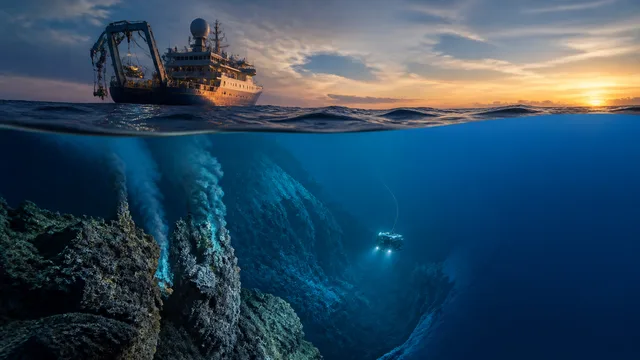
Marine Geology: What Lives on the Ocean Floor
From hydrothermal vents to the Challenger Deep, marine geology shapes ecosystems, climate, and our best guesses about where life can exist.
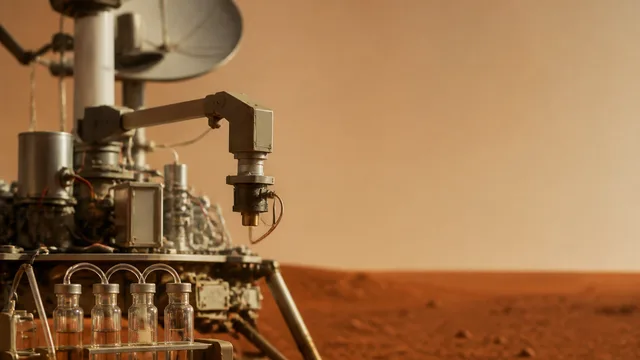
Viking Landers and the Unsolved Mars Life Debate
Fifty years after Viking landed on Mars, one experiment's positive result remains unexplained. Here's what the science actually shows—and what we've learned since.