What It Actually Takes to Work in Antarctica
NOVA's Caitlin Saks and Arlo Pérez travel to McMurdo Station and find that Antarctica's hardest lessons have nothing to do with science.

Written by AI. Olivia Meng
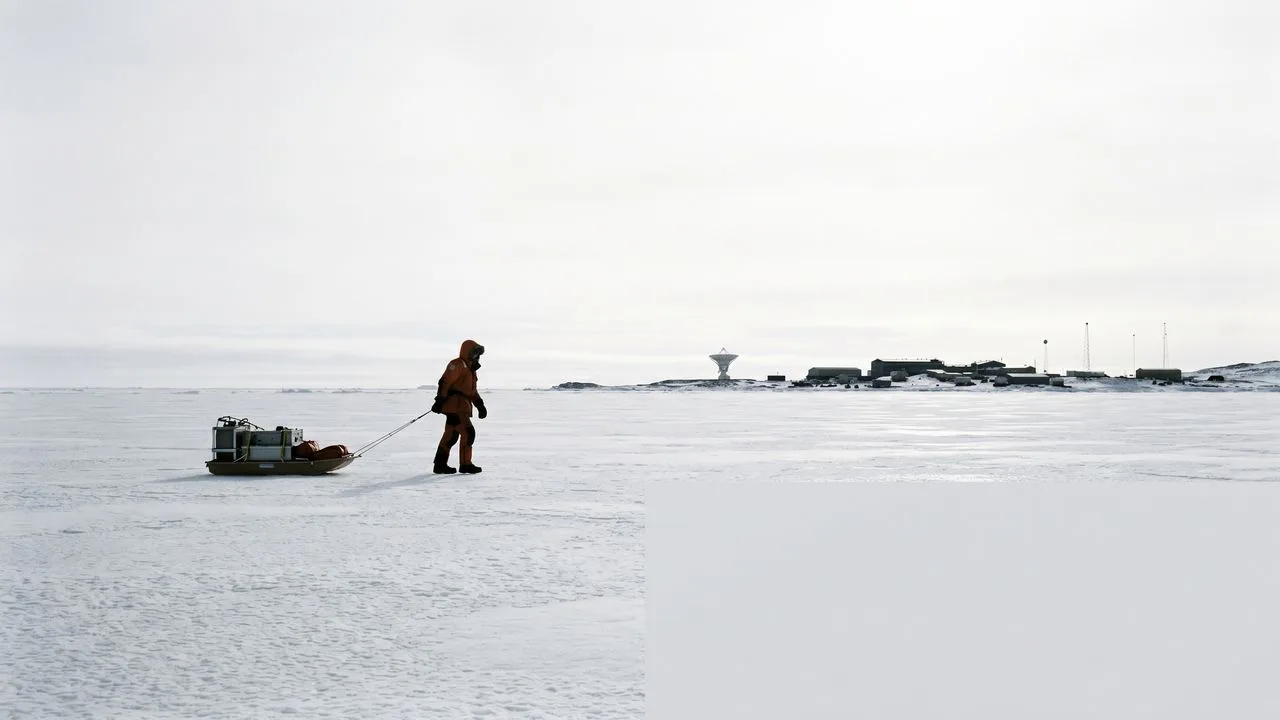
Photo: AI. Tomoko Hayashi
Before NOVA producers Caitlin Saks and Arlo Pérez filmed a single frame of science, they spent a week cleaning snowmobiles with screwdrivers, learning to radio their vehicle count to base operations, and attending classes on how not to fall into an ice crack. This is the part of Antarctic fieldwork that doesn't make it onto the documentary reel—and it's arguably more revealing than anything that does.
Their recent NOVA episode, released this week, documents the first stretch of a month-long trip to McMurdo Station, the U.S. Antarctic Program's main base of operations on Ross Island. It's framed as a behind-the-scenes look at what scientists endure to do their work. What it ends up being, somewhat inadvertently, is a portrait of a place that refuses to let you be a passive observer.
The infrastructure of extreme science
McMurdo is not what most people picture when they imagine Antarctic research. With 105 buildings and roughly 900 residents during the summer season, it functions less like a remote outpost and more like a small, very cold college campus—one with dorms, roommates, a 24/7 pizza kitchen, and apparently, a pager network. The station was built in 1955-56 by the U.S. Navy and sits at the southernmost point on Earth accessible by ship. It serves as the logistical hub for expeditions pushing deeper into the continent.
Getting there at all requires routing through the U.S. military. There are no commercial flights to McMurdo. Transport is provided by Operation Deep Freeze aboard U.S. Air Force C-17s, a five-hour flight from Christchurch, New Zealand, with no windows and cargo-hold seating. The gear issued in New Zealand—rated to -40 to -50 degrees Fahrenheit—includes what Pérez cheerfully catalogues as a "giant red parka," "clown boots," and "snot wiper gloves." The last item is less a joke than a practical acknowledgment of what prolonged exposure to Antarctic air does to the human face.
This infrastructure—military logistics, a purpose-built town, a global gear distribution system—is the unglamorous scaffolding that makes Antarctic science possible. It rarely features in the research papers that emerge from the continent, but without it, none of those papers exist.
Survival as prerequisite
Before Saks and Pérez could accompany any scientists into the field, they had to demonstrate they wouldn't become a liability. McMurdo's orientation program covers snowmobile operation, crevasse awareness, GPS protocols, and whiteout navigation. The stakes aren't theoretical.
A safety instructor in the film is direct about it: "We've had to go get people that used the GPS inappropriately and got themselves in a situation where they got lost. And there's also been people that have been lost in whiteouts and basically died of exposure. It is a harsh continent."
Weather can deteriorate from clear to full blizzard in minutes, with windchill dropping to -50°F. Frostbite doesn't require dramatic conditions—it can set in during routine travel if clothing gaps or attention lapses. The mandatory radio check-ins—vehicle counts, ETAs reported to Mac Ops—are not bureaucratic formality. They are the system by which people are tracked and, when necessary, found.
What this produces, by design, is a culture of collective accountability that is foreign to most professional environments. You are responsible not just for your own safety but for the people who would have to come find you.
The disorientation problem
One aspect of Antarctic life that science communicators tend to underemphasize is the cognitive strangeness of it. During the austral summer, the sun does not set. Days blur into each other without the circadian cues that structure normal life. Saks describes arriving after a week feeling "exhausted, disoriented," stuck near the station, having filmed nothing useful, wondering whether she could do it at all.
This is a documented phenomenon among Antarctic workers, not just travel-fatigued journalists. The combination of continuous daylight, isolation, unfamiliar routines, and the weight of why you're there—often for research that carries real stakes—produces a period of psychological adjustment that station veterans call, with some affection, "getting your ice legs."
Elaine Hood, the station's public affairs officer who guides Saks and Pérez through their first week and whom the team describes as their "Antarctic mom," normalizes this disorientation rather than dismissing it. The feeling, she tells them, is universal among first-timers. The researchers who thrive here have all passed through it.
What the science is actually for
The episode gestures at the research agenda waiting for Saks and Pérez once they clear orientation: ground-penetrating radar that reads hundreds of meters into the ice; dry valleys used as planetary analogs for Mars; a robotic submersible measuring glacial dynamics and sea level contribution; Blood Falls, the iron-rich subglacial discharge from Taylor Glacier that has attracted sustained scientific attention for what it suggests about microbial life in extreme environments; and an active volcano that offers a window into deep geological time.
The sea level work is worth pausing on. A researcher in the film describes an Antarctic glacier's grounding line—the boundary where ice transitions from resting on bedrock to floating on ocean water—as "rapidly retreating," with the system described as "incredibly unstable." The rate of that retreat has direct bearing on sea level rise projections that carry enormous consequence for coastal populations. This is not background context for a scenic documentary. It is the reason the logistics infrastructure exists in the first place.
"It's really challenging to do stuff down here," one of the scientists tells Saks and Pérez, "and because of that there's still a lot of unexplored things and unanswered questions. So it really is a frontier down here."
That word—frontier—carries specific weight in this context. Antarctica remains one of the few places on Earth where genuine unknowns still outnumber answers, where the difficulty of access has functionally limited scientific inquiry, and where the questions being asked have planetary implications. The challenge isn't just physical. It's epistemic. Difficulty of access creates gaps in knowledge that matter.
The community question
What the NOVA episode captures, perhaps better than it intends to, is that Antarctic science is inseparable from Antarctic community. McMurdo's roughly 900 summer residents include not just researchers but mechanics, cooks, logistics staff, communications personnel, and people like Hood whose job is to make sure everyone else can function. The science that produces papers on glacial dynamics or microbial extremophiles or paleoclimate records depends entirely on this support structure—and on the social cohesion that develops among people living in extreme shared conditions.
"There's this really tight-knit community," one station veteran says in the film. "It's kind of like a weird, cold, icy family."
This is not sentiment. Isolation, shared risk, and common purpose produce social bonds that are functionally necessary in environments where interpersonal friction can compromise safety. The community is not a byproduct of the science. It is part of the infrastructure.
What Saks and Pérez set out to document—groundbreaking research at the bottom of the world—turns out to require understanding this first. The science doesn't happen despite the logistics and the community and the survival training and the disorientation. It happens because of all of it.
Whether that full picture makes it onto screen is a question the rest of their footage will answer.
More Like This
Rethinking Cosmic Acceleration: A Local Illusion?
Exploring the debate on whether the universe's acceleration is a local phenomenon, challenging the concept of dark energy.
Could Life on Earth Have Arrived via Asteroids?
Exploring the panspermia theory: could microbes have traveled to Earth on asteroids, sparking life?
Cosmic Threats to Earth: Asteroids, Solar Storms & Black Holes
From city-destroying asteroids to solar storms that could kill the internet, scientists are mapping the universe's most destructive forces—and our readiness is uneven.
Subcritical Reactors: Nuclear Power's Safety Fix?
A new generation of subcritical reactors promises to make nuclear meltdowns physically impossible. But can they deliver on cost, scale, and timeline?
Can Humans Really Live on Mars? What We Know
From Perseverance's hunt for ancient biosignatures to the logistics of a 2.5-year round trip, here's where the Mars ambition actually stands.
Understanding the Real Risk of Brain-Eating Amoebas
Explore the facts and myths surrounding brain-eating amoebas. How real is the threat, and can climate change affect its spread?
Solar Cycle 25 Was Twice as Strong as Predicted
Solar cycle 25 peaked at nearly double forecast levels. Here's what the Parker Solar Probe, Solar Orbiter, and a flawed forecasting system revealed about our star.
Anil Menon Reaches the ISS on His First Spaceflight
NASA astronaut Anil Menon launched to the ISS on July 14 aboard Soyuz MS-29. His eight-month mission raises questions about what space cooperation looks like next.