Could Life on Earth Have Arrived via Asteroids?
Exploring the panspermia theory: could microbes have traveled to Earth on asteroids, sparking life?

Written by AI. Olivia Meng
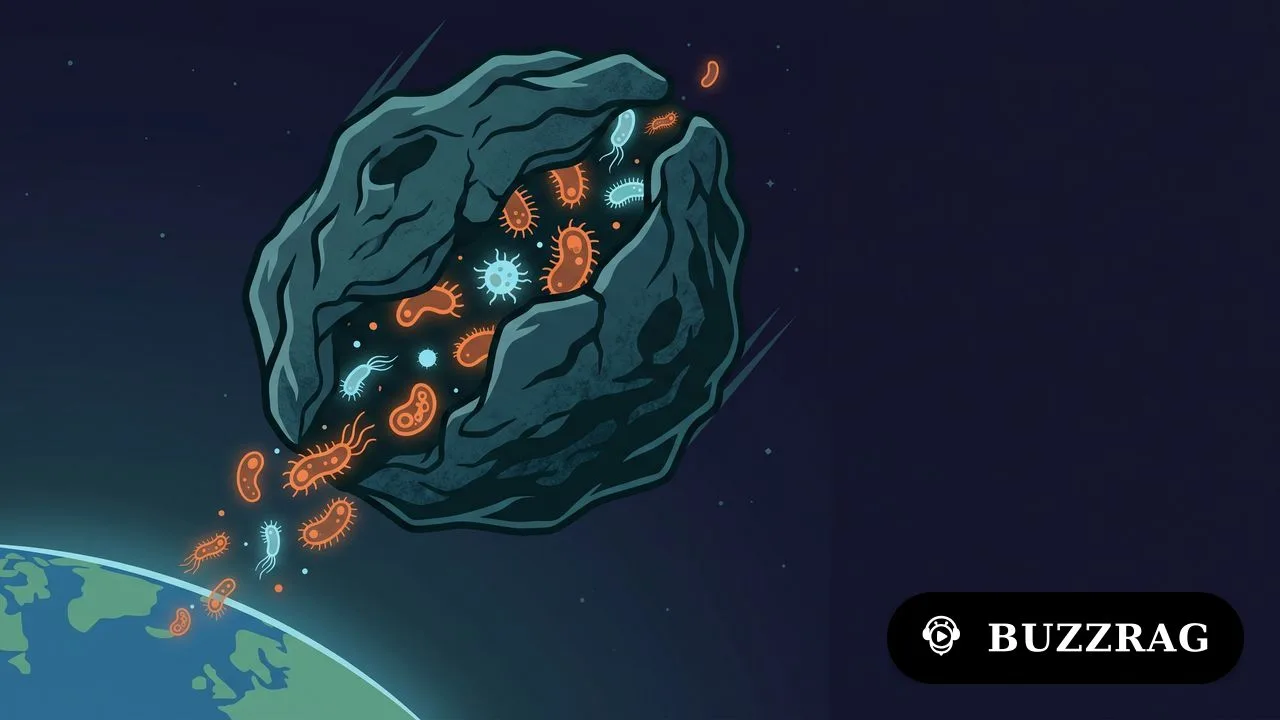
Photo: AI. Mika Sørensen
The notion that life on Earth might have extraterrestrial origins is no longer confined to the realm of science fiction. Recent studies have brought renewed interest to the once fringe theory of panspermia—the idea that life could have arrived here from outer space, hitching a ride on asteroids or comets.
A Shift in Perspective
Once regarded with skepticism, panspermia has gained traction in scientific circles over the past decade. This shift is largely due to a growing body of research demonstrating the resilience of microorganisms under extreme conditions. The bacterium Deinococcus radiodurans, for example, has shown an impressive ability to withstand environments that would typically prove lethal. According to a recent study, this bacterium survived pressures up to 3 gigapascals, conditions comparable to those experienced during an asteroid impact.
"If anything could survive an asteroid impact," the study's authors note, "this [bacterium] is a good candidate." The research involved simulating the high-pressure conditions of an asteroid collision by sandwiching the bacteria between metal plates and subjecting them to intense impacts.
The Plausibility of Interplanetary Travel
The concept of lithopanspermia—life spreading within or between solar systems on rocks ejected by celestial impacts—is supported by these findings. Life's potential journey within a solar system seems plausible, as a rock could be captured by the gravitational pull of another planet. However, the idea of interstellar travel is less likely, given the vast distances and time scales involved.
"Within one solar system, it's quite plausible," the video’s host, Sabine Hossenfelder, suggests, "though this might take millions of years." But the odds of a rock traveling between solar systems and landing in a habitable zone are significantly slimmer.
Extreme Survivors
Beyond Deinococcus radiodurans, other organisms like tardigrades—microscopic creatures known for their resilience—illustrate life's ability to endure harsh environments. Tardigrades have survived the vacuum of space, extreme radiation, and temperatures as low as minus 200°C. These findings underscore the robustness of life and lend credence to the panspermia hypothesis.
Implications for the Origins of Life
If panspermia holds true, the origins of life on Earth could be far more complex than previously thought. This theory raises the possibility that life in our solar system may have originated on Mars or another celestial body. "We might all be Martians," Hossenfelder quips, prompting a reevaluation of our cosmic ancestry.
Open Questions and Future Research
While the idea of panspermia is compelling, it remains a hypothesis requiring further investigation. Key questions persist: What are the actual odds of life surviving interstellar travel? Can we find definitive evidence of life forms on Earth that share a common origin with extraterrestrial counterparts?
This exploration into the origins of life invites a broader consideration of the resilience and adaptability inherent in living organisms. As our understanding of microbial survival grows, so too does our appreciation for the complexities of life's journey through the cosmos. Whether or not panspermia proves to be the key to our existence, it undeniably enriches the narrative of life's tenacity and potential interconnectedness across the universe.
More Like This

James Webb Challenges Dark Matter Beliefs
James Webb Telescope data questions the Bullet Cluster's role as dark matter proof, suggesting complex galaxy interactions.
Mold on the ISS: A Clue to Life's Cosmic Journey?
Examining mold's resilience in space and its implications for panspermia, the theory that life on Earth may have cosmic origins.
CERN's Particle Asymmetry: Cracking the Universe's Mysteries
Exploring CERN's recent findings on matter-antimatter asymmetry and their implications for understanding the universe.
Unraveling Time and Reality with Sean Carroll
Explore time, black holes, and reality with Sean Carroll, as science and philosophy intertwine in our understanding of the universe.
Lab-Grown Mini Brains and Climate Solutions
Exploring the ethical and practical implications of lab-grown brain organoids and solar geoengineering.
Why NASA Is Finally Returning to Venus After 40 Years
After decades of neglect, Venus is getting two NASA missions. Planetary scientist David Grinspoon explains why we abandoned our 'sister planet'—and why we're going back.
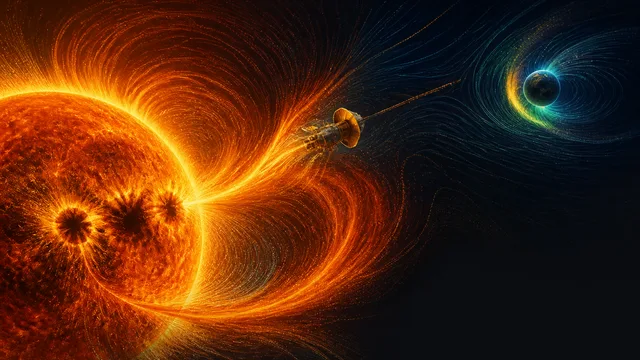
Solar Cycle 25 Was Twice as Strong as Predicted
Solar cycle 25 peaked at nearly double forecast levels. Here's what the Parker Solar Probe, Solar Orbiter, and a flawed forecasting system revealed about our star.
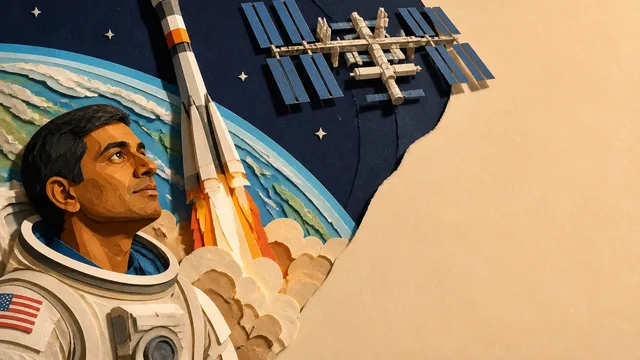
Anil Menon Reaches the ISS on His First Spaceflight
NASA astronaut Anil Menon launched to the ISS on July 14 aboard Soyuz MS-29. His eight-month mission raises questions about what space cooperation looks like next.