Unraveling Time and Reality with Sean Carroll
Explore time, black holes, and reality with Sean Carroll, as science and philosophy intertwine in our understanding of the universe.

Written by AI. Olivia Meng
Imagine a universe where the very concept of time as we experience it is a mere shadow of deeper cosmic truths. In a recent episode of StarTalk, astrophysicist Neil deGrasse Tyson and comedian Chuck Nice joined forces with theoretical physicist Sean Carroll to delve into the intricate dance between physics and philosophy. Their conversation spanned from the invisible yet omnipresent fields that weave our universe together to the profound implications of black holes and the arrow of time.
The Unseen Forces
One of the session's most enlightening discussions revolved around the nature of fields—those elusive entities that shape our reality despite remaining unseen. As Carroll explained, the journey to accepting fields was long and fraught with skepticism. "Isaac Newton worried about the concept of fields," Carroll noted. "He said there was a gravitational force between the sun and the earth... but he didn't know how it got there." It wasn't until the 1800s, with Faraday's intuitive experiments and Maxwell's mathematical rigor, that fields like electromagnetism became fundamental cornerstones of physics.
This acceptance of fields as real, despite their invisibility, challenges us to trust scientific evidence over sensory perception. As Tyson put it, "The universe is under no obligation to make sense to you." It's a lesson that resonates beyond physics, reminding us of the complexities hidden within our planet's environmental systems.
Black Holes: The Cosmic Enigmas
The conversation soon turned to black holes, those enigmatic entities that defy our conventional understanding of the universe. Carroll pondered a paradox that has perplexed scientists: "If you fall into a black hole, you see nothing special when you cross the boundary." Yet, from afar, black holes emit Hawking radiation, predicted by Stephen Hawking. How can both realities coexist?
Carroll's insights offered a glimpse into the nature of these cosmic giants. "There is high-intensity radiation when you're crossing the event horizon," he explained, "but you're moving so fast that you don't have time to observe it." This conundrum exemplifies the intricate dance between observation and reality—a theme that echoes in our understanding of Earth's climate systems, where rapid changes often elude immediate perception.
The Arrow of Time
At the heart of the discussion was the arrow of time—a concept that not only challenges our understanding of the universe but also our perception of reality itself. Carroll articulated the mystery eloquently: "The early universe 14 billion years ago... was in a very special organized state, and it's becoming more disorganized and higher entropy ever since then."
This progression from order to chaos is a cosmological puzzle that touches on the philosophical as much as the scientific. Why was the universe initially so ordered? While Carroll admits that "we still don't know," the quest for answers continues to propel scientific inquiry. It's a reminder that, much like our efforts to comprehend climate change, understanding time requires grappling with the unknown and embracing complexity.
Intersections of Science and Philosophy
The conversation didn't shy away from the philosophical implications of these scientific explorations. From the many-worlds theory to the philosophical nature of decisions, Carroll and his co-hosts wove a narrative where science and philosophy are inseparable. The universe, it seems, is a tapestry of possibilities, each thread contributing to the fabric of reality.
As we navigate the uncertainties of our world—be it the cosmos or our climate—the lessons from this dialogue remain pertinent. They remind us that understanding requires us to look beyond the surface, to question our assumptions, and to embrace the complexities that define our existence. In a world where environmental challenges loom large, perhaps the greatest lesson is this: our quest for knowledge is as vast and boundless as the universe itself.
More Like This
Black Holes: The Universe's Invisible Architects
Explore the enigmatic nature of black holes and their cosmic impact, from gravitational waves to the bending of spacetime.
Exploring Black Holes and Asteroids with StarTalk
Neil deGrasse Tyson delves into black holes, asteroids, and more in StarTalk's latest Cosmic Queries episode with Chuck Nice.
The Elusive Nature of Mathematics
Exploring math as a cognitive practice, beyond numbers and symbols.

The Power of Unexpected Results in Science
Explore how unexpected scientific results challenge assumptions and drive discovery.
Unveiling the Big Dipper: Misconceptions and Marvels
Explore the Big Dipper's role in stargazing, its misconceptions, and hidden marvels like double stars.
Does Reality Require Us? Exploring Quantum Mysteries
Unpack the role of observers in reality, exploring quantum mechanics, entropy, and the nature of existence.
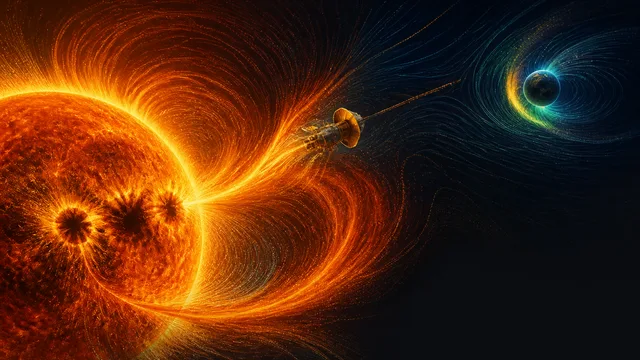
Solar Cycle 25 Was Twice as Strong as Predicted
Solar cycle 25 peaked at nearly double forecast levels. Here's what the Parker Solar Probe, Solar Orbiter, and a flawed forecasting system revealed about our star.
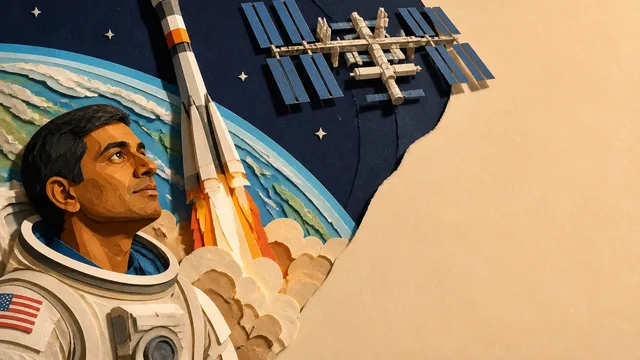
Anil Menon Reaches the ISS on His First Spaceflight
NASA astronaut Anil Menon launched to the ISS on July 14 aboard Soyuz MS-29. His eight-month mission raises questions about what space cooperation looks like next.