The Power of Unexpected Results in Science
Explore how unexpected scientific results challenge assumptions and drive discovery.

Written by AI. Olivia Meng

The scientific method is often portrayed as a straightforward path to discovery: formulate a hypothesis, conduct an experiment, and confirm or refute your initial assumption. However, as explored in a recent StarTalk episode featuring Neil deGrasse Tyson and Chuck Nice, the true nature of scientific inquiry is far more intricate and, frankly, more exciting.
Unexpected results are the unsung heroes of scientific discovery. While they may initially appear as setbacks or failures, these anomalies often illuminate the path to groundbreaking insights. As Tyson and Nice discuss, the value of an unexpected result lies not in its ability to confirm our beliefs but to challenge them, forcing us to rethink our assumptions and expand our understanding of the universe.
The Scientific Process and Null Results
At the heart of the scientific process is the design of experiments that are robust enough to yield valuable insights, even if they result in null findings. A null result, contrary to its seemingly unproductive nature, can be just as enlightening as a positive one. Tyson highlights the Michelson-Morley experiment as a quintessential example. Conducted in the late 1800s, it sought to measure variations in the speed of light relative to Earth's motion around the sun. The experiment's null result—no variation detected—became a cornerstone for Einstein's theory of relativity, establishing that the speed of light is constant in all reference frames.
"A well-designed experiment, you'd want the no result to still be interesting," Tyson notes. This sentiment underscores the importance of designing research that doesn't hinge solely on a specific outcome but is structured to generate further inquiry regardless of the initial findings.
Upending Expectations: The Accelerating Universe
The allure of unexpected results is further exemplified in the discovery of the accelerating universe. Astrophysicist Adam Riess, mentioned by Tyson, encountered an unexpected sign in his data suggesting that the universe's expansion was accelerating rather than decelerating. Initially suspecting a mistake, Riess double-checked his calculations and consulted with colleagues, ultimately confirming the unexpected result. This revelation not only earned a Nobel Prize but also redefined our understanding of cosmology.
"Unexpected results force you to rethink the assumptions that went into the experiment you proposed in the first place," Tyson explains. Such findings propel scientists to re-examine foundational beliefs, leading to paradigm shifts that advance our collective knowledge.
The Messiness of Scientific Inquiry
Science, as Tyson and Nice emphasize, is far from a linear process. It is a messy, collaborative endeavor characterized by constant reassessment and adaptation. Each unexpected result serves as a branching point, prompting new questions and avenues of exploration. This iterative nature is what makes science, in Tyson's words, "a way of thinking and a way of querying nature to arrive at what is objectively true."
In a world where scientific research often faces scrutiny from those outside the field, it's crucial to appreciate the role of unexpected results in driving progress. Tyson's discussion with Nice highlights the importance of maintaining an open mind and embracing the unknown. It is through this willingness to venture into the uncharted territory of unexpected results that science continues to unravel the mysteries of our universe.
When the Data Defies the Hypothesis
In conclusion, unexpected results are not merely anomalies to be dismissed; they are catalysts for innovation and discovery. By challenging our preconceived notions, they compel us to delve deeper into the fabric of reality. As Tyson and Nice eloquently illustrate, the true power of science lies in its ability to transform uncertainty into understanding, one unexpected result at a time.
More Like This

Apple's AI Pin: The Future of Wearable Tech?
Explore Apple's AI pin, Microsoft's Row Alpha, and YouTube's ambitious AI roadmap shaping the future of technology.

This $30 Breadboard Scans Rooms in 3D. Here's How
Engineer Henrique Ferrolho built a functional 3D room scanner for $30 using AliExpress parts. The interesting part isn't the price—it's what it reveals.

Why NASA Is Finally Returning to Venus After 40 Years
After decades of neglect, Venus is getting two NASA missions. Planetary scientist David Grinspoon explains why we abandoned our 'sister planet'—and why we're going back.
Decentralized Tech: Gadgets for the Privacy-Conscious
Explore gadgets that blend tech and anarchism to maintain privacy and autonomy in a surveilled world.
Tech Predictions 2026: Linux, Cybersecurity & AI
Explore bold predictions for 2026 in Linux, cybersecurity, and AI acquisitions, including a potential Amazon-Anthropic deal.
Terry Tao, AI, and the Fluid Dynamics Enigma
Exploring how Tao and AI tackle fluid dynamics, a puzzle crucial for tech and climate.
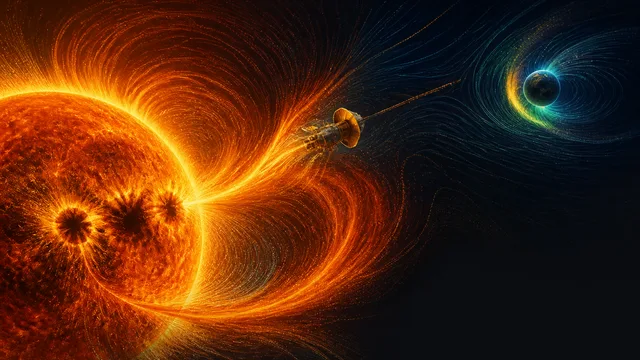
Solar Cycle 25 Was Twice as Strong as Predicted
Solar cycle 25 peaked at nearly double forecast levels. Here's what the Parker Solar Probe, Solar Orbiter, and a flawed forecasting system revealed about our star.
Anil Menon Reaches the ISS on His First Spaceflight
NASA astronaut Anil Menon launched to the ISS on July 14 aboard Soyuz MS-29. His eight-month mission raises questions about what space cooperation looks like next.