Cosmic Threats to Earth: Asteroids, Solar Storms & Black Holes
From city-destroying asteroids to solar storms that could kill the internet, scientists are mapping the universe's most destructive forces—and our readiness is uneven.

Written by AI. Priya Sharma
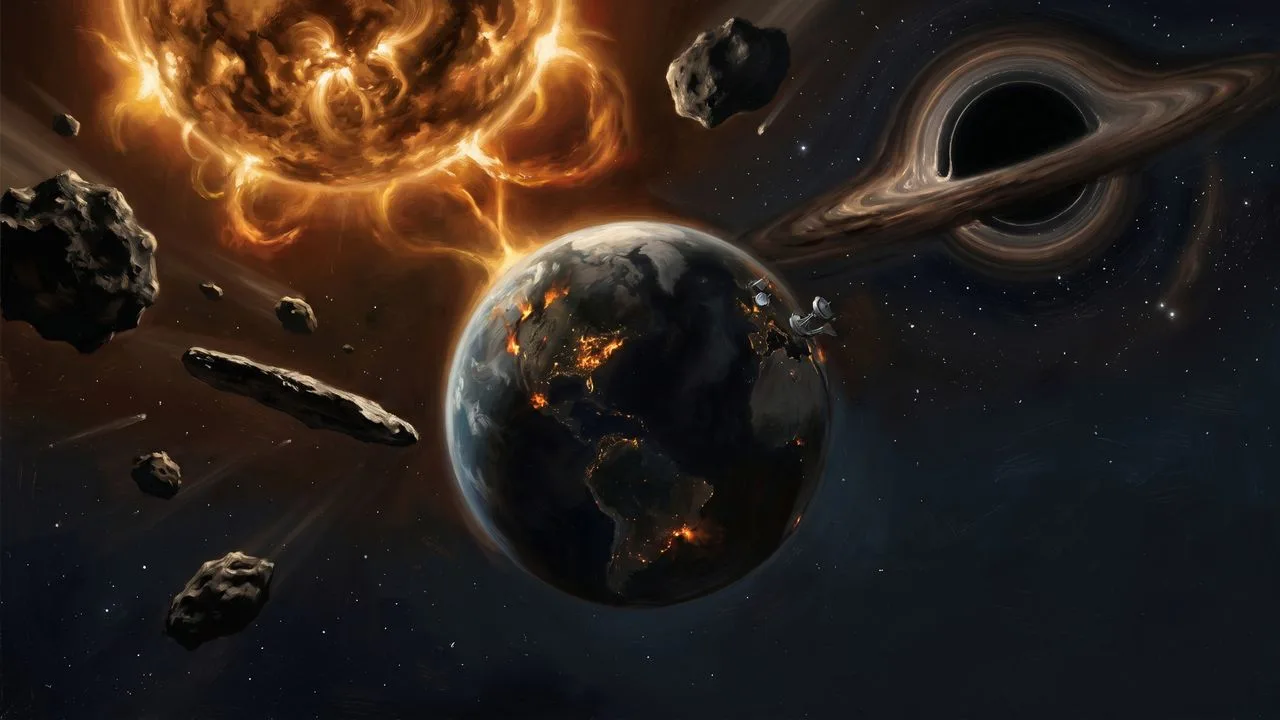
Photo: AI. Henrik Solberg
There is a particular kind of cognitive dissonance involved in learning, simultaneously, that the gold in your jewelry was delivered by a meteorite billions of years ago and that we currently track only about one in four asteroids large enough to destroy a city. The universe has always been both generous and indifferent. We are only recently developing the instruments to appreciate the difference.
A new Science Channel documentary compilation, Space's Deepest Secrets, works through the catalog of cosmic threats methodically—solar storms, asteroid impacts, black holes, and the first confirmed interstellar visitor to our solar system—and the picture it assembles is less "aren't stars pretty" and more "here is a list of ways things could go very wrong, and here is how seriously we are taking each one."
The answer, it turns out, varies considerably.
The Star We Depend On Is Getting Less Predictable
The documentary opens with the sun, which feels appropriate. It is 4.5 billion years old, it provides every joule of energy that sustains life on this planet, and it is, according to researchers interviewed in the film, becoming more volatile with age. A significant solar storm—the kind that produces coronal mass ejections capable of reaching Earth—could cripple communications infrastructure, knock out banking systems, and disable weather forecasting.
"Weather forecasting, communication, banking, the internet—all of that would be damaged if not destroyed by a big solar storm," one researcher warns. "The warning system that we have in place now is better than nothing, certainly. Is it enough? I would say no."
That is a brisk and somewhat alarming assessment. The documentary doesn't linger on it long enough to unpack what "not enough" means in practice—how much warning time current systems provide, what a more adequate system would require, or whether there are active policy conversations about upgrading it. For a threat that could affect essentially every person on the planet with access to electricity, the treatment here is notably brief. Worth flagging, because the solar storm risk is not theoretical: the 1859 Carrington Event—not mentioned in the documentary—was a geomagnetic storm so severe it set telegraph offices on fire. A comparable event today would hit infrastructure of incomparably greater complexity and fragility.
Meteor Crater and the Question of How Often "Rare" Actually Is
The film moves to Arizona's Meteor Crater, where Christian Koeberl, an impact specialist from the University of Vienna, stands at the rim of a bowl roughly 1.2 kilometers wide. He walks through the arithmetic of the impact: an asteroid perhaps 50 meters in diameter, traveling at 15 to 20 kilometers per second, releasing energy approximately 1,000 times that of the Hiroshima bomb, excavating a crater 20 times its own diameter within seconds. The meteorite itself essentially vaporized on impact.
What the documentary handles well here is context. Only about 180 confirmed impact craters are known on Earth's land surface—a number that sounds reassuring until you realize it reflects geology, not frequency. Three-quarters of the planet is ocean, and erosion has erased most of the rest. The moon, with no atmosphere and no liquid water, keeps its record intact: it is comprehensively pockmarked. Earth has been hit just as often. We just don't see the scars.
The Chelyabinsk event of February 2013 makes this concrete. An asteroid roughly 20 meters in diameter—undetected prior to entry—exploded in the atmosphere above a Russian city, producing a shock wave that injured approximately 1,500 people, mostly from shattered glass. On the same day, entirely by coincidence, asteroid 2012 DA14 (130 feet wide) passed within 18,000 miles of Earth—closer than our geostationary satellites.
"Here is an event happening that shows us that this is not just a theoretical subject, one that happens every few million years in Earth history," Koeberl observes. "It happens now. It happens all the time."
The Infrastructure of Planetary Defense
Don Yeomans, then head of NASA's Near Earth Object program at JPL, appears in the documentary to explain how the detection effort works. His timeline is clarifying: systematic searches for NEOs only began in earnest around 1998. Before that, astronomers largely weren't looking. The field is, by scientific standards, extremely young.
The Pan-STARRS telescope on Maui's Haleakala summit represents the current state of the art: a 1.4-gigapixel camera on a wide-angle telescope that scans the same patch of sky twice in 15-minute intervals. Astronomers apply image subtraction—removing static stars to isolate moving objects—to flag candidates for follow-up. Since becoming operational in May 2010, it has detected around 300 near-Earth objects.
The problem is the denominator. NASA estimates there are roughly 5,000 potentially hazardous asteroids wider than 300 feet. Detection programs have so far catalogued about one in four. Yeomans is measured but clear about what this means: more telescopes, wider fields of view, faster data processing pipelines. A second Pan-STARRS instrument is in development.
The gap between what we know and what's out there is the honest headline, and to the documentary's credit, it doesn't paper over it.
Black Holes: Known Physics, Unknown Territory
The transition from "rocks that might hit us" to "black holes" is not as jarring as it sounds. Both are cases where we understand the physics well enough to know that we don't understand it completely.
Danielle Faccio, a physicist based in Scotland, is doing something genuinely unusual: building analog black holes in the laboratory using extremely powerful lasers to force light to behave as a fluid. Near a real black hole, spacetime flows inward toward the event horizon the way a river flows toward a waterfall—past a certain point, nothing swims fast enough against the current to escape. Faccio replicates this geometry with light, then fires additional light waves toward his artificial horizon to observe what happens.
What he observes confirms a prediction from general relativity: waves freeze at the boundary.
"If you were to observe a spaceship or someone falling into a black hole from very far away, you would actually never see that person pass through the event horizon," Faccio explains. "You would see them approach the event horizon, time as seen from us would slow down, and we'd see them slow down and essentially remain frozen on the event horizon forever."
This is time dilation made visible in a terrestrial experiment—a striking thing. The caveat worth noting is that analog experiments, however elegant, are not the same as direct observation. Faccio's light-fluid system reproduces certain mathematical features of black hole physics, but it cannot reproduce all of them, and the interior of a black hole remains, in every practical sense, inaccessible. The documentary frames his work with appropriate enthusiasm; I'd add only that "confirms a prediction" and "proves the inner workings" are not equivalent claims, and the film occasionally elides that distinction.
What happens past the event horizon remains genuinely contested. The firewall hypothesis, the singularity model, and tidal spaghettification (the rather visceral process by which differential gravitational forces would stretch an infalling body into a thin filament of vapor) are each presented as live possibilities, because they are.
Wormholes: The Speculative End of the Spectrum
The documentary's final third pivots to wormholes, white holes, and the work of Los Angeles researcher Umar Mohideen, who is using a device based on the Casimir effect—trapping virtual particles in a micron-scale gap between a metal sphere and a metal plate—to investigate whether quantum vacuum energy could theoretically stabilize a wormhole mouth.
I want to be precise about the epistemic status of this work, because the documentary's framing is quite optimistic. Wormholes are solutions to Einstein's field equations. They are mathematically permissible. Whether they exist in nature, whether they could be traversable, and whether anything resembling Mohideen's device could interact with one at a useful scale are all open questions—some of them very open. The "scaled up" version of his device required to even approach wormhole stabilization would involve metal spheres millions of miles wide, positioned at an atomic-scale separation, dropped into a black hole. The engineering gap between Mohideen's lab and that scenario is not a detail.
That said, the documentary makes a point worth sitting with: "Even if wormholes don't exist, even if wormholes can't exist, the mathematics, the science, the physics of figuring them out theoretically can lead to new discoveries and things that we can use." This is a defensible philosophy of science. Investigating mathematically coherent structures, even ones we can't build, has historically produced real physics. Quantum mechanics emerged partly from people taking the mathematics seriously when the results seemed absurd.
The Visitor That Changed the Question
The documentary closes with Oumuamua, detected by astronomer Robert Weryk at the Maunakea Observatory on October 19, 2017. Its trajectory was hyperbolic—an open orbit, not a closed one—meaning it came from outside the solar system and was not gravitationally bound to our sun. The first confirmed interstellar object ever observed.
"Oumuamua was like nothing we had ever seen before," Weryk says. "And think about that. That's literally true. This was actually a completely alien object."
Weryk's team had approximately two to three weeks to study it before it moved beyond the range of available telescopes. What they collected raised more questions than it answered—Oumuamua's acceleration as it departed was slightly anomalous, a fact that generated significant subsequent debate in the literature (the documentary, which appears to predate or at least not incorporate the latest analyses, does not address this). It is, scientifically, still not fully explained.
Which makes it an apt note on which to end any survey of cosmic forces. The universe keeps producing phenomena that our best frameworks don't quite account for. The solar storm warning system is inadequate. Three-quarters of city-killer asteroids remain uncatalogued. The interior of a black hole has never been and may never be directly observed. And the first object we confirmed came from another star system left us with questions we still can't fully answer.
The science here is not a story of mastery. It is a story of instruments getting sharper and the picture getting more complicated.
More Like This
Crafting Supercars: The Science Behind Speed and Style
Explore how supercars like Alfa Romeo 4C and Aston Martin Vanquish are meticulously crafted using cutting-edge materials and precision engineering.
Exploring Mercury's Mysteries: From Alchemy to Modern Science
Discover the unique properties of mercury, its historical significance, and intriguing experiments in Andrew Szydlo's lecture.
Jupiter's Storms Run Deeper Than Anyone Expected
NASA's Juno probe reveals Jupiter's storms plunge 1,800 miles deep—and the sun isn't powering them. Here's what scientists think is going on inside.
Mars, Enceladus, and the Search for Life
From Mars's vanishing water to Enceladus's hidden ocean, planetary science is reshaping our understanding of where life might exist.
Exploring Black Holes and Asteroids with StarTalk
Neil deGrasse Tyson delves into black holes, asteroids, and more in StarTalk's latest Cosmic Queries episode with Chuck Nice.
Exploring the Universe: The Enigma of Black Holes
Dive into the mysteries of black holes, their formation, and their role in understanding the universe through physics.
CERN's LHC and the Search for Hidden Dimensions
Inside CERN's Large Hadron Collider: how 600 million proton collisions per second could reveal dark matter, extra dimensions, and the Higgs boson.
Triton's Strange Orbit and the Ice Giants' Secrets
Triton's retrograde orbit, nitrogen geysers, and the chaotic magnetic fields of Uranus and Neptune reveal how little we understand our own solar system.