Jupiter's Storms Run Deeper Than Anyone Expected
NASA's Juno probe reveals Jupiter's storms plunge 1,800 miles deep—and the sun isn't powering them. Here's what scientists think is going on inside.

Written by AI. Priya Sharma
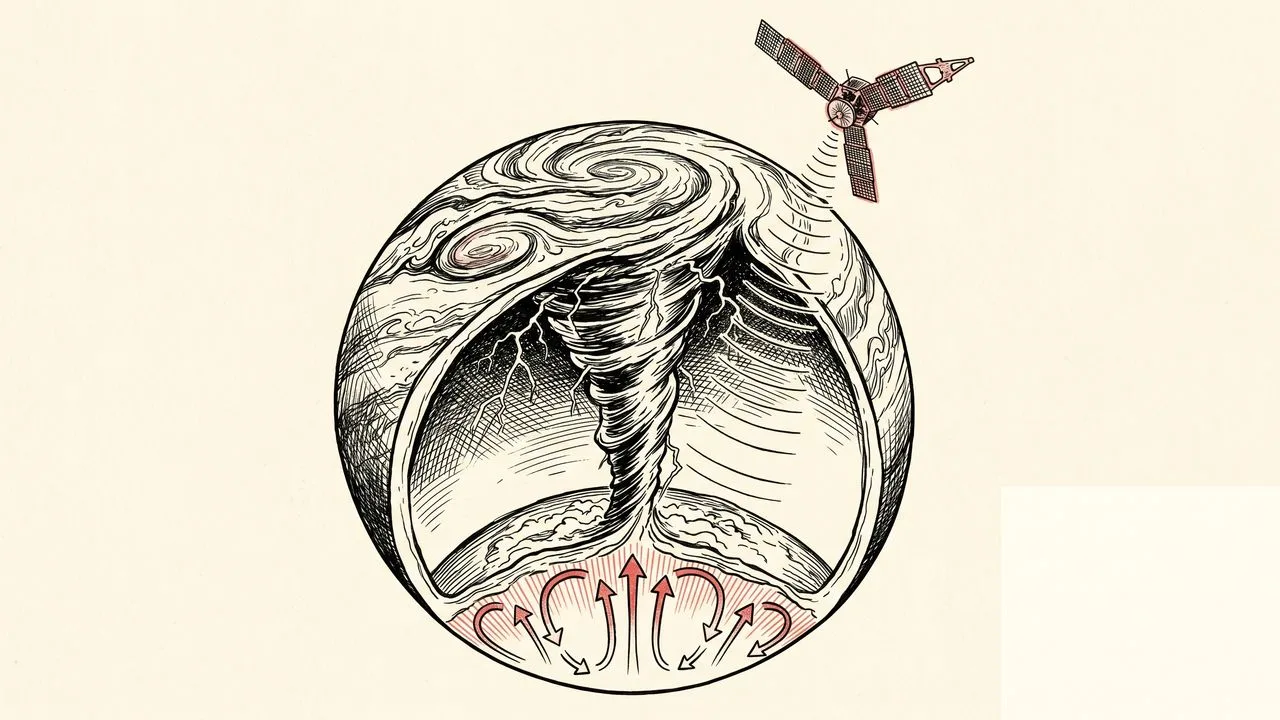
Photo: AI. Eira Pendragon
Jupiter doesn't really fit anywhere in our mental taxonomy of planets. It contains more mass than everything else in the solar system combined—minus the sun. Every other planet, moon, asteroid, and comet we know of accounts for the remaining 30 percent. Jupiter is, in a meaningful sense, the solar system's real story, with everything else as supporting material.
That framing comes from a researcher interviewed in a recent Science Channel documentary on Jupiter's extremes, and it's worth sitting with for a moment before moving on to the mechanics. We tend to think of our solar system as a collection of worlds. Astronomically speaking, it's closer to Jupiter and a bunch of debris.
What makes Jupiter scientifically interesting—beyond its sheer scale—is that it keeps confounding predictions. Its magnetic field is so powerful it strips charged particles from its own moons and generates auroras at its poles that dwarf anything Earth produces. Its core temperature sits at roughly 41,000 degrees Fahrenheit, hotter than the surface of the sun. Its cloud bands, which look like elegant painted brushstrokes from a distance, are actually counter-rotating jet streams moving at up to 370 miles per hour—multiple bands pushing against each other, generating turbulence on a scale that has no analogue in our experience of weather.
Astronomers have watched these features for centuries. Understanding why they exist has been considerably harder.
What Juno Was Actually Built to Do
NASA's Juno spacecraft launched in 2011 and reached Jupiter orbit in 2016, carrying a particle detector, infrared and ultraviolet imaging systems, and a magnetometer. The engineering goal was to get closer and look deeper than any previous mission. But one of Juno's most productive instruments wasn't designed to take pictures at all—it was the probe itself.
The technique is elegant in its indirectness. Jupiter's atmosphere is opaque; no telescope, onboard or Earth-based, can see through those iconic cloud bands to measure what lies beneath. But gravity doesn't hide. The density of Jupiter's storm bands affects the local gravitational field, which in turn affects Juno's velocity as it passes overhead. Denser, more massive regions pull the probe inward slightly; less dense regions release it. By tracking Juno's speed with extraordinary precision across thousands of orbits, scientists could reconstruct a density map of what's happening below the visible surface.
As one researcher explains it in the documentary: "By measuring the speed of Juno as it travels, we're actually seeing the different masses of the different storm bands on Jupiter. The more massive a storm band is, the deeper it extends into Jupiter."
What those measurements revealed surprised the people who took them: the storm bands extend approximately 1,800 miles into the planet. To put that in some perspective, Earth's entire radius is about 3,960 miles. Jupiter's storm systems reach depths comparable to half the Earth's radius, and they do so while remaining coherent, organized atmospheric structures. "What Juno is showing us is that these things go very, very deep," one scientist noted in the segment. "Surprisingly deep."
The word "surprisingly" is doing real work there. These weren't depths that existing models had predicted.
The Energy Problem
Depth alone is a clue, not an answer. The more urgent question is what's driving weather systems that run 1,800 miles down.
On Earth, the answer is solar energy. The sun's radiation heats the surface, that heat drives atmospheric circulation, and we get weather. The mechanism is well understood. Jupiter, however, sits five times farther from the sun than Earth does, and its atmosphere is enormously thick. The solar energy reaching Jupiter's cloud tops is a small fraction of what reaches ours. Whatever is churning those storms 1,800 miles into the planet, it isn't the sun.
"It can't be energy from the sun that's powering all these storms," one researcher states flatly. "The immense energy that has to be powering these incredible storms can't be coming from outside Jupiter. It has to be coming from within it."
This is the hypothesis that current research is pushing toward: Jupiter is generating its own heat, and that internal heat is the engine behind its extreme atmospheric dynamics. The question is where that internal heat comes from and how it couples to the visible storm systems.
A Tank of Water and 130 Gallons of Evidence
One of the more unexpected details in the documentary involves a laboratory in Marseilles, France, where researchers are running tabletop experiments to test the internal-heat hypothesis.
The setup is deliberately simplified: a 130-gallon tank of water seeded with tens of thousands of fluorescent plastic beads, designed to represent gas particles in Jupiter's thick atmosphere. The tank is spun to mimic Jupiter's rotation, and pumps at the bottom push water upward, simulating heat energy radiating from the planet's interior. Cameras track the bead movement with precision.
The result: the beads self-organize into alternating, counter-rotating bands that extend deep into the fluid—structurally similar to what Juno is measuring in the real Jovian atmosphere.
Laboratory analogs have obvious limits. Water in a tank is not a hydrogen-helium gas giant. The spatial and temporal scales are incomparably different. What these experiments can demonstrate is that the proposed mechanism—deep internal heat driving banded circulation—is physically plausible. They can't confirm it's what Jupiter is actually doing. That distinction between "consistent with" and "proven by" is exactly the kind of thing that gets lost in popular science coverage, so it's worth naming explicitly here.
Still, physical plausibility is not nothing. It narrows the hypothesis space.
What We Don't Yet Know
The documentary gestures toward Jupiter's formation—4.5 billion years ago—as part of the explanation for why the planet retains so much internal heat. The general scientific thinking is that gas giants generate heat through gravitational contraction: as they form, the energy released by infalling material converts to heat, and that heat can persist for billions of years. Jupiter is massive enough that it may still be radiating more energy than it receives from the sun, a phenomenon that's been measured and published in the peer-reviewed literature.
But the documentary stops short of explaining the full mechanism, and that's an honest stopping point. How exactly that primordial heat couples to the banded jet streams, why the bands maintain their structure and counter-rotation over such enormous timescales, and what role Jupiter's magnetic field plays in all of this remain genuinely open questions. Juno has been extended through 2025 and has completed dozens of close flybys, generating data that researchers are still processing and publishing.
There's also the magnetic field question, which the documentary raises and doesn't fully resolve: how does a gas giant—with no solid metallic core the way Earth has—generate a magnetic field fourteen times stronger than ours? The leading hypothesis involves metallic hydrogen, a phase of hydrogen that conducts electricity under the extreme pressures inside Jupiter, deep enough to act like the liquid iron in Earth's outer core. Juno's magnetometer data is contributing to that picture, but "contributing to" and "settled" are not synonyms.
Why Jupiter Keeps Mattering
There's a reason planetary scientists describe Jupiter as a natural laboratory. It's the largest experiment in planetary physics currently running in our vicinity, operating under conditions we could never reproduce on Earth and operating on timescales that make our weather look like a rounding error.
The storms visible in Juno's close-approach images—colors so vivid and geometries so intricate that at least one researcher in the documentary admitted to sometimes forgetting they were looking at a planet—aren't just aesthetically remarkable. They're data. Every banded jet stream, every cyclone nested inside another cyclone at Jupiter's poles, is a readout of processes happening 1,800 miles below what we can see, powered by heat that has been building since the solar system was young.
Whether the internal-heat model fully explains what Juno is measuring, or whether it's one piece of a more complicated picture, is something the mission data will continue to clarify. The question worth holding onto isn't just what powers Jupiter—it's what Jupiter, in its excess and strangeness, tells us about how planets form and persist in the first place.
More Like This

Crafting Supercars: The Science Behind Speed and Style
Explore how supercars like Alfa Romeo 4C and Aston Martin Vanquish are meticulously crafted using cutting-edge materials and precision engineering.

Exploring Mercury's Mysteries: From Alchemy to Modern Science
Discover the unique properties of mercury, its historical significance, and intriguing experiments in Andrew Szydlo's lecture.
Cosmic Threats to Earth: Asteroids, Solar Storms & Black Holes
From city-destroying asteroids to solar storms that could kill the internet, scientists are mapping the universe's most destructive forces—and our readiness is uneven.

Unlocking New Skills After 50: The 'Pillar & Playground' Approach
Explore how the 'Pillar & Playground' method helps those over 50 learn efficiently, leveraging crystallized intelligence and cognitive flexibility.

Fulgurites: How Petrified Lightning Reveals Earth's Past
Fulgurites form in a lightning flash—but these glassy tubes hold 15,000-year-old clues about the Sahara's lost monsoons and Earth's orbital shifts.

Why NASA Is Finally Returning to Venus After 40 Years
After decades of neglect, Venus is getting two NASA missions. Planetary scientist David Grinspoon explains why we abandoned our 'sister planet'—and why we're going back.
Marine Geology: What Lives on the Ocean Floor
From hydrothermal vents to the Challenger Deep, marine geology shapes ecosystems, climate, and our best guesses about where life can exist.

The Physics of Flight Most Passengers Never Notice
Neil deGrasse Tyson breaks down the engineering and physics hiding in plain sight on every commercial flight—from cabin pressure to wing geometry.