Mars, Enceladus, and the Search for Life
From Mars's vanishing water to Enceladus's hidden ocean, planetary science is reshaping our understanding of where life might exist.

Written by AI. Priya Sharma
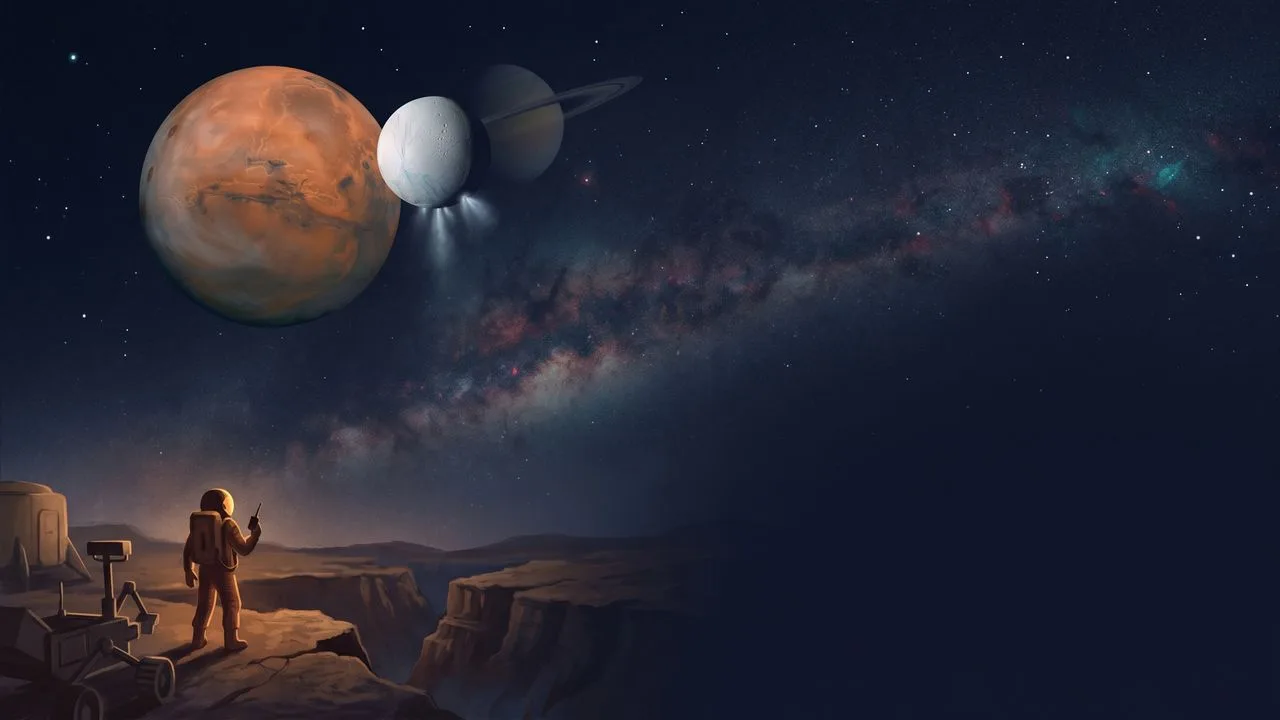
Photo: AI. Castor Belov
Fifty percent. That is humanity's success rate at landing spacecraft on Mars—a figure that tends to get quietly omitted from the press releases celebrating our interplanetary ambitions. Half of everything we've sent to the Martian surface either arrived as wreckage or never arrived at all. The European Space Agency's Schiaparelli lander, a $250 million spacecraft, free-fell for 33 seconds in 2016 after its parachute detached prematurely, hitting the surface at 335 miles per hour and carving a black scar into the Martian landscape. It is, as one researcher put it in the Science Channel's recent documentary How the Universe Works, "kind of like a graveyard for spacecraft."
That graveyard metaphor is useful beyond its obvious application to hardware. Mars is a planet that has, in a very real sense, died—and understanding how it died is central to understanding both the engineering challenge of getting humans there and the scientific question of whether anything ever lived there to begin with.
The Atmosphere Problem Is Also a History Problem
Mars's thin atmosphere—roughly 100 times less dense than Earth's—is the proximate cause of every landing engineer's nightmare. There isn't enough air to generate meaningful drag, which means the parachute-and-retrorocket choreography that delivers rovers to the surface won't scale to a crewed lander. The Curiosity rover's Sky Crane system, itself an engineering marvel, weighed about 2,300 pounds. A human lander would be an order of magnitude heavier. NASA's current conceptual answer involves a kind of atmospheric judo: dive in fast, use the thin lower atmosphere as a brake by flying nearly horizontal, then pull up and fire descent engines for the final touchdown. Researchers in the documentary describe this approach as "a little bit weird"—which, in engineering circles, is the polite way of saying it has never been tested at operational scale and exists primarily on whiteboards.
But the thinness of the Martian atmosphere is not an accident of geography. It is the consequence of a planetary body that lacked the mass to sustain a liquid metal core. Earth's rotating molten core generates a magnetic field that acts as a shield against the solar wind—the constant stream of charged particles streaming outward from the sun. Mars, roughly one-tenth Earth's mass, cooled and solidified its core approximately 4 billion years ago. With no magnetic field, the solar wind has been methodically stripping away the Martian atmosphere ever since. What was once, scientists believe, a thicker atmosphere capable of sustaining liquid water on the surface is now a whisper of its former self.
This is where the engineering problem and the scientific question converge. NASA's MAVEN mission has been studying the ratio of two hydrogen isotopes in the Martian atmosphere: ordinary hydrogen and deuterium, its heavier variant. Because Mars's gravity holds onto heavier molecules more easily, a planet that had lost most of its water to space would be expected to show a high deuterium-to-hydrogen ratio—the lighter hydrogen preferentially escaping, leaving the heavy kind behind. The 2021 Caltech analysis of MAVEN and rover data found the opposite: less heavy hydrogen than expected. The inference is counterintuitive but significant: Mars didn't lose most of its water upward. It went downward.
Water Below, Somewhere
Where exactly "downward" is remains genuinely contested. The leading candidates are not mutually exclusive.
The first is mineral absorption. Crustal rocks on Mars contain minerals capable of chemically binding water—phyllosilicates, hydrated salts, and similar compounds. Researchers estimate that mineral absorption alone could account for the equivalent of a global water layer more than 300 feet deep, potentially sequestering up to 99% of ancient Martian water in solid rock. The planet, in this reading, drank itself dry from the inside.
The second candidate is the south polar ice cap. The European Space Agency's Mars Express orbiter, using radar to probe roughly a mile beneath the polar ice, detected what appears to be a system of shallow liquid lakes—some up to 20 kilometers across, potentially connected by channels. The temperatures at the Martian poles can reach -200 degrees Fahrenheit, which raises the obvious question of why the water isn't frozen solid. Two possible answers: residual geothermal heat from the planet's slowly dying interior, and salt. Perchlorate salts, known to be present on Mars, dramatically lower water's freezing point—the same principle as road salt on an icy driveway, scaled to planetary chemistry.
The critical qualifier: some scientists argue the radar signal could be explained by frozen clay rather than liquid water. The debate won't be resolved from orbit. It will require a mission that drills.
The Manganese Question
The Curiosity rover's ChemCam instrument—a precision laser that vaporizes rock samples from up to 23 feet away and reads the resulting light signature—has been picking through Gale Crater's geological record for over a decade. Among its more intriguing findings: rocks coated in unusually high concentrations of manganese oxide.
On Earth, manganese oxide varnish on desert rocks is associated with microbial life. The microbes don't just tolerate the manganese; they appear to actively concentrate it. The varnishes also appear on Earth only after the Great Oxidation Event roughly 2.4 billion years ago—the point at which photosynthetic bacteria began pumping oxygen into the atmosphere in meaningful quantities. The presence of manganese coatings on Mars raises the question of whether a similar oxidation event, and the life that drives it, once occurred there.
Nina Lanza, principal investigator of ChemCam at Los Alamos National Laboratory, has described this as "one of the most exciting discoveries from Curiosity in Gale Crater"—and she is someone who gets to say she works "on a spaceship with lasers," so her excitement threshold is presumably calibrated upward.
The More Promising Address: 886 Million Miles Away
Here is the uncomfortable irony at the center of current astrobiology: Mars, the planet we are most actively trying to reach and the one most often invoked in conversations about life beyond Earth, may not be the solar system's best candidate for finding it.
That distinction increasingly belongs to Enceladus—a moon of Saturn roughly the diameter of Colorado, orbiting a planet nearly a billion miles from the sun. The Cassini spacecraft, before its deliberate plunge into Saturn's atmosphere in 2017, discovered that Enceladus is shooting plumes of water vapor into space at 800 miles per hour—geysers three times more powerful than all of Yellowstone's hot springs combined, erupting through parallel fractures called tiger stripes near the moon's south pole. Beneath the ice, Cassini confirmed a global liquid water ocean approximately six miles deep.
The heat source for this activity is tidal flexing. Enceladus orbits Saturn in a slightly elliptical path, which means the gravitational forces acting on it vary over each orbit. The moon is essentially being squeezed and released continuously, like a stress ball. That mechanical energy converts to heat, warming the rocky core, which in turn heats the ocean above it.
A 2021 reanalysis of Cassini's plume data found quantities of methane that geochemical processes alone cannot account for. On Earth, the shortfall between what hydrothermal vents produce and what the atmosphere contains is made up by methanogenic microorganisms. "Hydrothermal vents on Enceladus could offer the perfect location for chemistry becoming biochemistry becoming life," one researcher noted in the documentary—a claim that sounds like hyperbole until you work through the checklist: liquid water, chemical energy, organic compounds, thermal gradients. Enceladus checks every box.
None of this constitutes evidence of life. It constitutes evidence of conditions that, on Earth, reliably produce life. The distinction matters, and it's one the scientific community is careful to maintain even when popular coverage is not.
What We're Actually Asking
The two stories—Mars and Enceladus—ask slightly different versions of the same question. Mars asks whether life arose on a planet that subsequently lost the conditions that support it, and whether any traces remain. Enceladus asks whether life can arise in conditions radically unlike the surface environments we typically imagine when we think about habitability.
Both questions are answerable in principle. Mars requires a drilling mission to the polar lakes and continued rover fieldwork. Enceladus requires a dedicated mission—one that could, in theory, fly directly through its plumes and analyze the contents without ever touching the surface.
The 50% landing success rate on Mars is a solvable engineering problem. The question of whether we're looking for life in the right place is harder.
More Like This

Crafting Supercars: The Science Behind Speed and Style
Explore how supercars like Alfa Romeo 4C and Aston Martin Vanquish are meticulously crafted using cutting-edge materials and precision engineering.
Cosmic Threats to Earth: Asteroids, Solar Storms & Black Holes
From city-destroying asteroids to solar storms that could kill the internet, scientists are mapping the universe's most destructive forces—and our readiness is uneven.

Jupiter's Storms Run Deeper Than Anyone Expected
NASA's Juno probe reveals Jupiter's storms plunge 1,800 miles deep—and the sun isn't powering them. Here's what scientists think is going on inside.
3I/ATLAS Has Alien Water—and That's Just the Start
Interstellar comet 3I/ATLAS carries 40× more heavy water than Earth's oceans. Here's what that chemistry tells us—and what we still can't explain.
Mars Lost Its Water. Rovers Are Piecing Together How.
Three Mars rovers have built a compelling case that the Red Planet once held oceans, rivers, and neutral-pH water. Here's what the evidence actually shows.

Can Humans Really Live on Mars? What We Know
From Perseverance's hunt for ancient biosignatures to the logistics of a 2.5-year round trip, here's where the Mars ambition actually stands.
Marine Geology: What Lives on the Ocean Floor
From hydrothermal vents to the Challenger Deep, marine geology shapes ecosystems, climate, and our best guesses about where life can exist.

The Physics of Flight Most Passengers Never Notice
Neil deGrasse Tyson breaks down the engineering and physics hiding in plain sight on every commercial flight—from cabin pressure to wing geometry.