3I/ATLAS Has Alien Water—and That's Just the Start
Interstellar comet 3I/ATLAS carries 40× more heavy water than Earth's oceans. Here's what that chemistry tells us—and what we still can't explain.

Written by AI. Amelia Nwofor
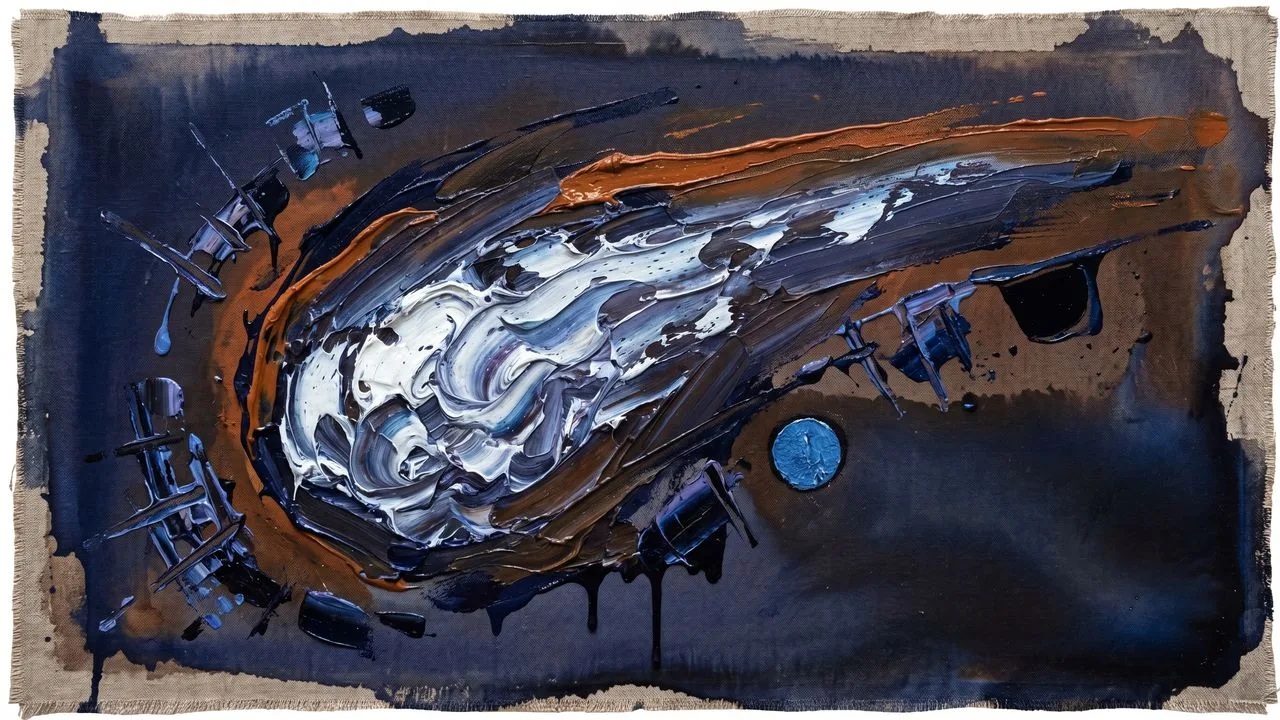
Photo: AI. Saskia Aaltonen
There's a comet currently passing through our solar system that formed around a completely different star, traveled through interstellar space for an unknown amount of time, and carries water that looks nothing like ours. The ratio of heavy water to regular water in 3I/ATLAS is roughly 40 times higher than in Earth's oceans. Not 40% higher. Forty times.
That number deserves to sit for a moment before we start explaining it away.
Oxford astrophysicist Dr. Becky Smethurst covered the new findings in her May 2026 Night Sky News, and it's worth unpacking both what the research actually shows and what it leaves stubbornly unanswered. Because this is one of those results that is genuinely strange—and the temptation to immediately reach for a tidy narrative about it is exactly the temptation we should resist.
What the chemistry is actually telling us
3I/ATLAS is only the third interstellar object ever detected passing through our solar system. The first, 'Oumuamua, showed up in 2017 and promptly baffled everyone with its non-comet-like behavior. The second, Borisov, arrived in 2019 and was more recognizably comet-shaped. 3I/ATLAS, discovered in July 2025, has been the subject of an extraordinary observing campaign—Hubble, JWST, the JUICE spacecraft en route to Jupiter, and even the Perseverance rover on Mars have all been pointed at it.
The new result comes from Salazar Manzano and collaborators, who used the ALMA radio telescope array in Chile to detect the vibrational signatures of both ordinary water molecules and semi-heavy water (HDO)—water where one hydrogen atom is replaced by deuterium, hydrogen's heavier isotope (same element, one extra neutron). As Smethurst explains: "This work by Salazar Manzano and collaborators is the very first detection of deuterium and heavy water on one of these interstellar visitors to the solar system."
First detection ever, full stop. That's scientifically significant regardless of what the ratio turns out to be.
But the ratio is what's generating the most attention. The deuterium-to-hydrogen (D/H) ratio in 3I/ATLAS's water is dramatically elevated compared to anything we see in solar system comets, and dramatically elevated compared to Earth's oceans—which are themselves enriched in deuterium compared to the sun. This D/H ratio is used by planetary scientists as a kind of chemical fingerprint: comets with ratios closer to Earth's are considered more plausible candidates for delivering water to the early Earth. By that logic, 3I/ATLAS's home system experienced very different chemistry than ours.
The reason D/H ratios vary is tied to temperature and formation history. Deuterium enrichment in water tends to happen in cold, dense molecular clouds—the kind of environment where stars and their planets are born. Different stellar nurseries, different temperatures, different timescales of chemical processing all leave different isotopic imprints. Smethurst describes the result as showing "chemistry that is just so alien to it, so distinct from anything in our solar system."
What we don't yet know is what exactly that tells us about 3I/ATLAS's home system. Was it formed in a colder, more chemically active region than our own solar system's birth environment? Was it assembled in an outer region of its parent system analogous to our Kuiper Belt? Did it spend millions of years in cold interstellar space undergoing additional chemical processing before arriving here? The data doesn't yet discriminate between these possibilities, and anyone claiming otherwise is getting ahead of the evidence.
What the detection does do is open a new observational window. Every interstellar visitor we've caught has given us a data point about chemical diversity across stellar systems. 'Oumuamua gave us a shape and a trajectory that challenged our comet models. Borisov gave us a recognizable comet structure. 3I/ATLAS is now giving us isotopic chemistry. The sample size is three. Which means we're still very much in the phase where each object has the power to rewrite our priors.
The infrastructure paradox
Here's where the week's news gets uncomfortably ironic. At virtually the same moment that scientists are making first-of-their-kind measurements on an interstellar visitor—the kind of science that requires decades of telescope-building, detector development, and trained workforce to even be possible—the US administration has proposed, for the second consecutive year, slashing NASA's science budget by 47%.
The FY2027 proposal would take NASA's science funding from $7.25 billion to $3.9 billion, and eliminate the science communication budget entirely. Around 50 missions would be threatened. As Smethurst notes, the proposal was released on April 3rd, two days after the Artemis 2 launch, and—unlike every NASA budget for the past 60 years—without comparative figures from prior years.
The structural contradiction here is worth naming plainly: the exploration agenda (crewed Moon and Mars missions) is being funded, while the science agenda that provides the context for understanding what we find when we get there is being cut. These aren't separable. The chemistry of 3I/ATLAS, mapped by ALMA and JWST, is exactly the kind of baseline knowledge that future crewed exploration would build on. You can't just send humans somewhere and then figure out the science later.
The administration's position, to steelman it as charitably as possible, seems to be a prioritization of visible, milestone-driven human spaceflight over distributed scientific infrastructure. That's a coherent value choice. It's also a choice with compounding costs that won't be visible for years—because the graduate students not funded today, the missions not built this decade, the institutional knowledge not preserved, don't generate headlines when they fail to materialize.
For non-US readers: the ripple effects are already landing elsewhere. UK astronomy is facing its own cuts through STFC and UKRI. International collaborations depend on shared infrastructure and shared funding assumptions. When the largest single funder of space science restructures this dramatically, it doesn't stay contained.
DESI, Pluto, and the art of keeping things in proportion
Two other items from Smethurst's roundup are worth noting, with appropriately different registers of enthusiasm.
The Dark Energy Spectroscopic Instrument (DESI) completed its planned five-year survey last month, having mapped 47 million galaxies and 20 million nearby stars—against an original target of 34 million galaxies. That's six times more data than all previous cosmological spectroscopic surveys combined, and it's now the largest 3D map of the observable universe ever produced. The scientifically significant piece: early DESI results suggested that dark energy—the driver of the universe's accelerating expansion—may itself not be constant. If the full five-year dataset confirms that, we're looking at revisions to the standard cosmological model. The data release is expected in 2027. Worth watching.
On Pluto: NASA Administrator Jared Isaacman has been publicly floating the idea of reclassifying Pluto as a planet. Smethurst's take is characteristically precise—"you cannot hop on about Pluto being a planet again and forget about Eris and Haumea and Makemake and Gonggong and Quaoar, Orcus, and Sedna." The third criterion for planethood—gravitational dominance, meaning you've cleared your orbital neighborhood of comparably-sized objects—is the one Pluto fails. It's also the one that, if relaxed, immediately applies to eight or nine other trans-Neptunian objects with equally compelling cases. The Pluto debate is mostly a cultural nostalgia project at this point, which is fine, but it's worth being clear that's what it is.
The 3I/ATLAS result is the kind of finding that's easy to oversell and hard to fully appreciate at the appropriate scale. We have, for the first time, measured the isotopic composition of water from outside our solar system. The answer is: it's different from ours. Profoundly different. What that difference means—what it tells us about how planetary systems form, whether it tells us anything about the distribution of water across the galaxy, whether it narrows or widens the space of conditions that produce ocean-bearing worlds—those questions are still open.
The telescope that made this measurement exists because someone built it. The scientists who designed the observation trained somewhere. The data pipeline that extracted a signal from noise was written by people with jobs.
Whether those jobs exist in five years is, right now, a policy question as much as a scientific one.
More Like This
Cosmic Threats to Earth: Asteroids, Solar Storms & Black Holes
From city-destroying asteroids to solar storms that could kill the internet, scientists are mapping the universe's most destructive forces—and our readiness is uneven.

What Spinosaurus Tells Us About Dinosaur Science
Dr. Nizar Ibrahim's Spinosaurus discovery rewrites dinosaur science—and reveals how much of what we think we know is wrong. Here's what the fossil record actually shows.

Can Humans Really Live on Mars? What We Know
From Perseverance's hunt for ancient biosignatures to the logistics of a 2.5-year round trip, here's where the Mars ambition actually stands.

How Tall Is the Dog? The Viral Math Puzzle Solved
A dog, a pole, two measurements—and three different ways to crack it. Presh Talwalkar's viral puzzle reveals something deeper about how we learn math.
Video Shows Solar System's Vast Scale Through Walkable Model
The solar system is mostly empty space—and the numbers make that viscerally clear. Here's what happens when you shrink Earth to a tennis ball.
Space Developments: Tech Triumphs and Challenges
Exploring recent space missions, tech innovations, and their broader impacts on humanity's cosmic ambitions.

Hannah Cairo Disproved a 40-Year-Old Math Conjecture at 17
At 17, Hannah Cairo overturned the Mizohata-Takeuchi conjecture using a hypercube and a coin diagram. Here's what she actually did—and why it matters.

How Language Shapes Thought, According to Lera Boroditsky
Cognitive scientist Lera Boroditsky explains how the language you speak shapes memory, color perception, and thought—and what's lost when languages disappear.