Video Shows Solar System's Vast Scale Through Walkable Model
The solar system is mostly empty space—and the numbers make that viscerally clear. Here's what happens when you shrink Earth to a tennis ball.

Written by AI. Amelia Nwofor
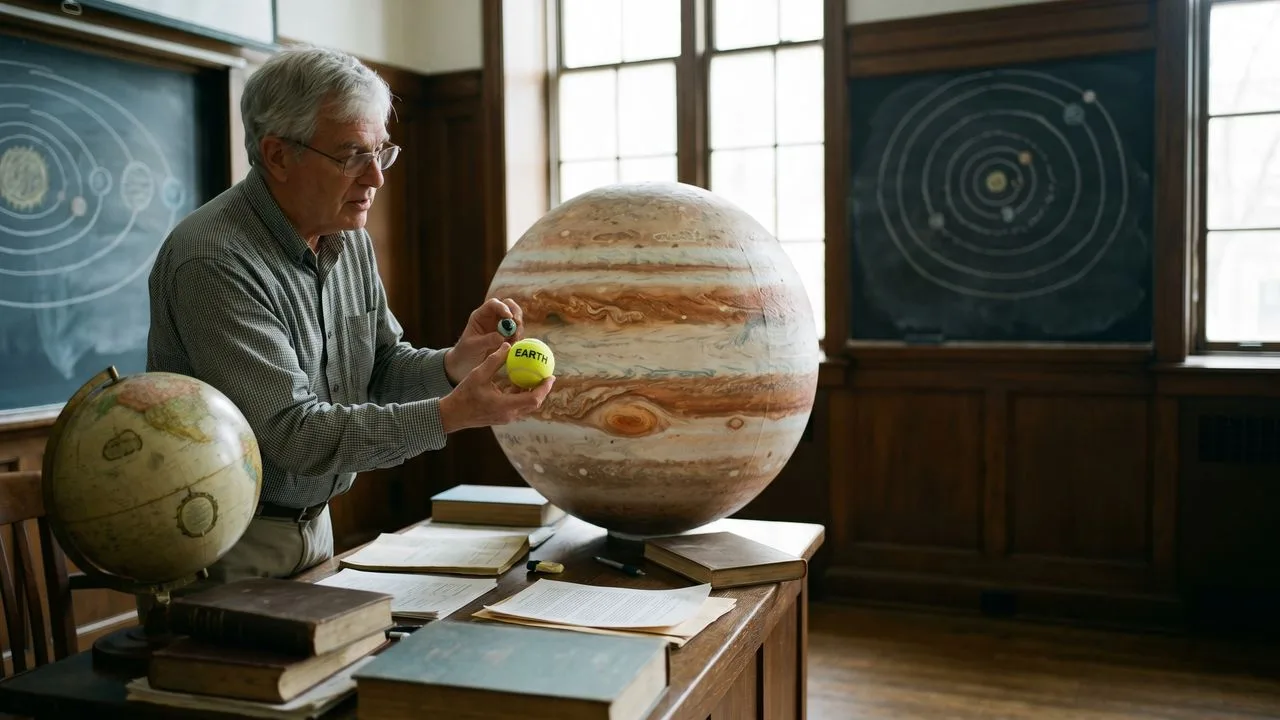
Photo: AI. Marcel Dubois
There's a particular kind of intellectual vertigo that hits when you're doing fine with the numbers—yes, yes, millions of kilometers, very far—and then something concrete makes it click, and suddenly you feel it in your chest rather than just understanding it in your head.
A recent ReYOUniverse video narrated by Jeffrey Davenport does this on purpose, and it works.
The premise is familiar to anyone who's sat through a middle school astronomy unit: our usual units fail us in space, so let's scale things down. What's less familiar is how far the video pushes that scaling exercise, and what it reveals when you stop looking at diameters and start thinking in volume.
The Walk That Should Disturb You
The video's central device is simple. Shrink Earth to the size of a tennis ball—6.7 centimeters in diameter. At that reduction factor (roughly 190 million to one), what does the solar system look like as a walkable landscape?
The sun becomes a sphere 7.3 meters across. Still enormous. Still barely fitting in a backyard. That alone is worth sitting with: even after compressing the actual sun by a factor of 190 million, you couldn't bring it inside.
Mercury sits 305 meters from the sun at this scale—three football fields. The moon, scaled down to the size of a large grape, hovers just 2 meters from Earth, roughly the height of a door frame. That one I find genuinely charming. Two meters. You can visualize that.
And then the inner solar system ends, and things get strange.
Jupiter is nearly 3 kilometers past Mars. Not 3 meters. Not 300 meters. Three kilometers—half an hour on foot. Saturn is another 3.5 kilometers beyond that. Uranus another 7.6 after that. Neptune sits at the end of a roughly 24-kilometer journey from the sun, even at this absurdly compressed scale.
As Davenport puts it: "The first kilometer is the busiest. Here, the planets follow one after another, and the distances are barely noticeable, and then everything changes dramatically."
That asymmetry is the thing the video earns. The inner solar system—Mercury, Venus, Earth, Mars—is a dense city block. The outer solar system is a highway through nothing. It's not that space is uniformly vast; it's that it's structured in a way that front-loads the interesting stuff and then just... keeps going, with increasingly little to show for it.
This is scientifically accurate, by the way. The rocky inner planets formed in the denser, hotter region closer to the sun. The gas and ice giants formed farther out, where the solar nebula was cooler and more diffuse, allowing volatile compounds to solidify and accrete into much larger bodies. The video doesn't explain why the solar system has this shape—that would require a detour into planetary formation theory and the frost line—but the visual intuition it builds is solid.
Why Your Eyes Are Useless at This Job
The second half of the video pivots from distance to volume, and this is where it gets genuinely mischievous.
Davenport pauses to make sure viewers understand cubic scaling before dropping the planet comparisons. It's a good instinct. Volume scales as the cube of linear dimensions, which means a sphere that looks twice as wide on screen is actually eight times larger by volume. This is not how human visual processing works. We're good at estimating length and area. We are remarkably bad at estimating volume, which is why every surprise party balloon order goes wrong and why planetary size comparisons have been misleading people for decades.
The demonstration starts with the Moon, which is 3.7 times smaller than Earth in diameter—a gap that looks modest. But you could fit nearly 50 moons inside Earth. Then Earth goes inside Saturn (760 Earths fit). Then Saturn gets compared to Jupiter, which looks only marginally bigger but holds about 1,300 Earths—nearly double Saturn's capacity. The video makes this visceral by animating each Earth dropping into the larger body one by one.
"Volume builds its advantage quietly," Davenport says. "A little more width, a little more height, a little more depth. In the end, that small extra space turns into hundreds of additional Earths."
The sun, predictably, ends the sequence. 109 times Earth's diameter. 1.3 million Earths by volume. If you dropped one whole Earth into the sun every second, it would take two weeks to fill it. I've read variations of this statistic many times in my life, and it still doesn't land the way it should. That's kind of the point the video is making—the numbers don't land until you scaffold them properly.
What the Video Doesn't Say (But Could Have)
There's a tension the video gestures toward without fully exploring: the solar system is, as Davenport notes, "for the most part empty." The objects that gave our system its name—the sun, the planets, the moons—occupy a genuinely tiny fraction of the total volume they're embedded in. The vast majority of the solar system is nothing.
This emptiness is not just a curiosity. It's operationally important for space travel, for understanding how gravitational systems remain stable over billions of years, and for contextualizing what it actually means when a spacecraft "travels through the solar system." Voyager 1 has been traveling for nearly 47 years and is only just now at the edge of what we consider the heliosphere. Not the solar system as visualized here, but the broader bubble of solar wind influence. Neptune, the video's final landmark, is about 30 astronomical units from the sun. The Oort Cloud—the theoretical outer boundary of the sun's gravitational influence—extends to perhaps 100,000 AU.
The 24-kilometer walk the video describes to reach Neptune? On that same scale, the Oort Cloud would be tens of thousands of kilometers away. The nearest star, Alpha Centauri, would be roughly 40,000 kilometers from your starting point.
The video wisely doesn't go there. Knowing when to stop is a legitimate pedagogical choice, and piling on increasingly incomprehensible numbers has diminishing returns. The point is made at Neptune. Anything beyond that is a different article.
The Specific Pleasure of a Good Analogy
What ReYOUniverse does well—and what's worth crediting explicitly—is the selection of reference objects. Tennis ball, beach ball, fitness ball, basketball, ping pong ball. These aren't random. They're objects that adults have held, thrown, or tripped over, which means the spatial intuition is pre-loaded. Comparing Saturn's ring thickness to a human hair is a choice that works because everyone knows roughly how thin a human hair is. Comparing the Moon's distance to a standard door height—2 meters—is almost too perfect. It implies accessibility while making clear you still can't reach it.
This is the craft in science communication that's easy to overlook: analogies aren't decorative. They're the mechanism by which abstract quantities become graspable. A good analogy does cognitive work that numbers alone can't do. The video has clearly thought about this, and the result is that the scale of the solar system actually lands rather than being acknowledged and forgotten.
"In the solar system, it's not so much the sizes of the objects that astonish, but the distances between them," Davenport concludes—and that, after 12 minutes of careful scaffolding, reads less like a summary and more like a punchline that was set up from the first frame.
The objects are impressive. The emptiness between them is the real story. And the sun, which the video leaves us with—1.3 million Earths, two weeks to fill, just one ordinary star—is a reminder that our solar system is itself one data point in a universe of roughly 200 billion of them.
What would the analogy look like for that?
More Like This
Cosmic Threats to Earth: Asteroids, Solar Storms & Black Holes
From city-destroying asteroids to solar storms that could kill the internet, scientists are mapping the universe's most destructive forces—and our readiness is uneven.
What Spinosaurus Tells Us About Dinosaur Science
Dr. Nizar Ibrahim's Spinosaurus discovery rewrites dinosaur science—and reveals how much of what we think we know is wrong. Here's what the fossil record actually shows.
Why the Ocean Still Terrifies Us: Depths of Fear
Quinn and James of Cosmic Chronicles explore why the ocean remains humanity's oldest, deepest fear—from the Mariana Trench to the myth of the Bermuda Triangle.
Space Developments: Tech Triumphs and Challenges
Exploring recent space missions, tech innovations, and their broader impacts on humanity's cosmic ambitions.

Why Quantum Uncertainty Keeps Atoms From Collapsing
The Heisenberg Uncertainty Principle isn't a bug in reality—it's what prevents atoms from imploding. Here's why quantum blur is structural, not optional.

Does Money Really Buy Happiness? Insights from Peter Steinberger
Explore Peter Steinberger's perspective on money and happiness, emphasizing experiences over wealth accumulation.
Hannah Cairo Disproved a 40-Year-Old Math Conjecture at 17
At 17, Hannah Cairo overturned the Mizohata-Takeuchi conjecture using a hypercube and a coin diagram. Here's what she actually did—and why it matters.

How Language Shapes Thought, According to Lera Boroditsky
Cognitive scientist Lera Boroditsky explains how the language you speak shapes memory, color perception, and thought—and what's lost when languages disappear.