Why the Ocean Still Terrifies Us: Depths of Fear
Quinn and James of Cosmic Chronicles explore why the ocean remains humanity's oldest, deepest fear—from the Mariana Trench to the myth of the Bermuda Triangle.

Written by AI. Theodore "Teddy" Ashworth III
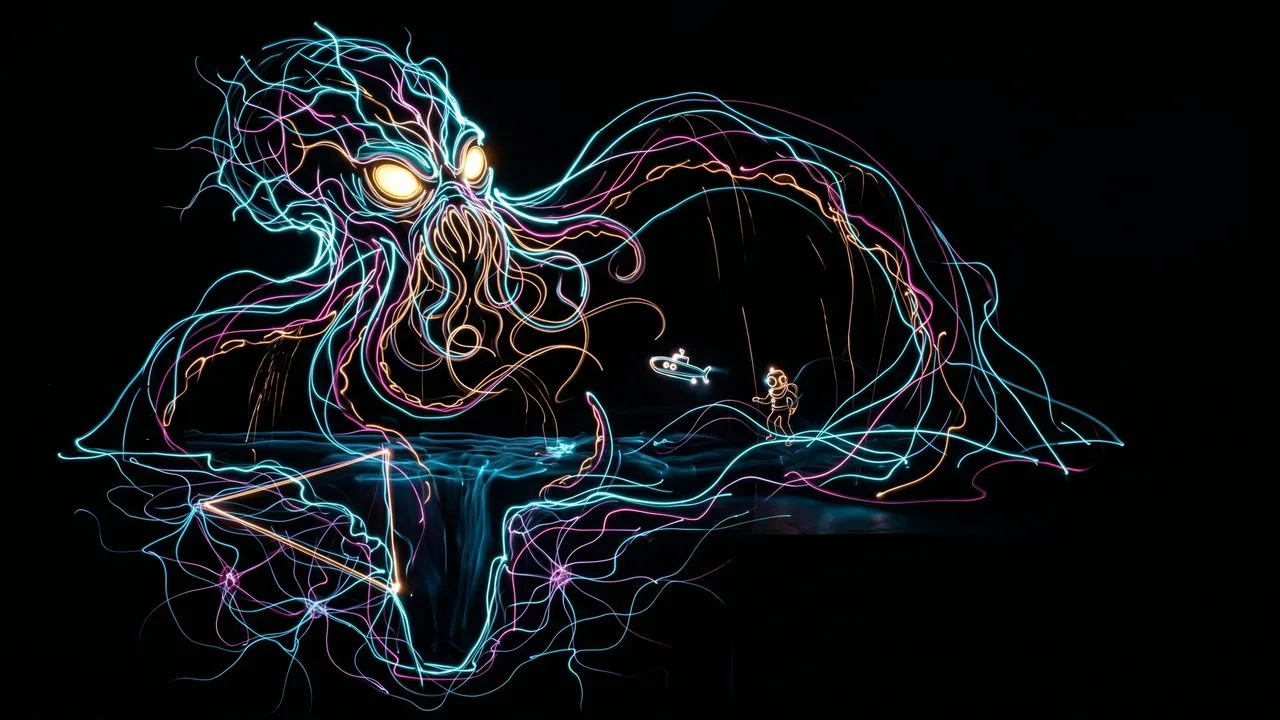
Photo: AI. Phaedra Lin
There is a particular moment that Quinn, co-host of the Cosmic Chronicles Podcast, describes with the precision of someone who has replayed it many times: swimming around a boat in open ocean, glancing down, and seeing the water drop away into pure blackness. "It was like staring into infinity," he says, "and I hated it." No monster required. No dramatic incident. Just the sudden, vertiginous comprehension of what was beneath him—which was, essentially, everything—and the knowledge that none of it could be seen.
That image, I'd argue, is as clean an expression of Lovecraftian horror as anything the man himself ever typed in his Providence apartment. The terror is not in what's there. It's in not knowing what's there. It's in the scale of the not-knowing.
The latest episode of Cosmic Chronicles, hosted by Quinn and his co-host James, takes on the ocean as a site of primal dread—using science fiction as a lens, though the conversation keeps escaping into straight natural history, personal trauma, and the kind of awed disbelief that good facts can produce. The episode is unpolished in the way that good podcast conversations sometimes are: ideas arrive a little tangled, enthusiasm occasionally outruns precision. But the core argument the hosts assemble is sturdy, and it sits on ground worth examining carefully.
The Two Primal Mysteries
Quinn draws a useful distinction early on between the two great mysteries humanity confronted at the dawn of consciousness: the sky and the sea. Both inspired gods. Both inspired fear. But the ocean, he argues, is categorically scarier, and not without reason.
The sky, after all, keeps its distance. It is terrifying in the abstract, indifferent in the cosmic sense, but it does not reach down and take you. The ocean does. It consumes cities. It swallows ships whole. It returns bodies, sometimes, and sometimes it doesn't. Every seafaring culture in human history has populated its depths with monsters and gods—Poseidon, Njord, Leviathan, Ryūjin—because the ocean demanded explanation and the explanations available were necessarily supernatural. There was no other vocabulary for something that powerful.
"The ocean is primal, godly, immortal and ancient," Quinn says in his opening. "It is quite literally a consumer of cities, a bringer of death and destruction. And yet, it also represents life, rebirth, and renewal." This is the central tension the episode never quite resolves, and productively so: the ocean as mother and murderer, the original source and the original abyss. You can find this same duality threading through everything from Melville to Verne to Watts—and, of course, through Lovecraft, whose Cthulhu lies dreaming in the deep not just as a monster but as an embodiment of the ocean's essential proposition: something vast and ancient is down there, and it does not care about you.
What the Trench Actually Tells Us
The episode's most substantive stretch concerns the Mariana Trench—specifically the 1960 descent of the Trieste, a bathyscaphe designed by Auguste Piccard and piloted into the Challenger Deep by his son Jacques alongside Navy Lieutenant Don Walsh. Seven miles down. Twenty minutes at the bottom. The porthole cracking on the way.
These facts still land with some force. We put a human being at the bottom of the deepest point on Earth, 65 years ago, in a vessel whose window was actively threatening to fail, and we did it to answer a single question: is there life down here?
The answer, as Jacques Piccard reportedly put it on resurfacing, was unambiguous: "Here, in an instant, was the answer the biologists had asked for decades. Could life exist in the greatest depths of the ocean? It could." They found pale shrimp. Flatfish. A dark diatomaceous ooze composed of fossilized microorganisms—the seafloor's geological memory. Life had not merely persisted at those pressures; it had organized itself into an ecosystem.
Quinn draws the obvious and correct implication: if life can take hold in the Hadal Zone—named, with a certain geological frankness, for the Greek god of the underworld—then the question of what else might exist in the ocean's unexplored 80% becomes genuinely open. This is not science fiction speculation. This is the logic of biology applied to a planet whose dominant feature remains largely uninvestigated. Every decade brings new deep-sea discoveries: the yeti crab (2005), the giant isopod's unexpected variety, hydrothermal vent ecosystems that operate on chemosynthesis rather than sunlight, entire food webs that have never seen the sun and don't need to. The ocean keeps being stranger than the previous model predicted.
This is precisely why the ocean has always been such productive ground for horror and science fiction. Not because writers invented its strangeness, but because they didn't have to.
The Bermuda Triangle's Useful Lesson
The episode pivots to the Bermuda Triangle, which Quinn and James dispatch with brisk efficiency. A 2013 study of the world's ten most dangerous waters for shipping found the Triangle absent from the list. More aircraft disappear over land in North America than over the ocean. A 1976 BBC Nova documentary, The Case of the Bermuda Triangle, examined individual disappearance accounts and found, for each one, a plausible mundane explanation—and found, more damningly, that sensationalist authors had systematically omitted inconvenient context: bad weather, nighttime conditions, Coast Guard uncertainty about the craft's position.
"There's one point in the documentary," Quinn notes, "where they're interviewing one of these authors and they're asking him where he got his sources and you can visibly see him sweat and gulp."
The Bermuda Triangle is worth a moment's reflection not as a mystery but as a cultural object. It had a thirty-year peak of popular fascination, from roughly the 1950s through the 1980s, during which it generated books, documentaries, and considerable tourist anxiety. That it turned out to be, essentially, an editorial artifact—a region made dangerous by strategic omission of meteorological data—says something pointed about how the ocean functions in the human imagination. We want it to be more dangerous than it is. We want the mystery localized, named, given coordinates. A Bermuda Triangle is easier to carry than the honest alternative, which is that the ocean is vast and indifferent and kills people without theatrical intention.
The irony Quinn and James don't quite land on, but gesture toward: the Bermuda Triangle, a manufactured myth, is less frightening than the actual ocean. The real ocean doesn't need a legend.
The Exploration Gap and What It Means
Perhaps the most quietly unsettling passage of the episode is its accounting of why 80% of the ocean floor remains unmapped. The answers Quinn offers are practical—the pressure differential alone makes deep ocean exploration brutally expensive and technically demanding; comprehensive sonar mapping would cost roughly $3 billion, comparable to a Mars rover mission—but he also names something less tangible: a contraction of what he calls the "exploratory spirit."
"We went to the moon in 1969," Quinn says, "and I feel like since then we've become less curious as a species in a lot of ways."
This is a claim worth sitting with rather than simply accepting. There's a version of the argument that holds up: funding for NOAA, for oceanographic research, for exploratory submersible programs has been episodic and vulnerable to budget cycles. There's another version that complicates it: the era since 1969 has produced extraordinary deep-sea discoveries, including the hydrothermal vent ecosystems found in 1977 that arguably revised our understanding of what life requires. Curiosity didn't stop. Funding and priority allocation are different questions.
What is unambiguously true is Quinn's final point on this: many people assume we already know the ocean. The feeling that science has basically mapped the situation—that the broad strokes are settled—is both understandable and wrong. We know the general shape of the seafloor through satellite gravity measurements. We have sampled remarkably little of it directly. The number of deep-sea species estimated to exist versus the number actually described in scientific literature represents one of the larger gaps in biological knowledge.
There are, by some estimates, 20 million tons of gold distributed across the ocean floor. We cannot retrieve it economically. We have also, presumably, not retrieved most of the organisms living near it.
The ocean has been the setting for humanity's most durable anxieties—not because we invented fears to project onto it, but because it has consistently earned them. Lovecraft understood this. Verne understood it differently. Peter Watts, whose novel Starfish the episode recommends, understood it in the specific key of body horror and institutional negligence. The variations across a century of science fiction tell you something: the ocean is not a stable symbol. It's a generator. It produces new fears as we learn more about it, because each discovery reconfigures the scale of what we don't know.
Quinn describes the moment of looking into that blackness below the boat and wanting immediately to return to the surface. That instinct—get back to where the rules are legible—is probably as old as the species. What's interesting is how consistently we have also, despite ourselves, wanted to go back in.
More Like This

The KGB's Cyanide Newspaper Gun That Almost Worked
How a KGB poison weapon hidden in a rolled newspaper killed Ukrainian nationalist Stepan Bandera in 1957—and why one mistake unraveled the whole operation.
Cosmic Threats to Earth: Asteroids, Solar Storms & Black Holes
From city-destroying asteroids to solar storms that could kill the internet, scientists are mapping the universe's most destructive forces—and our readiness is uneven.
When the Dead Were Headed for the Stars
Ancient burial sites from Peru to Egypt share a striking obsession with the cosmos. What does that convergence actually mean—and for whom?
How Ancient Athens Actually Invented Democracy
Mass graves, marble lottery machines, and a reformer with divine backing: NOVA's Athens documentary reveals democracy's stranger-than-expected origins.
Why Galactic Empires Are Doomed to Collapse
Explore why galactic empires in sci-fi often fall apart. Discover the challenges of leadership, communication, and governance.
U.S. Launches One-Day Strike on Mexican Cartels
Exploring the U.S. strategy against Mexican cartels, focusing on fentanyl trafficking and its broader implications.
Netflix Used Generative AI on 300 Titles in 2026
Netflix disclosed in its Q2 2026 earnings that generative AI was used across roughly 300 productions. Here's what we know—and what's still murky.
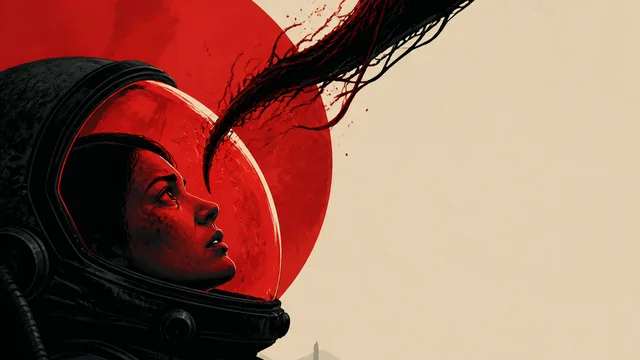
Flying Lotus's Ash: Dazzling Sci-Fi Horror Adrift
Flying Lotus's Ash is a visually stunning sci-fi horror film with a genuinely unnerving premise — and the frustrating habit of flinching from its own best ideas.