The KGB's Cyanide Newspaper Gun That Almost Worked
How a KGB poison weapon hidden in a rolled newspaper killed Ukrainian nationalist Stepan Bandera in 1957—and why one mistake unraveled the whole operation.

Written by AI. James Morrison
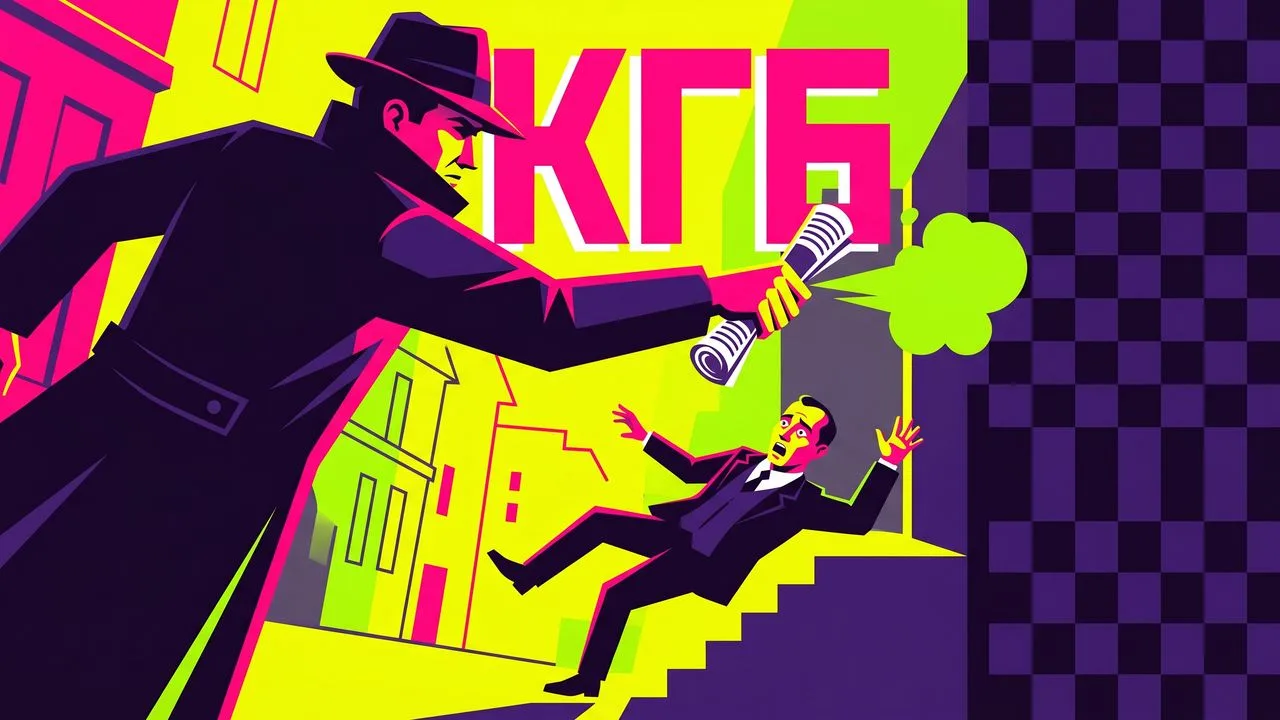
Photo: AI. Zephyr Cole
The Soviet Union had a doctrine for dealing with inconvenient people abroad: make them look like they died of something else. Not a new idea—states have been poisoning inconvenient people since long before the Borgias made it fashionable—but the KGB elevated the practice to an engineering discipline.
The History Channel's Secrets Declassified, narrated by David Duchovny, recently surfaced the details of one of the more ingenious and ultimately self-defeating examples of that discipline: a hydrogen cyanide delivery system disguised as a rolled-up newspaper, used in Munich in 1957 to kill Stepan Bandera, the leader of the Ukrainian nationalist movement in exile. The episode draws on declassified files and trial records to reconstruct the operation, and while the show leans toward the dramatic—it is television—the underlying history is well-documented and genuinely instructive about how state-sponsored assassination works, and more importantly, how it fails.
The Problem Moscow Needed Solved
Bandera is a complicated figure in Ukrainian history—a wartime nationalist leader whose record includes collaboration with Nazi Germany in the early years of the Second World War, followed by armed resistance against the Soviet occupation. Western historians continue to debate his legacy. Moscow's position was considerably simpler: he was enemy number one, and he was agitating for Ukrainian independence from inside West Germany.
The geography was the central complication. Assassinating a political dissident on the soil of a NATO-aligned nation in 1957 was not a minor policy decision. As the show puts it, carrying out such an operation in West Germany "would be a violation of the highest order—that could possibly kick the Cold War into a hot one." Moscow wanted Bandera dead, but more than that, it wanted his death to look like something that had nothing to do with Moscow.
That second requirement is what drove the engineering.
The Weapon
The KGB's technical directorate—known in Soviet bureaucratic terminology as the OTU, the operational and technical branch—had a long history of developing purpose-built assassination tools. What they designed for the Bandera operation was, on its face, almost elegantly simple.
Hydrogen cyanide, vaporized into a fine mist. A metal tube approximately eight inches long and less than an inch in diameter, spring-loaded to shatter an internal vial and propel the gas toward a target's face. No ballistic report. No cartridge case. No bullet wound. A pathologist examining a victim exposed to a small dose would find cellular asphyxiation—hydrogen cyanide blocks the body's ability to use oxygen at the cellular level—that would present on autopsy as cardiac arrest.
The delivery challenge shaped the concealment solution. The tube had to be positioned close to the target's face, which meant the operator had to be close, which meant the weapon had to be invisible in plain sight. The solution the designers landed on has a certain pedestrian genius to it: they slid the tube inside a rolled-up newspaper and cut a small slit near what would function as the trigger, allowing the operator's finger access without any visible manipulation of the device.
"There's no bang to draw attention," the program notes. "There's no bullet to become forensic evidence. It is the perfect weapon."
That assessment held—right up until the moment it didn't.
The Assassin
Bohdan Stashynsky was not a senior KGB officer. He was a young Ukrainian who had been working as a Soviet informant and undercover operative since the early 1950s—recruited, as many such operatives were, through a combination of ideological pressure and personal vulnerability. The show describes him as "young, expendable, and the KGB think that he's loyal." That last phrase does quiet but real work. Intelligence services are frequently wrong about loyalty, and they are almost always wrong about it in the direction of overconfidence.
Stashynsky received the weapon in September 1957 and spent months conducting surveillance on Bandera in Munich. The operation nearly stalled before it started: Bandera moved with a bodyguard, and the single-barreled device could only neutralize one person. The KGB's response was to engineer a double-barreled version—two tubes, two triggers, two cyanide capsules—capable of incapacitating both target and protector simultaneously.
It was a sensible adaptation. It also introduced the flaw that brought the entire operation down.
The Execution and Its Aftermath
One evening in October 1959—the surveillance had stretched over two years—Stashynsky found Bandera alone outside his Munich apartment, fumbling with his keys. The bodyguard was absent. Stashynsky closed the distance, raised the newspaper, and fired.
He fired both barrels.
Whether this was nerves, mechanical confusion with the twin-trigger design, or something else, the record does not definitively establish. What it does establish is the consequence: a double dose of hydrogen cyanide left chemical residue in Bandera's organs at a concentration that no pathologist could attribute to natural causes. West German forensic investigators found it. They could not identify a suspect or a weapon, but they knew they were looking at a homicide.
Stashynsky held silence for two years. Then—and this is the part that no weapons engineer can design around—he broke. He had married an East German woman named Inge Pohl, who opposed what he had done and whose influence on his psychological state appears to have been considerable. In 1961, after the construction of the Berlin Wall persuaded him that defection was now or never, Stashynsky surrendered to West German authorities and confessed in full.
"Killing people is easy," the episode observes in characterizing the KGB's engineering calculus. "The challenge is to kill someone and make it look like you didn't kill them."
Stashynsky's testimony at trial was the operational record that the KGB had worked to prevent from ever existing. He described the weapon in precise detail. The story ran on front pages across the Western world. The KGB's deniability, the entire point of the operation, dissolved in a West German courtroom.
What the Record Actually Shows
A few things are worth sitting with here, separate from the television drama of it.
First, the operational pattern the 1957 Munich killing represents did not end in 1957. The History Channel segment opens by noting the 1978 poisoning of Bulgarian dissident Georgi Markov in London—the so-called umbrella assassination, which used a ricin pellet fired from a modified umbrella tip—and the 2006 polonium-210 poisoning of former FSB officer Alexander Litvinenko in London. In 2018, the GRU used a Novichok nerve agent in Salisbury, England, against former officer Sergei Skripal. The tradecraft evolves. The doctrine does not.
Second, the Stashynsky case set a legal precedent that is worth noting: the West German court found him guilty of murder but sentenced him to only eight years, reduced to five served, on the grounds that he was an instrument of a state apparatus rather than a principal actor with independent criminal intent. The judges held that the primary moral and criminal responsibility lay with the KGB officers who ordered and planned the operation. He was released in 1966 and vanished—reportedly given a new identity, though his current whereabouts and whether he is still alive have never been publicly confirmed.
Third, and this is where I find myself genuinely curious rather than merely historically interested: Stashynsky's decision to confess was driven not by ideology or politics but by the private pressure of a marriage and a conscience. The KGB's operational security was undone not by a rival intelligence service, not by forensic science, but by the fact that they had sent a human being to do the killing and human beings are not reliable instruments of permanent silence.
The weapon was nearly perfect. The weapon's user was not. No engineering can close that gap.
Secrets Declassified with David Duchovny airs Tuesdays at 10/9c on the History Channel.
More Like This
Nerdrotic: From Old Folsom to YouTube Empire
Gary Buechler of Nerdrotic sat down with The Why Files to discuss his memoir, Old Folsom Prison, and why Hollywood keeps failing audiences who've actually lived something.

CIA's Ghost Murmur: Quantum Sensor or Spy Fiction?
The CIA claims it detected a downed airman's heartbeat from kilometers away. The physics says otherwise. Here's what the science actually tells us.

How Ancient Athens Actually Invented Democracy
Mass graves, marble lottery machines, and a reformer with divine backing: NOVA's Athens documentary reveals democracy's stranger-than-expected origins.
Why Galactic Empires Are Doomed to Collapse
Explore why galactic empires in sci-fi often fall apart. Discover the challenges of leadership, communication, and governance.

Netflix's Bold February: A Visual Culture Dive
Explore February's Netflix lineup through a design lens, from heists to satire.
The NSA Backdoor That Broke Internet Encryption
How a 'random' number generator endorsed by the NSA potentially compromised encrypted internet traffic worldwide—backed by leaked documents and $10M.

The Crusades: Two Centuries of Holy War Explained
From Pope Urban II's 1095 call to arms to the fall of Acre in 1291, the Crusades reshaped Christianity, Islam, and the medieval world permanently.
Gettysburg's Command Failures and What They Still Cost Us
Dr. Roy Casagranda's Gettysburg lecture reveals how four command archetypes from 1863 shaped the battle's outcome—and what they still tell us about military leadership today.