Nerdrotic: From Old Folsom to YouTube Empire
Gary Buechler of Nerdrotic sat down with The Why Files to discuss his memoir, Old Folsom Prison, and why Hollywood keeps failing audiences who've actually lived something.

Written by AI. James Morrison
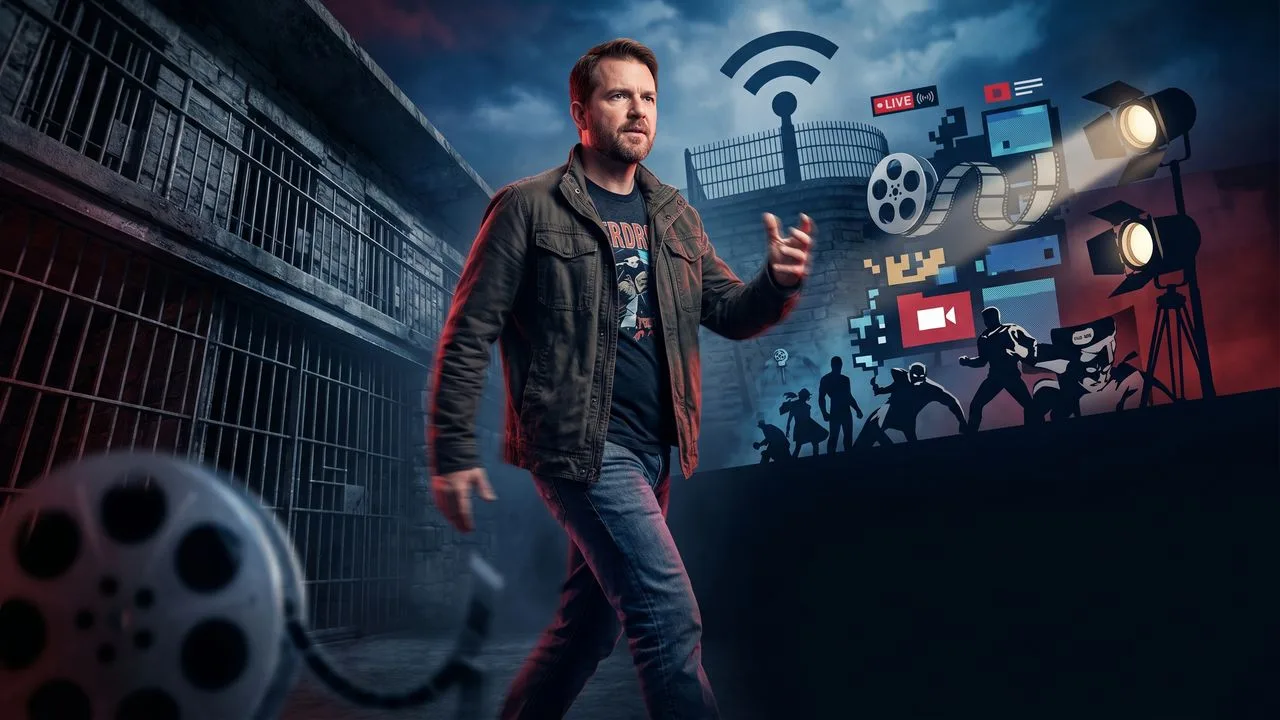
Photo: AI. Lev Zolotov
Gene Roddenberry flew thirty-four combat missions as a B-17 bombardier in the Pacific Theater during World War II. He survived a crash landing on a wartime runway. He came home, joined the LAPD, worked a fatal accident beat that put him alongside human wreckage most Americans never see. Then he built a television show set in a future where humanity had, somehow, solved its ugliest problems — war, poverty, tribalism — and gone to the stars instead.
I've thought about that trajectory for twenty years. The man who imagined the Federation had first dropped ordnance over the Solomon Islands. He earned his optimism the hard way, and the audience felt that weight underneath the hope, whether they could articulate it or not. That's not a coincidence. That's the difference between a writer who has lived something and a writer whose life experience is primarily other television shows.
Gary Buechler — who operates under the name Nerdrotic and has built a substantial pop culture commentary platform around Friday Night Tights and related programming — made that same argument last week in a three-hour-plus conversation with AJ Gentile on The Why Files. Buechler was talking about Hollywood's current failures, but he arrived there from a direction most commentators don't travel: through Old Folsom State Prison, a double-murderer cellmate, and a memoir he's titled Waiting For (rendered here as sourced from the interview; readers should verify final punctuation with the published edition).
The conversation is worth your time precisely because Buechler's credibility on the subject of hard circumstances is not theoretical.
What Old Folsom Actually Was
When Gentile introduces the prison context, he makes the distinction explicit: not New Folsom — California State Prison, Folsom — but Old Folsom, California State Prison, Sacramento. Johnny Cash Folsom. The facility that opened in 1880, built on granite quarried by the inmates themselves, and that by the 1980s housed some of the most violent offenders in the California Department of Corrections system. The two prisons sit a few miles apart but occupy entirely different institutional universes. New Folsom, opened in 1986, was designed with modern correctional theory in mind. Old Folsom was designed in the nineteenth century and looked it — stone cellblocks, a culture of violence that predated the current inmates by generations, and a population that in the 1980s included men warehoused by a system that had largely given up on rehabilitation as a stated goal.
The California prison system of that era was not subtle about its priorities. Legislative shifts in the 1970s had moved sentencing toward determinacy and away from parole-board discretion, which flooded the facilities and changed the social calculus inside the walls. The transcript confirms Buechler was at Old Folsom; it does not confirm whether he was transferred at any point during his incarceration, a distinction that matters for anyone reading the memoir as a historical document.
What Buechler describes — helping other inmates make and conceal pruno, navigating a cell with a man convicted of double murder, learning institutional survival at close range — is consistent with documented accounts of Old Folsom in that period. He describes it without drama or self-congratulation, which is the tell of someone describing memory rather than performance.
The Adoption, the Anger, the Trajectory
Before Folsom, there was San Diego. Before San Diego's particular 1980s texture — which Buechler and Gentile sketch with enough specificity that anyone who was there will recognize it — there was a boy told at age six or seven that he was adopted.
Buechler is direct about what that knowledge did to him: "You don't feel wanted. And you're always thinking about that person who — why did she do this? Why were you rejected? And you're trying to deal with stuff like that when you're like seven years old."
He's equally direct that the anger which followed had roots he couldn't name at the time. The memoir, by his account, traces that anger through its consequences without flinching. Gentile, who describes reading it and finding himself furious at Buechler on nearly every page precisely because he knew the ending, puts it plainly: "There's an undercurrent of anger in your origin story. Railing against the man, authority, all of that."
The path from that anger to Old Folsom, and from Old Folsom to sleeping in his car (his account, as reported in the interview; independently unverified), and from a car to a media platform with a subscriber count the video description places at approximately five million — I'd encourage readers to check the current channel figure directly, as these numbers move — that path is the substance of Waiting For. It is also, structurally, the kind of story that institutions produce but cannot contain.
This is Buechler's most interesting quality as a cultural commentator, and I don't think it gets examined enough: he is not speaking from inside any establishment. Not Hollywood's. Not the legacy media's. Not a political apparatus's. He was processed by the California corrections system and came out the other side building something outside every institution that had previously claimed jurisdiction over him. His audience responds to that, and the response is not simply ideological.
What Roddenberry Knew That Current Writers Don't
Here is where Buechler's pop culture criticism becomes genuinely interesting, and where I want to press on the argument rather than simply report it.
Buechler's thesis — that Roddenberry's politics worked in the original Star Trek because they were embedded in story rather than substituted for it — is correct as far as it goes. "He's a writer who lived a life," Buechler says. "None of the writers — not most of the writers in current Hollywood — have not lived the lives of the writers of even ten or twenty years ago who were veterans or had careers before writing. Now their knowledge of the world is other TV shows and riffing other TV shows."
The B-17 missions matter here. Roddenberry, flying over the Pacific, understood in his body what the failure of human institutions looks like from the inside. The Federation was not naive idealism; it was a proposition from someone who had seen the alternative at close range and chose, consciously, to imagine past it. That imaginative act carries moral weight that no amount of writers-room theorizing can replicate.
The parallel with Buechler is not strained. Men who have navigated genuine institutional failure — military, penal, economic — and come out writing toward something better tend to produce work that audiences recognize as honest, even when they can't say why. Audie Murphy's postwar film work had that quality. So did the early work of Oliver Stone, who came home from Vietnam and spent decades processing what he'd seen through narrative. The processing doesn't always succeed — Stone's filmography is uneven, to say the least — but the attempt is legible in ways that purely academic storytelling is not.
Buechler's argument about audience longing for hope over nihilism lands differently when you understand where he's speaking from. He's not a critic who prefers optimistic narratives for aesthetic reasons. He's someone who required a reason to be optimistic and had to construct one under conditions that did not encourage it.
"I'm so sick to death of nihilism," he tells Gentile. "I liked all that subversion stuff back in the 2010s when it was cool. It is so overdone. Seeing heroes with a positive outlook, seeing something hopeful — it's just really nice."
The three properties he cites as current examples — A Knight of the Seven Kingdoms, One Piece season two, and Project Hail Mary — share a structural commitment to protagonists who choose to keep going. That's not a political position. When survival becomes a worldview, hope is what it produces, and an audience that has lived anything recognizes the difference between hope that was earned and hope that was manufactured.
The question Buechler's arc puts to Hollywood is not whether studios can hire better writers. It's whether the conditions that produced writers like Roddenberry — men who had done something before they wrote about anything — can be approximated by an industry that has largely insulated its creative class from the material consequences of failure.
Based on the current output, the answer is not encouraging.
More Like This
Eckhart Tolle Says You're Not Who You Think You Are
Eckhart Tolle's 'historical self' vs 'deep eye' framework is either profound or a very elegant dodge. A parenting writer tries to figure out which.
Val Kilmer's AI Resurrection Asks: Who Gets to Live Forever?
Val Kilmer's AI-generated performance in 'As Deep as the Grave' raises uncomfortable questions about digital immortality, consent, and what makes acting art.
Why Galactic Empires Are Doomed to Collapse
Explore why galactic empires in sci-fi often fall apart. Discover the challenges of leadership, communication, and governance.

Netflix's Bold February: A Visual Culture Dive
Explore February's Netflix lineup through a design lens, from heists to satire.
Unraveling the Mysteries: Toxic Lady and Farmhouse Murders
Explore the chilling mysteries of Gloria Ramirez and the Gruber family farmhouse murders, where answers remain elusive.

Heavy Spoilers Builds an Office, Ditches the Algorithm
YouTube creator Paul from Heavy Spoilers explains why he built a garden office, changed his logo, and chose depth over views in content strategy.
Audie Murphy: Soldier, Icon, and Haunted Man
Audie Murphy was America's most decorated WWII soldier. His battlefield heroism and Hollywood fame masked a man deeply scarred by combat and survivor's guilt.

The Crusades: Two Centuries of Holy War Explained
From Pope Urban II's 1095 call to arms to the fall of Acre in 1291, the Crusades reshaped Christianity, Islam, and the medieval world permanently.