Eckhart Tolle Says You're Not Who You Think You Are
Eckhart Tolle's 'historical self' vs 'deep eye' framework is either profound or a very elegant dodge. A parenting writer tries to figure out which.

Written by AI. Marcus Obi
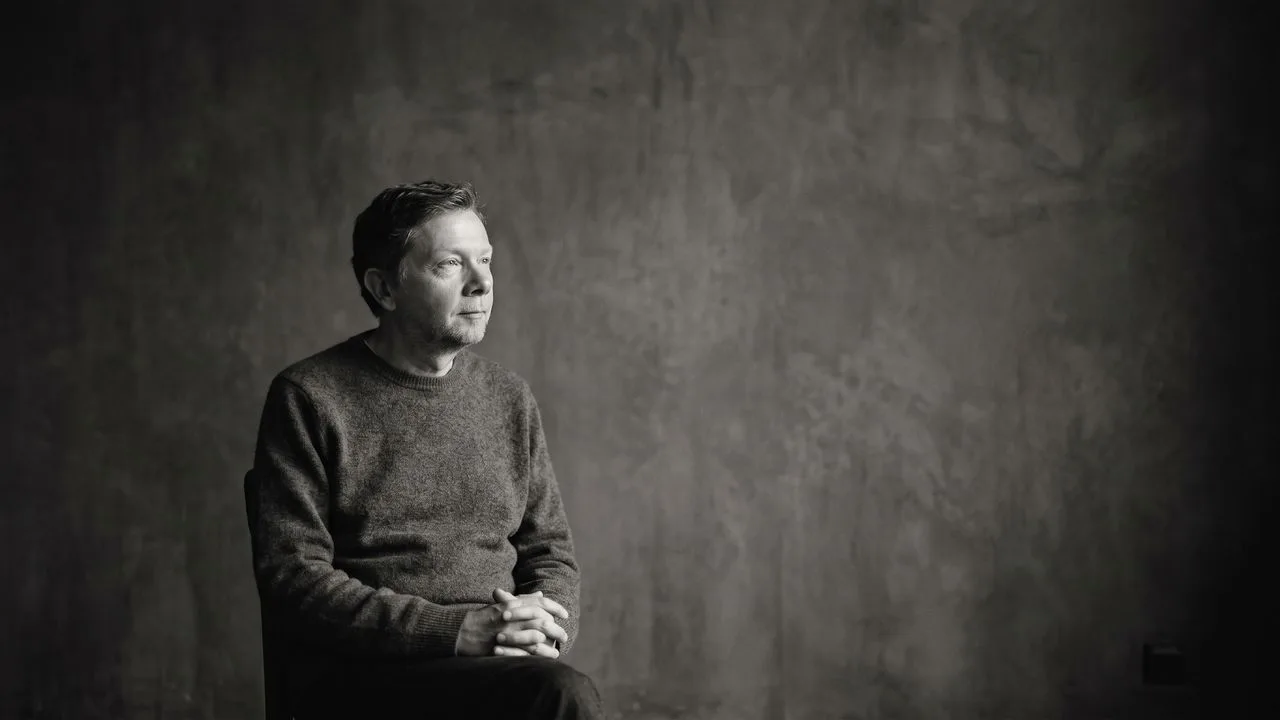
Photo: AI. Tomoko Hayashi
I watched this video at 11 p.m. on a Tuesday, which I mention only because that is precisely the kind of detail Eckhart Tolle would say reveals everything about me. I was not present. I was sitting in the kitchen half-watching YouTube while simultaneously composing a mental rebuttal to something my brother-in-law said at dinner three weeks ago. Classic historical person behavior.
The video in question is "You are not who you think you are. Here is the truth," posted to Tolle's YouTube channel, and it's a clean 9-minute articulation of something that sits at the center of basically everything he's written since The Power of Now. The New York Times once called him "the most popular spiritual author in the United States," and whatever you make of his ideas, the reach is undeniable. When Tolle talks about the human mind, a genuinely large slice of the human population is listening.
So I figured I should actually listen.
The Two Selves, Explained Without the Incense
Tolle opens with a premise that's hard to argue with: "Your attention is being absorbed by thought. That's a normal state for millions of humans. And the only relief they get is when they get too tired to think."
He's not wrong. Harvard psychologists Matthew Killingsworth and Daniel Gilbert published a study in Science in 2010 finding that people's minds wander roughly 47% of the time—and that mind-wandering, regardless of what they were doing, was associated with lower happiness. We are, it turns out, extraordinarily bad at being here.
From this, Tolle builds a framework: there are two dimensions to who you are. The first is what he calls the historical person—everything assembled from your past. Your childhood, your culture, your religion, your nation, your accumulated conditioning. "Who you are as a historical person is dependent on the past," he says. "What you think and how you think is dependent on the past." This is the "I" most of us walk around with. It's the version that knows all your old embarrassments by heart and will replay them for you at 2 a.m., free of charge.
The second dimension is what Tolle calls the deep eye—a "timeless being" that exists underneath the historical person and doesn't depend on any of it. Most people, he argues, never access this because "the historical person has so many things to think about and to do and to experience" that the deeper thing gets completely buried.
I'll be honest: that framing does something to me. Not in a guru-on-a-mountain way—more in a oh, that's the thing I keep almost noticing and then immediately losing way. There's a version of this I recognize. The moments right after the twins fall asleep and the house is quiet and for about forty-five seconds I'm not anybody's dad or anyone's former colleague or anyone who made a dumb mistake in 2019. I'm just... there. And then my phone buzzes and I'm back.
Tolle is essentially asking: what if that forty-five seconds is actually more real than everything else?
Where It Gets Genuinely Interesting—And Genuinely Tricky
The strongest version of Tolle's argument isn't the metaphysics. It's the observation about thought as a trap. He makes a pointed claim about addiction: the reason so many people turn to substances, he says, is that they "offer you momentary release from the prison of your mind." That's not a small claim. It's also not an unsupported one. There's a meaningful body of research on how mindfulness practices reduce addictive behavior—Jon Kabat-Zinn's work developing Mindfulness-Based Stress Reduction (MBSR) at UMass Medical School is probably the most clinically documented entry point—that arrives at something structurally similar from a secular direction. The monkey mind is a problem. Most people know this from the inside.
Where I get more tangled is the identity question, and this is where parenting makes it weird in a specific way. My kids are seven. I watch them absorbing the world in real time—learning what things mean, what's safe, what's funny, who they are. That process is the historical person getting built. And yes, I find myself thinking about what I'm passing down: my anxieties, my particular brand of stubbornness, the way I get loud when I feel unheard. The conditioning doesn't just affect you. It flows.
Tolle would probably say that's exactly the point. The historical person isn't bad—it's just not the whole story. The goal isn't to annihilate your past or pretend your childhood didn't happen. It's to not be only that. To have some access to the part of you that isn't just an accumulation of damage and habit and inherited belief.
That's a genuinely useful reframe. I'm not going to pretend otherwise.
But here's the tension the video doesn't quite sit with: the historical self isn't just the source of suffering. It's also the source of love, accountability, and the knowledge that your actions have consequences across time. The "timeless being" that has no past also has no mortgage, no one counting on it to remember pediatric appointment dates, no reason to feel guilt or responsibility or grief. There is something almost convenient about pure presence when you're the one doing the teaching rather than the one doing the school pickup.
This isn't a takedown. Tolle is careful enough to frame the deep eye as something beneath the historical person, not a replacement for it. But the video skips over the practical question of how these two dimensions are supposed to coexist when one of them needs to file taxes.
The Clean Model Problem
What makes the framework compelling is also what makes it slippery: it's elegant. Two selves, one surface, one deep. The historical person as limitation, the deep eye as liberation. It resolves cleanly in a way that actual human experience mostly refuses to.
Secular mindfulness researchers tend to be more cautious about what exactly is being accessed during contemplative practice. Neuroscientists like Judson Brewer have documented real, measurable changes in the brain's default mode network during mindfulness states—but those findings don't require a "timeless being." They just require a nervous system that can, under certain conditions, quiet down. Which is interesting and well-supported and also considerably less poetic than what Tolle is selling.
What Tolle is offering is a story about those quiet moments—a story in which they are glimpses of your truest self rather than just your brain briefly running a different program. Whether that story is literally accurate, metaphorically useful, or just really well-told is not something I can settle for you. What I can say is that the story is doing a lot of work, and it's worth knowing that.
The part I keep coming back to, honestly? The observation that people drink and use drugs partly to escape the noise of their own heads. Not as the whole explanation—addiction is complicated and structural and political—but as part of it. The idea that the relentless internal monologue is exhausting enough that people will do significant damage to themselves just to turn the volume down for a few hours. That lands. That lands hard.
I don't think Eckhart Tolle has all of this figured out. I'm not sure he'd claim to. But he's pointing at something real—something about the cost of being perpetually trapped in your own mental weather—and doing it in a way that nine and a half million YouTube subscribers apparently find useful.
The question I'm sitting with, mostly because I was already thinking about it before I watched this video and now I can't stop: how much of what I'm teaching my kids about who they are is just my own unexamined historical person, running on autopilot, convincing itself it's parenting?
That's not a comfortable question. Which is probably why Tolle has a paid subscription tier.
More Like This
Eckhart Tolle on Mindfulness: Parenting Edition
Explore how Eckhart Tolle's mindfulness concepts can transform parenting and family life.
The Missing Middle of Note-Taking: What Happens Next?
Tris Oaten's Obsidian system solves note-taking's biggest problem: what to do after you've captured everything. A look at the processing layer.

Why You Keep Falling Off (It's Not Discipline)
Dan Koe's viral framework says your identity is built from survival-coded "memes"—and that's why self-improvement keeps failing. Here's what the argument actually claims.

What Seven Years Building a Startup Actually Teaches You
Undo CEO Greg Law shares the uncomfortable truths about going from programmer to founder—ego, misdiagnosis, and why sales is harder than code.
Why Coding Without Goals Might Be the Point
A developer shares his habit of coding for fun—no deadlines, no clients, no outcomes. Just solving problems he actually has. What does that teach us?

Living in the Now: Eckhart Tolle's Wisdom for Parents
Discover Eckhart Tolle's insights on mindfulness and presence, and how they relate to parenting.

How to Make a College Tour Actually Matter
College tour season is here. Here's how families can shift from passive observers to active explorers—and why who leads the visit changes everything.
Public Trust in Science Is Fragile and Complicated
Trust in science is eroding—but the data is more complicated than the panic suggests. Here's what's actually happening, and why it matters.