CIA's Ghost Murmur: Quantum Sensor or Spy Fiction?
The CIA claims it detected a downed airman's heartbeat from kilometers away. The physics says otherwise. Here's what the science actually tells us.

Written by AI. Amelia Nwofor
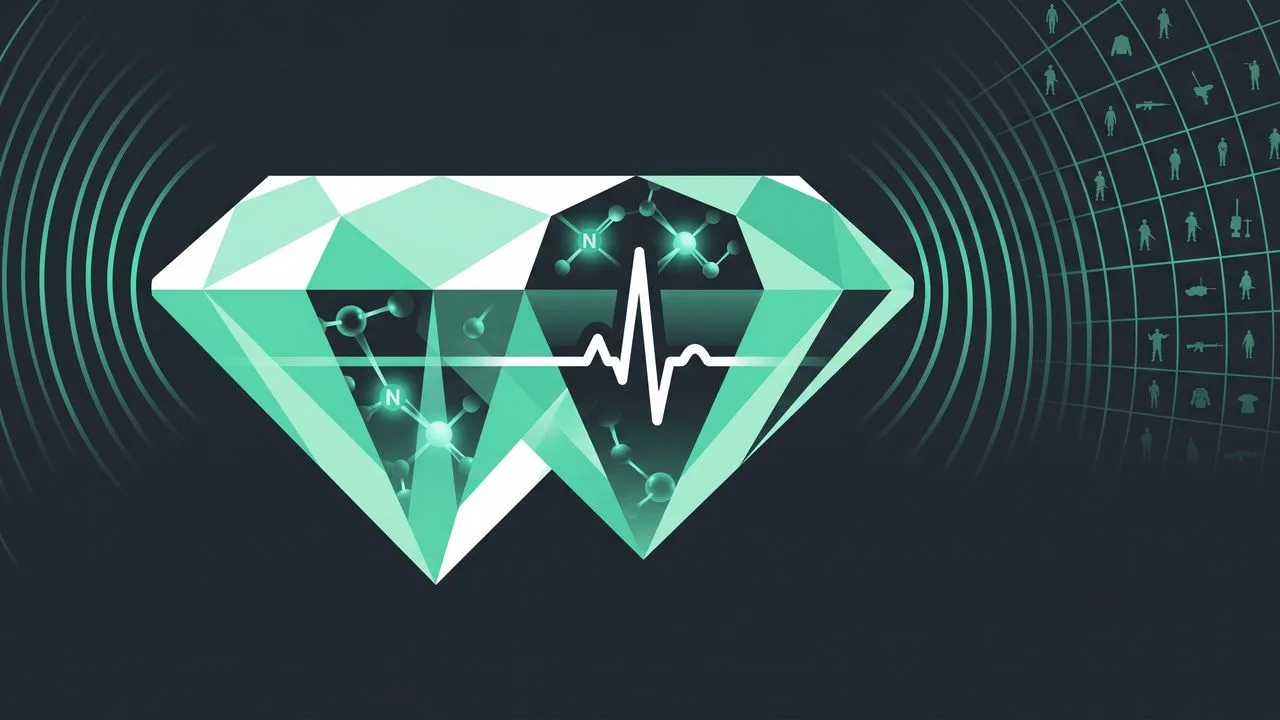
Photo: AI. Mika Sørensen
A US weapon system officer ejects over Iran. He's injured, hiding somewhere in hundreds of square kilometers of mountainous terrain, and he can only ping his rescue beacon in short, dangerous bursts. Forty hours later, he's home. The New York Post's explanation: the CIA used a quantum sensor to detect the magnetic field of his heartbeat from kilometers away—a program reportedly called "Ghost Murmur."
This story has done exactly what a good spy thriller does: it got everywhere, fast. But depending on which outlet you encountered first, you either walked away amazed, skeptical, or largely indifferent. That variance in reaction isn't just a media literacy problem. It's a symptom of something more interesting—a genuinely real and remarkable technology being asked to carry claims that the physics simply won't support.
So let's separate the diamond from the dust.
The heart really does have a magnetic field. Just barely.
The foundation of the Ghost Murmur story is legitimate science. Your heart muscles fire in a coordinated wave of electrical activity, and that coordinated current generates a magnetic field. It's real, it's measurable, and it was first detected in 1963—in a remote field location, with exquisitely still equipment, far from the electromagnetic noise of elevators and lab gear. The field strength sits around 50 to 100 picoteslas. That sounds respectable until you learn it's roughly a million times weaker than Earth's own magnetic field.
Getting more sensitive instruments helped. Superconducting quantum interference devices—SQUIDs—arrived by the 1970s and could detect fields in the femtotesla range. The military noticed. They strapped SQUIDs to aircraft and tried to use them to hunt submarines. That program faded. And while SQUIDs made cardiac magnetometry more accessible in clinical settings, they came with a catch: they demand meticulously shielded rooms, stable conditions, and a near-total absence of electromagnetic interference. Nothing about that description suggests "drone-mounted field sensor over hostile territory."
Where diamonds enter the picture
NV centers—nitrogen-vacancy defects in synthetic diamond—are the specific technology the New York Post article gestures toward, and they're genuinely fascinating. A pure diamond is just carbon atoms arranged in a crystal lattice, transparent to visible light and magnetically inert. But introduce a nitrogen atom where a carbon should be, remove the adjacent carbon entirely, and you've created a defect that traps two unpaired electrons. Those electrons have quantum spin—a property that makes them exquisitely sensitive to external magnetic fields.
Here's the elegant part: you can read out that sensitivity using light. The energy levels of the trapped electrons shift measurably when exposed to a magnetic field, a phenomenon called Zeeman splitting. Shine microwave radiation at the diamond, scan the frequencies, and you'll see absorption lines split apart by an amount that tells you exactly how strong the ambient field is. It works at room temperature. It's solid-state. It doesn't require cryogenic cooling or the kind of electromagnetic shielding that makes SQUIDs impractical outside a hospital basement.
Researchers have been quietly excited about NV diamond magnetometers for exactly this reason. As one expert in the Veritasium video put it: "It was a decade before the light bulb went on for a bunch of us to think about them as sensors. Takes a mindset switch to think differently. And once you do, you realize, oh my goodness, this could be useful."
Neuron-generated magnetic fields have been detected with NV sensors. In 2022, a research team picked up the magnetic field of a rat's beating heart using a diamond sensor placed less than 2 millimeters from the chest—after surgically opening it. That's the state of the art in peer-reviewed literature.
Two millimeters. Chest open. That's where the science currently is.
The numbers are not forgiving
Here's where Ghost Murmur runs into a wall that doesn't bend for classified programs or presidential confirmations.
Magnetic field strength falls off with the cube of distance. At the chest, the heart's field is ~50 picoteslas. At 100 meters, that figure drops by a factor of a billion—to around 5 × 10⁻²⁰ Tesla. At 50 to 100 kilometers, you're looking at fields on the order of 10⁻³⁰ Tesla.
That number needs context. The most sensitive magnetometry ever achieved, at heartbeat-relevant frequencies, sits at around 10⁻¹⁵ Tesla—and that's inside a shielded room. To detect a heartbeat at 60 km, you'd need a sensor roughly 15 orders of magnitude more sensitive than the best SQUIDs ever built, and about 18 orders of magnitude beyond current NV diamond technology.
One physicist interviewed for the Veritasium piece put it plainly: "The most sensitive measurement ever made at the frequencies that the human heartbeat work at is at the 10⁻¹⁵ Tesla level and that's in a shielded room. So you'd need a system that is 15 orders of magnitude more sensitive than the superconducting quantum interference devices and 18 orders of magnitude more sensitive than diamond sensors."
Eighteen orders of magnitude isn't an engineering gap you quietly close in a classified laboratory. That's the difference between a candle and the sun, and then multiply that by about a trillion. There's also the small matter of background noise: the vibration of the drone or helicopter carrying the sensor, the magnetic signatures of every animal in the Iranian hills, and the fact that a field of 10⁻³⁰ Tesla is weaker than the magnetic influence a single electron exerts at one meter. You can't separate signal from noise when the signal is smaller than the noise floor of the universe.
So why does the story exist?
This is the question that makes the Ghost Murmur story genuinely interesting as a story, rather than just as a physics problem.
The Veritasium investigation surfaces a compelling alternative explanation: the downed officer had a rescue beacon. He used it. Intelligence services routinely triangulate such signals. There may have been additional intelligence methods in play—the kind that don't require overturning the laws of electromagnetism. A retired CIA senior operations officer interviewed for the piece noted that "the processes are consistent with what's been done before"—pointing toward conventional tradecraft rather than quantum magic.
Which raises the other possibility: deliberate disinformation. Deception operations with exactly this structure—leak a terrifying-sounding technology to make adversaries question their own ability to hide—have a documented history going back centuries. During World War II, the British attributed their improved interception of German night bombers partly to carrots improving pilot night vision. The real reason was airborne radar, which they weren't ready to reveal. The carrot story was cover.
The Ghost Murmur claim was reported by a single outlet with a specific political lean, amplified unevenly across the media landscape, and confirmed by a president who is not known for conservative information hygiene. Researchers in the NV diamond space are apparently signing NDAs—which could mean classified development is happening, or could mean the government has an interest in who talks about the gap between what exists and what's being claimed.
Both of those things can be true at once.
What NV diamonds can actually do—and why it matters
Here's what I don't want to get lost in the debunking: NV diamond magnetometry is a real and important frontier. The gap between "2mm from a surgically opened rat heart" and "clinically useful cardiac scanner" is shrinking. These sensors could eventually give us portable, room-temperature magnetocardiography—meaningful for diagnosing arrhythmias without the shielded rooms and superconducting hardware current systems require. The neuroscience applications are potentially profound. The basic physics is genuinely elegant.
The technology deserves coverage that doesn't hitch it to claims it can't support. When the Ghost Murmur story collapses—as it should, under any serious scrutiny—it risks taking legitimate excitement about quantum sensing down with it. That's the real cost of hype: not just that readers feel misled, but that the actual science gets guilt by association.
The officer in the Iranian mountains was found. That's real, and it's worth understanding how it probably happened. Meanwhile, somewhere in a university lab, someone is coaxing a nitrogen-vacancy center in a synthetic diamond to detect a magnetic field one femtotesla weaker than what was measurable last year. That story is also real, and considerably more interesting than the CIA's alleged magic.
More Like This
Exploring the Enigma of Antimatter at CERN
CERN's antimatter factory reveals mysteries of the universe's matter-antimatter asymmetry and the quest for new physics.
Exploring the Enigma of Negative Time in Quantum Physics
Dive into the perplexing world of negative time in quantum physics with insights from Prof. Aephraim Steinberg.
Quantum Computing Finally Found Its Killer App: Breaking Stuff
Google just moved up the timeline for quantum computers to break encryption to 2029. After decades of promises, code-breaking is what quantum actually does.
Space Developments: Tech Triumphs and Challenges
Exploring recent space missions, tech innovations, and their broader impacts on humanity's cosmic ambitions.
Galaxies That Challenge Our Cosmic Timeline
James Webb Space Telescope finds galaxies too evolved for the young universe, challenging current cosmological models.
AI Agents Are Accelerating—But Nobody Agrees What That Means
New benchmarks show AI coding agents tripling capabilities in months. Researchers urge caution. Investors price in economic collapse. Welcome to 2026.
Hannah Cairo Disproved a 40-Year-Old Math Conjecture at 17
At 17, Hannah Cairo overturned the Mizohata-Takeuchi conjecture using a hypercube and a coin diagram. Here's what she actually did—and why it matters.

How Language Shapes Thought, According to Lera Boroditsky
Cognitive scientist Lera Boroditsky explains how the language you speak shapes memory, color perception, and thought—and what's lost when languages disappear.