When the Dead Were Headed for the Stars
Ancient burial sites from Peru to Egypt share a striking obsession with the cosmos. What does that convergence actually mean—and for whom?

Written by AI. Sofia Ramirez
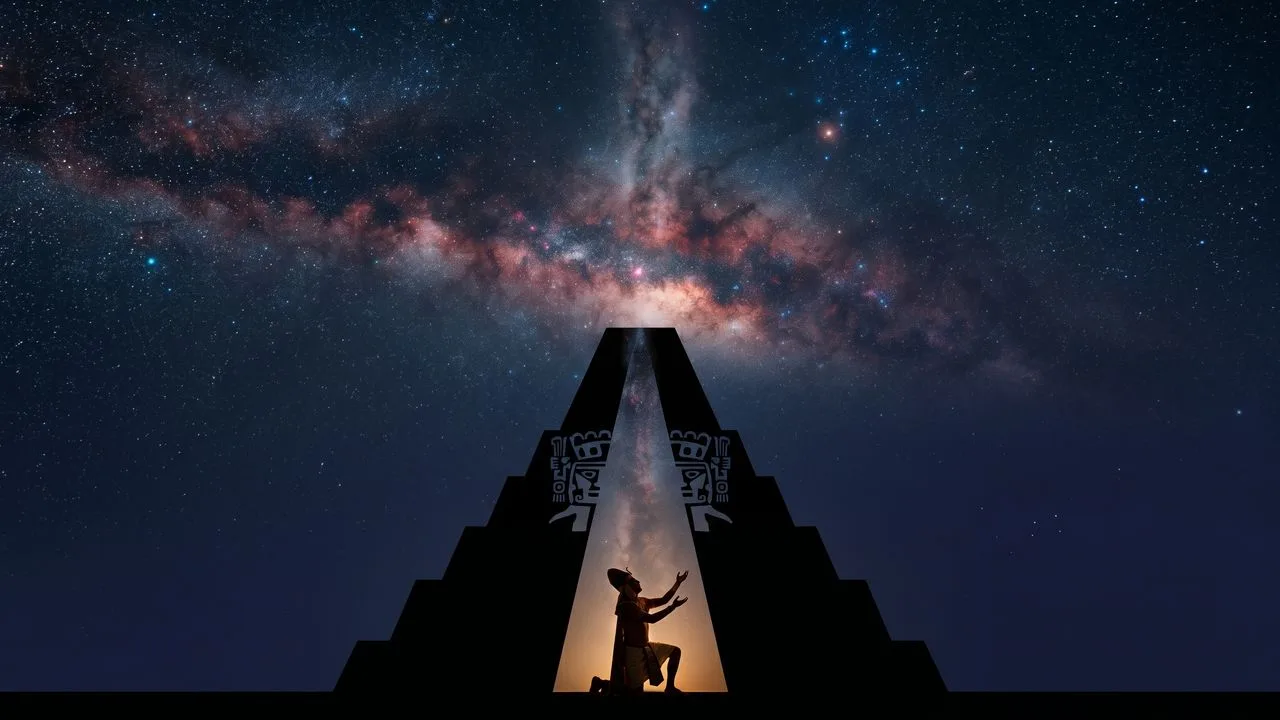
Photo: AI. Castor Belov
In 1987, archaeologist Walter Alva broke into a sealed tomb in the Lambayeque region of northern Peru and found a world intact. Gold, silver, feather ornaments, ceramic pots—and the remains of people who had been buried alive to accompany a dead king into whatever came next. The Lord of Sipán's tomb is routinely called the King Tut of South America, and the comparison is apt: both discoveries remind us that the ancient world's most powerful people spent enormous energy—and sometimes other people's lives—preparing for a journey nobody had confirmed was real.
That's the genuine historical puzzle at the center of Ancient Aliens' latest compilation, "Gods or Visitors From the Stars?"—and it's a better puzzle than the show's extraterrestrial framing lets it be.
The Evidence Is Real. The Interpretation Is the Fight.
Let's be clear about what isn't in dispute. The Lord of Sipán was buried with figurines depicting large-eyed, non-human-looking beings. The Pyramid Texts inside King Teti's pyramid at Saqqara—the oldest religious writing in the world, dating to roughly 2400 BC—obsessively describe the pharaoh becoming a star, ascending to join Osiris in the sky. The Torajan people of South Sulawesi have been burying their dead in boat-shaped coffins, interred in cliffsides, since 3000 BC, with explicit belief that the dead return to the stars. Embalmed human remains have been found in Chile and Peru dating to 5000 BC—predating Egypt's famous mummification tradition by millennia.
These aren't fringe claims. These are archaeological facts that historians of religion, anthropologists, and Egyptologists have documented extensively.
What Ancient Aliens does with those facts is a different matter. The show's move—repeated across every culture and every century it touches—is to treat cultural convergence as evidence of a single external cause. Many ancient peoples believed the dead journeyed to the stars; therefore, someone must have told them about the stars; therefore, extraterrestrials. As one commentator in the episode puts it: "You have to ask yourself where did our ancestors get these ideas that on our death we're being transported to the stars to another world? Wouldn't this have come from extraterrestrials?"
Wouldn't it, though? That's the question worth sitting with—not to dismiss it, but to take it seriously enough to interrogate it.
What the Convergence Actually Tells Us
Historians of religion have a different word for this phenomenon: universality. Humans across cultures independently developed beliefs in an afterlife, in stellar souls, in the body as a temporary vessel for something more permanent. Some scholars argue this reflects shared cognitive architecture—the human brain's difficulty accepting the finitude of consciousness. Others point to the fact that the night sky was the one constant, universally visible phenomenon that every culture on Earth shared. Before electric light, before urban sprawl, the stars were present in a way we have genuinely lost. Of course they organized death.
The tomb-as-technology idea—the burial chamber not as a place of disposal but as a mechanism, a "magical machine," in the words of one scholar in the episode—is also well-documented in mainstream Egyptology. The Pyramid Texts weren't just eulogies. They were instructions. The pharaoh was meant to navigate the underworld, face obstacles, pass trials, and arrive transformed. "It is through these structures that the king would begin a journey into the underworld in order to face obstacles, dangers, and threats," as the episode explains. That's not fringe theory. That's what the texts say.
The question is whether "the dead king becomes a star" is a metaphor for transformation, a genuine cosmological belief, or evidence of literal extraterrestrial contact. Egyptologists lean toward the first two. Ancient astronaut theorists insist on the third.
The Obelisk Problem
The episode's section on obelisks is where I find myself genuinely interested—and where the show's argument is at its weakest and its strongest simultaneously.
It's true that obelisks have scattered across the globe in ways that track imperial conquest rather than mystical convergence. The Paris obelisk was hauled from Luxor in 1833. London bought one in 1878. New York's Cleopatra's Needle was a gift in 1881. The show frames this as evidence of obelisks' inherent power—why else would conquerors want them? But there's a more mundane, more uncomfortable answer: prestige. Obelisks said we took this from Egypt, the same way the Elgin Marbles say something about the British Museum. The show gestures at this—"obelisks have literally become the spoils of war"—and then pivots away from it, toward the Benben stone and the god Atum's celestial vehicle.
The Benben mythology is genuinely fascinating regardless of how you interpret it. Atum, the god of all creation, was said to have arrived on Earth in the Benben—the pyramid-shaped capstone—and departed the same way. "We think of the Benben as a craft because it is believed to have come from the stars originally," one commentator explains. That's a real mythological tradition. The leap to "therefore it was a spaceship" is exactly where ancient astronaut theory parts ways with archaeology—not by inventing the myth, but by insisting on the most literal possible reading of it.
Huangdi and the Dragon Problem
The episode's treatment of the Yellow Emperor, Huangdi, cuts closer to something genuinely interesting about how civilizations construct origin myths. The Qingming Festival, still celebrated annually in Shaanxi province with thousands of participants, commemorates a semi-mythical ruler credited with inventing the calendar, domesticating animals, and founding Chinese civilization—who then, according to legend, rode a dragon into the sky and became the pole star.
The ancient astronaut reading: the dragon was a spacecraft. Huangdi was an extraterrestrial.
The more grounded historical reading: origin myths across cultures tend to attribute civilization's gifts to divine figures who eventually return to the heavens. It's a narrative technology for explaining where knowledge comes from and why it carries authority. You don't have to have seen a spaceship to tell that story.
But here's the tension the show doesn't fully reckon with: for the people gathering in that ceremonial courtyard in 2019—10,000 of them—this isn't an archaeological debate. It's identity. "We Chinese people consider ourselves the descendants of the dragon," one participant says simply. The meaning isn't in the literal truth of the dragon. It's in what the story does for a community across millennia.
Ancient astronaut theory tends to flatten that—to treat myth as corrupted memory of literal events rather than as a living technology communities use to make meaning. That's the real disagreement, and it's a meaningful one.
The Paul Hellyer Detour
The episode closes with former Canadian Minister of National Defense Paul Hellyer claiming, in a 2013 television interview, that UFOs are real and have been visiting Earth for thousands of years—that there is, in fact, "a federation of these people" monitoring us. Hellyer made these claims repeatedly after his political career ended, and the show treats his cabinet rank as a form of credibility transfer.
It's worth noting that cabinet rank doesn't confer access to classified UFO information, and Hellyer himself acknowledged he hadn't personally reviewed classified files on the subject. What he offered was conviction, not evidence. The show doesn't make that distinction.
What I keep returning to, after sitting with all of this, is the question the episode accidentally asks more honestly than it intends to: why do virtually all ancient cultures connect death to the stars?
That's worth investigating with the rigor it deserves—through anthropology, cognitive science, comparative religion, and archaeology. Not because the extraterrestrial answer is impossible, but because the human answers are extraordinary enough to demand our full attention first.
The Lord of Sipán's people buried their king dressed as a shining being, surrounded by the dead who loved him, pointed toward something beyond. Whatever they believed was real to them. That deserves better than a theory that treats their cosmology as misremembered technology—and it deserves better than a dismissal that calls it mere superstition. Somewhere in between is where the history lives.
More Like This
Artemis II's Six-Minute Gamble: What Really Mattered
NASA's Artemis II faced its biggest test during reentry. But the mission's real significance might be what happened at a crater called Carroll.
Exploring Mercury's Mysteries: From Alchemy to Modern Science
Discover the unique properties of mercury, its historical significance, and intriguing experiments in Andrew Szydlo's lecture.
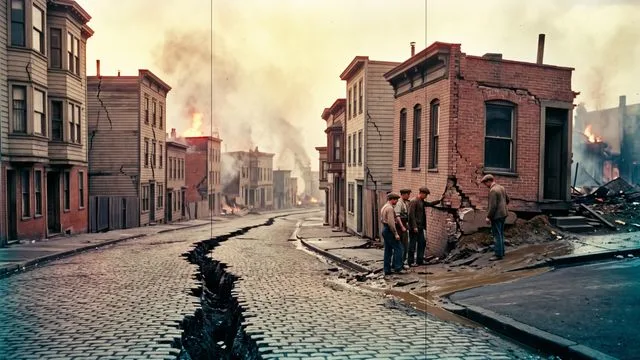
San Francisco 1906: The Disaster That Was Built
The 1906 San Francisco earthquake wasn't just an act of nature—it was the bill coming due on decades of willful ignorance. Here's what actually happened.
Val Kilmer's AI Resurrection Asks: Who Gets to Live Forever?
Val Kilmer's AI-generated performance in 'As Deep as the Grave' raises uncomfortable questions about digital immortality, consent, and what makes acting art.
Cosmic Threats to Earth: Asteroids, Solar Storms & Black Holes
From city-destroying asteroids to solar storms that could kill the internet, scientists are mapping the universe's most destructive forces—and our readiness is uneven.
What Spinosaurus Tells Us About Dinosaur Science
Dr. Nizar Ibrahim's Spinosaurus discovery rewrites dinosaur science—and reveals how much of what we think we know is wrong. Here's what the fossil record actually shows.
The Spanish Civil War at 90: What the Coup Unleashed
On July 17, 1936, a military coup fractured Spain and drew the world in. What the Spanish Civil War's 90th anniversary still asks of us.
Medieval England: How Peasants and Guilds Shaped Society
A new documentary traces medieval England's social divide through two real families—one peasant, one guild merchant—and the starkly different worlds they inhabited.