What Spinosaurus Tells Us About Dinosaur Science
Dr. Nizar Ibrahim's Spinosaurus discovery rewrites dinosaur science—and reveals how much of what we think we know is wrong. Here's what the fossil record actually shows.

Written by AI. Amelia Nwofor
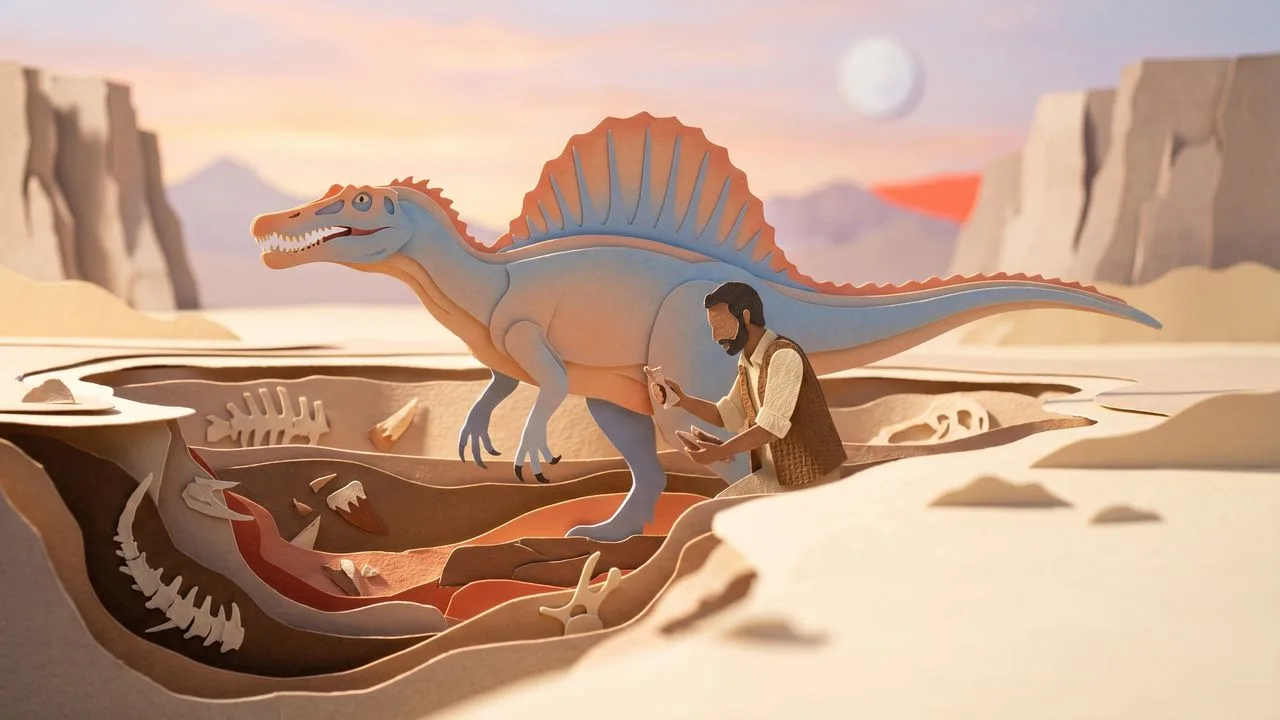
Photo: AI. Lila Bencher
The T-Rex that shakes the ground. The Velociraptor that opens doors. The long-necked giants wading through shallow lakes. These images have been accumulating for 150 years—in museum halls, in textbooks, in Spielberg's lens—and they feel like knowledge. They're not. According to paleontologist Dr. Nizar Ibrahim, speaking in a recent New Scientist marathon interview, most of what the public "knows" about dinosaurs is not slightly off or charmingly dated. It's structurally wrong, in ways that require something more disruptive than an update. They require a reimagining.
That's a strong claim. It's also, increasingly, a defensible one.
The Map Has Enormous Blank Spaces
The first thing to reckon with is the sheer scale of what we haven't found. Ibrahim, a paleontologist and comparative anatomist at the University of Portsmouth, estimates that we've uncovered less than 10% of recoverable dinosaur species. Less than 10%. In a field that produces a new species description somewhere on Earth almost every week, that figure should hit differently than it does.
But here's the thing that gets less attention: it's not just that we're missing species. It's that the species we have found are geographically skewed in ways that quietly warp our entire picture of the Mesozoic. The famous dinosaurs—T-Rex, Triceratops, Stegosaurus—are overwhelmingly North American. Europe contributes heavily too. What this means, Ibrahim points out, is that our mental model of "what dinosaurs were like" is essentially built from two continents out of several, and from whatever happened to fossilize well and get found.
Africa—the planet's second-largest landmass—is, in Ibrahim's words, "paleontology's forgotten continent." Fewer museums, fewer research institutions, fewer paleontologists on the ground. The fossil record there isn't thin because the animals weren't there. It's thin because we haven't looked hard enough, and because the infrastructure to look hasn't been built. That's a scientific problem with institutional roots, which makes it harder to solve than any technical challenge.
A River of Giants Under the Sahara
Ibrahim's primary field site is the Kem Kem Group, a rocky escarpment running along the Moroccan-Algerian border for hundreds of kilometers. The rocks there are mid-Cretaceous—approximately 100 million years old—and they preserve something genuinely strange: evidence of a vast ancient river system that once stretched from modern Morocco to Egypt across what is now among the driest terrain on Earth.
"In the middle of the Sahara, it's really, really hot. The sun is burning your skin, and then you pick up this giant fish scale," Ibrahim explains. "And that's when in your mind you start fleshing out this picture of a vast river system teeming with life."
What that river contained was unusual even by Cretaceous standards. Giant coelacanths. Massive lungfish. Crocodilians as long as a school bus. Ibrahim describes it as "a river of giants"—a place with an anomalously high concentration of enormous animals across multiple taxonomic groups, and an equally anomalous density of apex predators. He notes he hasn't found comparable evidence for this kind of stacked gigantism anywhere else in the fossil record. Whether that's because the Kem Kem was genuinely exceptional, or because similarly rich sites in other underexplored regions simply haven't been excavated yet, is an open question worth sitting with.
The Long, Strange Life of Spinosaurus
It's in this context—a forgotten continent, an extraordinary fossil site—that the Spinosaurus story lands with its full weight.
Spinosaurus was first described in 1915 by German paleontologist Ernst Stromer, from fragments recovered in Egypt: a strange, slender, crocodile-like lower jaw, and vertebrae with impossibly elongated spines forming a sail along the creature's back. Stromer suspected it might rival or exceed T-Rex in size, which had only recently been described from North American finds. A Saharan giant, possibly the largest predatory dinosaur ever. And then, gone.
The partial skeleton was housed in Munich's Bavarian State Collection Museum. Stromer spent years lobbying the museum director to move the bones somewhere safer as World War II escalated. The director—described in the interview as an ardent Nazi supporter—refused. Stromer, a vocal critic of the regime, managed to smuggle out smaller specimens in coat pockets with colleagues. The large bones stayed. They were destroyed in the Allied bombing of Munich in 1944. Stromer also lost two of his three sons in the war.
It's the kind of story that makes you think about how much scientific knowledge has been erased not by erosion or geological bad luck, but by human catastrophe. And it left Spinosaurus as an enigma for decades—a creature that appeared in dinosaur books as a vague reconstruction, "a generalized predatory dinosaur with a big sail stuck on its back," as Ibrahim puts it, because that's essentially all anyone had to go on.
The Mustache in the Oasis Café
Ibrahim's path to finding a new Spinosaurus reads less like a research program and more like a detective novel written by someone who'd never heard of Occam's razor.
It began with bones acquired from an anonymous fossil hunter in Morocco—mysterious-looking material Ibrahim deposited in a Casablanca university collection without quite knowing what to do with them. Then, during a separate museum visit in Italy, colleagues showed him a partial skeleton in their basement that might—might—be Spinosaurus. The problem: no provenance. No geographic origin. No way to confirm the bones came from the same animal, or even the same site.
Ibrahim noticed morphological details that matched the Moroccan bones. Which meant, in theory, he could find the original site—if he could find the original fossil hunter. Whose name he did not know. Whose contact details he did not have. Who was one of an estimated 50,000 commercial fossil hunters operating in that part of Morocco.
His colleagues, reasonably, thought this was not a plan.
Ibrahim searched anyway. On the last day, sitting in a café in an oasis town, a man walked past the table. Ibrahim recognized him by a single remembered detail: his mustache.
"It felt so surreal. It took me a moment to kind of get up and catch up with him."
The fossil hunter eventually led him to the site. When Ibrahim first saw it, bone fragments were visible everywhere across the surface. Years of excavation followed, and the Spinosaurus material they recovered—including a paddle-shaped tail that made the cover of Nature—overturned something fundamental.
The Animal We Were Wrong About
Dinosaurs, the received wisdom went, were terrestrial. Fully and definitively land animals. That distinction had been doing a lot of work in how paleontologists categorized the entire clade—it separated them from the marine reptiles like plesiosaurs, from the flying pterosaurs, from the aquatic lineages that ran alongside them. Spinosaurus, as it turned out, had other ideas.
The paddle-shaped tail was the key evidence. Combined with short hind limbs, dense bones consistent with a ballast function in water, and the already-known crocodile-like skull adapted for aquatic prey capture, the anatomy converged on a single conclusion: this was a dinosaur that was genuinely at home in the water. Not a dinosaur that occasionally waded. A dinosaur with suite of adaptations for aquatic locomotion.
Ibrahim is careful about the word "aquatic"—debate continues in the literature about whether Spinosaurus was an active swimmer or primarily a wader who plunged its head into the water to hunt, a distinction that matters for reconstructing its behavior and ecology. That tension is still live. But the directional shift is clear: a creature once depicted as a land predator with decorative dorsal ornamentation now looks like something substantially more unusual.
"Essentially what this creature does is challenge decade-old dogma," Ibrahim says. "We thought they never entered the aquatic world really."
What This Actually Means
The Spinosaurus story is compelling on its own terms—war, loss, a mustache in a desert café, a cover of Nature. But the deeper issue it surfaces is structural.
Our picture of dinosaurs is not a neutral sample of what existed. It reflects where researchers have gone, which reflects where funding flows, which reflects historical patterns of institutional development in science that map uncomfortably well onto colonial-era geography. Africa is underrepresented in the fossil record not because Africa had fewer dinosaurs, but because African paleontology has been systematically under-resourced. The Kem Kem findings are not just exciting new data—they're evidence of what was always there, waiting.
Ibrahim frames paleontology's relevance partly in terms of deep time: the ability to understand life across timescales that dwarf anything we can observe directly. That perspective, he argues, has something to offer contemporary science beyond the pure joy of discovery. The history of life is a dataset. We've been working with a very incomplete version of it.
Less than 10% found. The other 90% is somewhere under our feet—or more precisely, under the feet of places we haven't adequately looked. That should feel less like a comforting promise of future discovery and more like a question about what we've been assuming in the meantime.
More Like This
Three Biology Breakthroughs That Rewrote Evolution's Rules
New research reveals intelligence evolved twice independently, fathers pass traits through sperm RNA, and evolution happens in bursts—not gradual change.
The Deeper Geometry Behind the Pythagorean Theorem
Explore why the Pythagorean Theorem appears in unexpected places, from geometry to relativity.

How the Asteroid Impact Ended the Dinosaur Era
Explore the catastrophic asteroid impact that ended the dinosaurs, its immediate aftermath, and the long-term environmental changes.
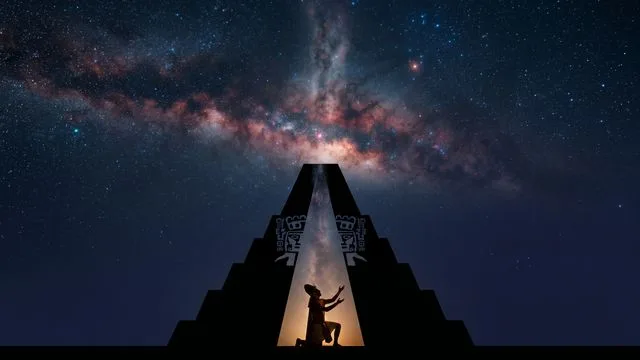
When the Dead Were Headed for the Stars
Ancient burial sites from Peru to Egypt share a striking obsession with the cosmos. What does that convergence actually mean—and for whom?

Space Developments: Tech Triumphs and Challenges
Exploring recent space missions, tech innovations, and their broader impacts on humanity's cosmic ambitions.
Bronze Age Evolution: What Ancient DNA Reveals About Us
David Reich's new preprint says human evolution accelerated during the Bronze Age. Here's what that means for your immune system, metabolism, and health today.

Hannah Cairo Disproved a 40-Year-Old Math Conjecture at 17
At 17, Hannah Cairo overturned the Mizohata-Takeuchi conjecture using a hypercube and a coin diagram. Here's what she actually did—and why it matters.

How Language Shapes Thought, According to Lera Boroditsky
Cognitive scientist Lera Boroditsky explains how the language you speak shapes memory, color perception, and thought—and what's lost when languages disappear.