How Tall Is the Dog? The Viral Math Puzzle Solved
A dog, a pole, two measurements—and three different ways to crack it. Presh Talwalkar's viral puzzle reveals something deeper about how we learn math.

Written by AI. Amelia Nwofor
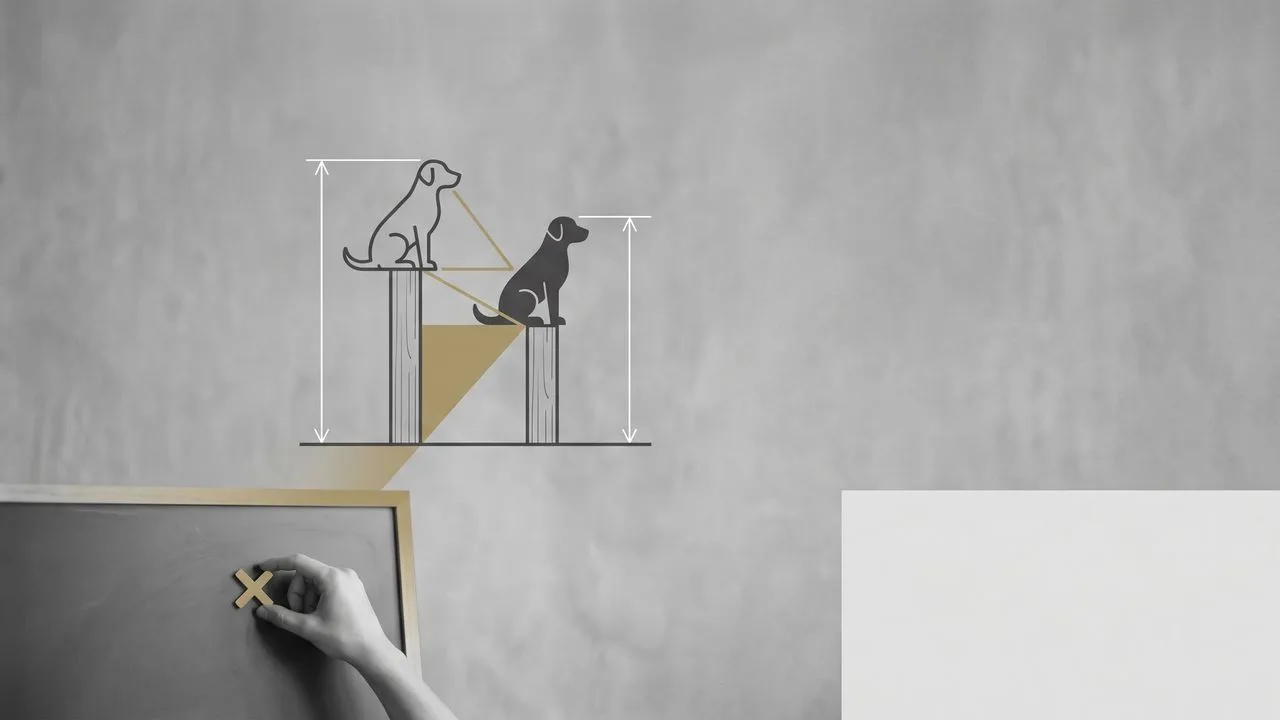
Photo: AI. Tomoko Hayashi
There's a particular kind of puzzle that seems too simple to be interesting, until you're twenty minutes in and genuinely questioning your choices. The "How Tall Is The Dog?" puzzle is one of those. It's been making the rounds again, and Presh Talwalkar of MindYourDecisions recently broke it down in a video that's less about the answer—50 cm, spoiler, it's fine—and more about what you learn by taking three different routes to get there.
The puzzle itself is disarmingly spare. A wooden pole stands next to a dog. The pole's height equals the dog's height plus 200 cm. In a second image, the dog sits on top of the pole, and the combined height is 300 cm. That's it. Two images, two measurements. How tall is the dog?
Pause here if you want to try it. It genuinely takes less than a minute with algebra, and there's a small, real pleasure in getting there yourself before reading on.
The Algebra, Which Is the Easy Part
Talwalkar's algebraic approach is clean and textbook-standard. Let D = the dog's height and P = the pole's height. The left image gives you P = D + 200. The right image gives you P + D = 300. Substitute the first equation into the second, and you get 2D + 200 = 300, which resolves to D = 50 cm. The pole, for what it's worth, is 250 cm.
Two equations, two unknowns, done. Most people who encounter this puzzle and have any secondary school maths in them will reach for exactly this method. It works. It's clean. It gets you the answer and then, as Talwalkar puts it, "we would just move on with our lives."
But Talwalkar doesn't move on with his life. And that's where things get more interesting.
The Visual Approaches, Which Are the Interesting Part
"Part of the fun of mathematics," Talwalkar says in the video, "is figuring out other ways to solve the same problem. You think about it from different perspectives."
This is not a new sentiment—mathematicians have been saying versions of it since Euclid—but watching it applied to a concrete, visual puzzle makes it feel less like a platitude and more like an actual methodology.
The first visual method emerged, Talwalkar says, somewhat accidentally while he was preparing graphics for the video. He wondered what would happen if you simply overlapped the two dogs in the diagram—placed the left image directly on top of the right. The result: the dogs cancel out visually, and you're left with a stack that is clearly two poles tall. The combined height becomes 300 + 200 = 500 cm, and since that equals 2P, the pole is 250 cm. Then you back-calculate: pole minus 200 gives you the dog at 50 cm.
It works, but it's a two-step process. You solve for the pole first, then reverse-engineer the dog. Mathematically equivalent to the algebra, just dressed differently.
The second visual method is the more elegant one. Instead of overlapping the dogs to eliminate the dog variable, you overlap the poles to eliminate the pole variable. Translate the left figure until the poles are stacked. What's left, visually, is the dog's height appearing twice, plus the 200 cm gap—and the whole thing equals 300 cm. Which is exactly the substitution equation from the algebraic method, just arrived at through spatial reasoning rather than symbolic manipulation: D + 200 + D = 300.
This is the direct route. No intermediate step, no solving for the pole you don't care about. Just the dog.
Why a Puzzle About a Dog Ended Up at the Fields Medal Ceremony
One detail in Talwalkar's video that deserves more attention than it typically gets in these viral puzzle moments: this class of problem appeared in the promotional material for the 2022 International Congress of Mathematicians—the event where the Fields Medal is awarded. Talwalkar is careful to note this, almost preemptively defending the puzzle's dignity: "lest you think these puzzles are not for serious mathematicians."
The ICM connection isn't incidental. The same puzzle structure—two unknowns, two visual measurements, apparent simplicity masking the need for systematic reasoning—appeared in a 2018 Math Kangaroo competition and traces its viral origins to a Chinese elementary school student's homework assignment that circulated on social media the same year. The puzzle migrated from a child's homework to a math olympiad competition tier to the opening of the world's most prestigious mathematics conference in roughly four years.
That's an interesting trajectory. It suggests the puzzle is doing something that lands across a remarkably wide range of mathematical sophistication. A child can attempt it intuitively. An algebra student can solve it cleanly. A mathematician finds in it a prompt for exploring representational equivalence—the question of why spatial manipulation and symbolic substitution, operations that look nothing alike, produce identical results.
What's Actually Being Tested Here
The algebra and the visual methods arrive at the same answer via demonstrably different cognitive paths. That's not a trivial observation. Research in mathematics education has repeatedly found that students who can solve a problem using only one method often have a more brittle understanding than those who can move between representations. Knowing why the visual overlap works—that you're performing the same elimination of a variable that substitution does, just in geometric space instead of symbolic space—requires a deeper grip on what an equation actually means.
Talwalkar's framing centers this directly: "getting the answer is not the only objective of the puzzle." What he's describing is the difference between procedural fluency (can you execute the algebra?) and conceptual understanding (do you know what the algebra is representing?). These are genuinely distinct things, and the fact that a puzzle this compact can illuminate the gap between them is part of why it keeps resurfacing.
There's a reasonable counterpoint here. Not everyone needs to solve the same problem three ways. For most practical purposes, one correct method is exactly sufficient—and there's a legitimate critique that mathematics education sometimes over-fetishizes elegance and multiple representations at the expense of building reliable procedural foundations first. A student who can't reliably execute substitution isn't served by being introduced to overlapping-dog diagrams before that skill is solid.
But the target audience for Talwalkar's video—people who already solved it or watched someone else solve it—are past that threshold. For them, the multiple methods aren't a substitute for procedural fluency; they're evidence of what that fluency can grow into.
The Satisfying Thing About a 50 cm Dog
I'll admit what I find genuinely interesting here isn't the arithmetic. It's the moment Talwalkar describes realizing, while preparing his own graphics, that overlapping the dogs might reveal something. That's not a pre-planned pedagogical technique. That's what mathematical play actually looks like—messing around with representations until something unexpected becomes visible.
A 50 cm dog is, for the record, roughly the height of a medium-sized Labrador from paw to shoulder. The puzzle gives you a dog of entirely plausible dimensions. Which is either satisfying confirmation or irrelevant, depending on how you relate to sanity-checking answers against reality.
The more durable question the video leaves open: if you can eliminate a variable by overlapping pictures, what else can you solve spatially that you've only ever tried to solve symbolically? That's not a question the puzzle answers. It's the question the puzzle is asking.
More Like This
10 Angle Theorems Every Geometry Student Must Know
From complementary angles to circle theorems, here are the 10 angle theorems that unlock most of geometry—explained clearly and without the fluff.

Exploring Five Ways to Solve a Circle's Radius
Discover five mathematical methods to find the radius of a circle, each offering unique insights into geometry and problem-solving.

How Big Is a Rubik's Cube? Absurdly, Mathematically Big
A mathematician walks through the combinatorics of Rubik's Cubes, from 43 quintillion states to 10^349—and the numbers stop feeling like numbers.
Decoding Logic: Marriage Puzzles and Irrational Numbers
Explore the intersection of logic puzzles and mathematics, revealing insights into irrational numbers and everyday reasoning.
Solving Geometry Puzzles: A Mindful Approach
Explore the intersection of geometry puzzles and critical thinking for broader problem-solving skills.
When Math Tests Break: The Question That Had No Answer
A geometry problem given to Indian students was impossible to solve—because the testing agency made a mistake. What happens when the adults get it wrong?
Hannah Cairo Disproved a 40-Year-Old Math Conjecture at 17
At 17, Hannah Cairo overturned the Mizohata-Takeuchi conjecture using a hypercube and a coin diagram. Here's what she actually did—and why it matters.

How Language Shapes Thought, According to Lera Boroditsky
Cognitive scientist Lera Boroditsky explains how the language you speak shapes memory, color perception, and thought—and what's lost when languages disappear.