10 Angle Theorems Every Geometry Student Must Know
From complementary angles to circle theorems, here are the 10 angle theorems that unlock most of geometry—explained clearly and without the fluff.

Written by AI. Ellis Redmond
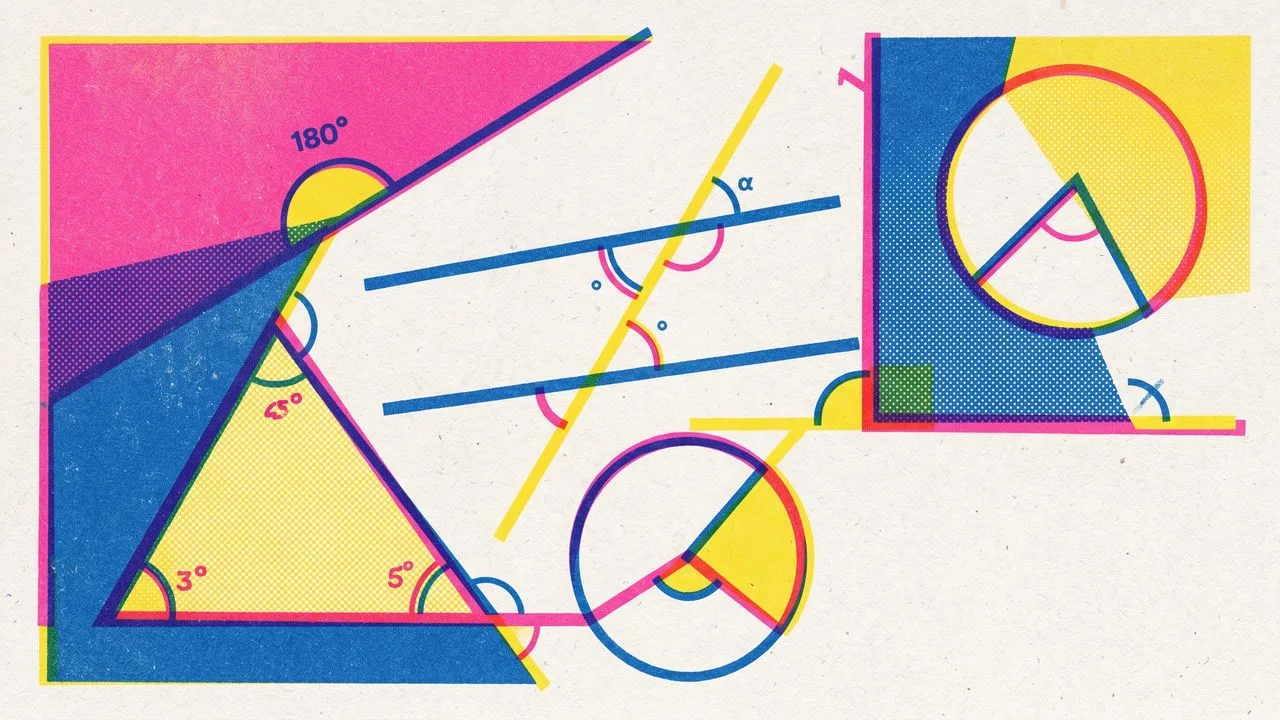
Photo: AI. Jorah Maktoum
There's a particular kind of frustration that lives in geometry class. You stare at a diagram full of lines and angles and labeled variables, and you know there's a logical path from what you're given to what you need—you just can't see it. The diagram looks like a conspiracy. The answer feels hidden.
Most of the time, it isn't. Most of the time, you're one theorem away.
JensenMath's YouTube video ANGLE THEOREMS - Top 10 Must Know spends just under 21 minutes walking through the theorems that unlock the majority of geometry problems you'll encounter in a standard math course. It's a straightforward instructional resource—no gimmicks, no padding—and the sequencing is deliberate: Jensen builds from the simplest ideas toward the more surprising ones. What follows is a tour through those ten theorems, with some added context on why they're structured the way they are and where they connect to each other in ways the video only briefly hints at.
The foundation: angles that share a sum
The first two entries aren't theorems in the strictest sense—they're definitions with geometric consequences.
Complementary angles sum to 90°. Put two complementary angles together and you get a right angle. Supplementary angles sum to 180°. Put two supplementary angles together and you get a straight line. These are the arithmetic floor beneath everything else: if you don't know these two facts reflexively, every subsequent theorem becomes harder than it needs to be.
They're also the reason so many geometry proofs end with a sentence like "…therefore these angles are supplementary, and since one is known, the other follows." It comes up constantly.
Triangles: three theorems that do a lot of heavy lifting
The sum of the interior angles of any triangle is always 180°. This is one of those facts that feels obvious once you've seen it demonstrated—fold the three corners of a paper triangle together and they form a straight line—but it's worth pausing on how much work it does. Knowing two angles of a triangle immediately gives you the third. Every time. No exceptions (in Euclidean geometry, anyway—but that's a rabbit hole for another article).
The isosceles triangle theorem builds directly on this: if two sides of a triangle are equal in length, the angles opposite those sides are also equal. Jensen's example is clean—a triangle with two equal sides and a known base angle of 35°. Because the triangle is isosceles, the other base angle is also 35°. The remaining angle at the apex? Subtract both from 180°. You get 110°. The theorem doesn't require any new arithmetic machinery; it just tells you which angles you're allowed to treat as twins.
The exterior angle theorem is where things get genuinely interesting. Extend one side of a triangle past a vertex, and the angle formed outside the triangle—the exterior angle—equals the sum of the two non-adjacent interior angles. Jensen offers two ways to see why this must be true. The first is algebraic: the exterior angle and the adjacent interior angle are supplementary (they form a straight line, summing to 180°), and the three interior angles also sum to 180°, so both the exterior angle and the sum of the two opposite interior angles must equal the same thing when combined with that adjacent angle. The second proof involves drawing a parallel line and invoking the alternate and corresponding angle theorems—which Jensen previews here and delivers later in the video.
That cross-referencing isn't accidental. These theorems aren't isolated facts; they're a web. The exterior angle theorem can be proven using parallel line theorems. The parallel line theorems can be understood through the lens of supplementary angles. Learning them as a connected system is more durable than memorizing them as a list.
The formula for sum of interior angles in any polygon—(n − 2) × 180°—extends this triangle logic outward. A quadrilateral can be cut into two triangles (2 × 180° = 360°). A pentagon into three (3 × 180° = 540°). The formula is really just triangle-angle-sum repeated n − 2 times. And for what it's worth: the sum of exterior angles for any polygon is always 360°, regardless of the number of sides. That one has an elegant proof involving imagining yourself walking around the perimeter of the polygon and tracking how much you've turned—you always complete exactly one full rotation.
Parallel lines: three patterns disguised as theorems
When a transversal crosses two parallel lines, it creates eight angles. Three theorems describe the relationships between them, and each gets a letter-based mnemonic that Jensen leans into.
The alternate angle theorem (the Z pattern): angles on opposite sides of the transversal, between the parallel lines, are equal. Draw a Z or a backwards Z through the diagram and the angles inside the zigzag are the equal ones. The alternate exterior angles—same logic, but outside the parallel lines—are also equal.
The co-interior angle theorem (the C pattern): angles on the same side of the transversal, between the parallel lines, sum to 180°. They're supplementary. As Jensen puts it, "interior angles on the same side of a transversal add up to 180°." Draw a C through the diagram; the two angles inside the curve are the ones that add up.
The corresponding angle theorem (the F pattern): angles in the same relative position at each intersection—both top-left, both bottom-right, etc.—are equal. The F can be drawn forwards or backwards to find the matching pair.
What's worth noticing is that these three theorems are not independent. If you accept the corresponding angle theorem as true, you can derive the alternate angle theorem (corresponding angles plus vertically opposite angles), and from there derive the co-interior theorem (alternate angles plus supplementary angles). They form a logical chain. Most geometry courses teach all three because spotting the right pattern quickly is a practical skill—but understanding that they're interrelated is what makes the knowledge stick.
The vertical angle theorem—when two lines intersect, opposite angles are equal—sits adjacent to this cluster. It's the simplest of the group: two straight lines create four angles, and the ones across from each other must be equal because both pairs share the same supplementary relationship with their neighbors.
Circles: where the geometry gets genuinely surprising
The two circle theorems in Jensen's video are the most counterintuitive entries on the list, and they're the ones most likely to produce that specific math-class feeling of wait, that's always true?
Inscribed angles subtended by the same arc are equal. Pick any two points on the circumference of a circle. Draw lines from each point to the two endpoints of the same arc. The angles formed at those two circumference points are identical—regardless of where on the circle you picked your points. Jensen's example: two angles both subtended by the same arc, one of which is 65°. Therefore the other is also 65°.
The bonus theorem here—that any angle inscribed in a semicircle equals exactly 90°—is a special case of this. If the arc in question is a semicircle (bounded by a diameter), then the inscribed angle must be 90°. Every time. It's a surprisingly powerful constraint.
The central angle is double the inscribed angle. When an arc subtends an angle at the center of a circle and another angle at any point on the circumference, the central angle is exactly twice the circumference angle. Jensen's example uses a central angle of 142°: divide by two, and the inscribed angle is 71°.
The proof of this theorem—which Jensen doesn't go into, but which is worth knowing exists—uses the isosceles triangle theorem. Draw lines from the center to both ends of the arc and to the circumference point; because two of those lines are radii (equal length), you get isosceles triangles, and the base angles let you establish the 2:1 ratio. The theorems are talking to each other again.
What a "top 10" list actually reveals
There's something worth sitting with here. Jensen frames these as the ten theorems "you have to know to be successful in your math classes"—a pragmatic, exam-oriented framing. And that's fair; this is explicitly a study resource. But the more interesting observation is that these ten theorems aren't ten separate facts. They're more like ten entry points into a single coherent structure.
Complementary and supplementary angles set the arithmetic. Triangle theorems apply that arithmetic to the simplest closed shape. Parallel line theorems explain what happens when you cut parallel lines with a transversal—and secretly explain the exterior angle theorem too. Circle theorems extend the logic into curved geometry, where the results feel almost magical until you trace them back to the isosceles triangle sitting quietly at their core.
Memorizing the list will get you through the test. Understanding how the pieces fit might change how you see diagrams entirely—not as conspiracies, but as puzzles where most of the information is already there, waiting for the right theorem to make it visible.
More Like This
This Geometry Puzzle Has Nine Solutions (Here Are Two)
A deceptively simple triangle problem reveals why some mathematical puzzles resist single approaches—and what that tells us about how we solve problems.

Exploring Five Ways to Solve a Circle's Radius
Discover five mathematical methods to find the radius of a circle, each offering unique insights into geometry and problem-solving.

What Spinosaurus Tells Us About Dinosaur Science
Dr. Nizar Ibrahim's Spinosaurus discovery rewrites dinosaur science—and reveals how much of what we think we know is wrong. Here's what the fossil record actually shows.

Why Struggling With Math Is the Point
A viral study method reframes math frustration as a feature, not a bug. Here's what the research-adjacent advice gets right—and what it quietly sidesteps.
The Hairy Ball Theorem: Math's Fuzzy Conundrum
Explore the Hairy Ball Theorem and its surprising applications in game development and physics, revealing the beauty of continuous vector fields.

Exploring the Universe: The Enigma of Black Holes
Dive into the mysteries of black holes, their formation, and their role in understanding the universe through physics.

Why Being Complicated Might Be the Point
Yahia Ghaleb's TEDx talk argues we should stop flattening ourselves into simple labels. Here's what the psychology actually says about living in the gray.

YouTube Lighting for Beginners: What Actually Matters
Before you buy a new camera, fix your lighting. A practical breakdown of what beginner YouTubers get wrong—and how to fix it for under $50.