Rethinking Cosmic Acceleration: A Local Illusion?
Exploring the debate on whether the universe's acceleration is a local phenomenon, challenging the concept of dark energy.

Written by AI. Olivia Meng
Few ideas in cosmology have sparked as much interest as the speeding up of the universe's expansion. But what if this widely held belief is wrong? Subir Sarkar, a physicist known for questioning mainstream cosmology, argues that the observed speed-up might be a trick of perspective -- a local effect, not a universal one.
The Dipolar Universe?
Sarkar's claim comes from a careful look at supernova data. His analysis points to a pattern that is dipolar, not uniform in all directions. As he puts it, "the data overwhelmingly thinks that the acceleration is a dipole." He backs this up with the updated Pantheon Plus dataset, which strengthened the dipolar signal using about 1,700 supernovae.
The stakes are high. If cosmic speed-up is not the same in every direction, the whole case for dark energy may need a rethink. Dark energy is the mysterious force thought to drive the universe's faster expansion. Sarkar's claim challenges the Nobel-winning discovery that has shaped cosmology since the late 1990s.
The Cosmological Constant Problem
At the core of this debate sits the cosmological constant problem. It has long troubled theoretical physics. Sarkar stresses the gap between how different fields see the cosmological constant. He argues that "for lambda to have that value, you would have to adjust operators in the standard model to 60 places of decimals." This points to a fine-tuning problem that defies easy answers.
This gap in understanding goes beyond academic debate. It reflects a deeper struggle to connect quantum field theories with general relativity. Astronomers see the cosmological constant as a simple number. Particle physicists see it as a deep puzzle. These views are hard to square.
Interdisciplinary Discord
The debate over cosmic speed-up is not just a science question. It shows real tensions between fields. Sarkar notes the "significant gap between relativists, astronomers, and particle physicists." This divide makes it harder to reach agreement on basic cosmic facts. It also shows the broader challenge of blending different scientific views into one clear picture.
A Local Phenomenon?
Sarkar's idea is that what we see as cosmic speed-up might be a local effect. He points to a "local bulk flow" as the cause. If he is right, the universe at large is not speeding up at all. Instead, nearby events just look like speed-up. This view casts doubt on dark energy. It also calls for a fresh look at the data and models long treated as settled truth.
A Call for Rigor
Sarkar also pushes back on how cosmology handles its data. He is frustrated by the habit of fitting data without enough physical checks. This leads to results that may break basic physics rules. "It's just put it very simply," he argues, "if I am analyzing data in the framework of a model which forces the only unknown quantity, namely lambda, to be added in the standard cosmological model..."
The Bigger Picture
The stakes reach beyond science labs. How we picture the universe shapes debates in philosophy, big-picture thinking, and even policy. Whether Sarkar turns out to be right or not, his work reminds us that science thrives on challenge and fresh eyes.
By questioning long-held ideas, Sarkar invites us to rethink how we grasp the cosmos and our place in it. The talk is far from over. As new data comes in, the debate will keep going -- driven by a scientific community that stays curious and keeps asking tough questions.
More Like This
James Webb Challenges Dark Matter Beliefs
James Webb Telescope data questions the Bullet Cluster's role as dark matter proof, suggesting complex galaxy interactions.
Rethinking Inflation and the FLRW Model
Explore the complexities and challenges of cosmological models, including inflation theory and the FLRW model.
Dark Energy: New Dimensions in Cosmological Models
Exploring how dark energy challenges our understanding of the universe and its evolution over time.
The Elusive Nature of Mathematics
Exploring math as a cognitive practice, beyond numbers and symbols.
Exploring Cosmic Time Delays and Dark Energy
Time delay cosmography may unveil dark energy mysteries, resolving Hubble tension with new cosmic insights.
Hubble Tension: The Universe's Unsolved Mystery
Explore the Hubble tension and its implications for our cosmic understanding.
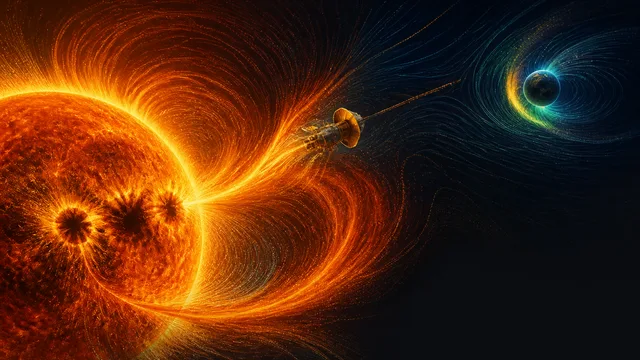
Solar Cycle 25 Was Twice as Strong as Predicted
Solar cycle 25 peaked at nearly double forecast levels. Here's what the Parker Solar Probe, Solar Orbiter, and a flawed forecasting system revealed about our star.
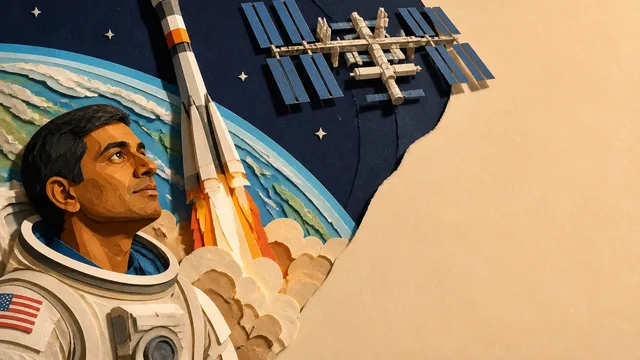
Anil Menon Reaches the ISS on His First Spaceflight
NASA astronaut Anil Menon launched to the ISS on July 14 aboard Soyuz MS-29. His eight-month mission raises questions about what space cooperation looks like next.