The Elusive Nature of Mathematics
Exploring math as a cognitive practice, beyond numbers and symbols.

Written by AI. Olivia Meng
If mathematics is anything, it’s a persistent enigma. Mathematician David Bessis challenges the traditional view of math as a rigid realm of numbers and symbols. Instead, he offers a more dynamic perspective: mathematics as a cognitive technology that rewires our brains. This notion invites us to reconsider what we think we know about this ancient discipline.
For centuries, defining mathematics has been a Sisyphean task. Bessis points out that "nobody seems to agree on the definition of mathematics," a claim that underscores the difficulty of pinning down its essence. The Wikipedia entry on mathematics, which he references, reflects this uncertainty. Traditionally, math is seen as either a science of numbers existing in a Platonic realm or a system of logical proofs. Yet, both views fall short when we consider the lived experience of doing math.
Bessis argues that math isn't just about proofs; it’s about imagination and intuition. "You spend your time dreaming, daydreaming, coming up with crazy ideas, testing your intuition," he explains. This perspective shifts the focus from external validation to internal cognition. It's not about cold, hard numbers but about engaging with concepts until they feel real.
This line of thinking aligns with the idea that the gap between a beginner and a mathematical genius like Terence Tao is not a matter of innate ability, but rather, as Bessis suggests, "compound interest on intuition." The notion that developing mathematical intuition is akin to accruing interest over time challenges the traditional emphasis on IQ as the sole determinant of mathematical prowess.
However, this cognitive approach raises questions about the nature of mathematical truth. Bessis likens the practice of math to a game of truth, where "you can write statements that are absolutely true" and build upon them through formal deduction. Yet, the meaning we derive from these statements is a distinctly human phenomenon. It’s not the symbols themselves that hold power, but our interpretation of them.
Mistakes in mathematical proofs, then, are not merely errors to be corrected. They are, as Bessis illustrates, opportunities for deeper understanding. When Andrew Wiles famously corrected his proof of Fermat’s Last Theorem, it wasn’t just about fixing a bug. It was about engaging with the theorem on a deeper level, aligning the mechanical proof with human intuition and meaning.
This approach does not dismiss formalism but recognizes its limitations. It suggests that mathematics, at its core, is a human enterprise, rich with imagination and creativity. The practice of mathematics, much like the practice of sustainability in climate science, requires a balance between rigorous formalism and the human drive to make sense of our world.
So, what is mathematics? Perhaps it’s the art of making the abstract tangible, the pursuit of understanding through the lens of human cognition. As we grapple with its definitions, we are reminded that mathematics, much like life itself, is a journey of discovery rather than a destination.
More Like This

Rethinking Cosmic Acceleration: A Local Illusion?
Exploring the debate on whether the universe's acceleration is a local phenomenon, challenging the concept of dark energy.
Unraveling Time and Reality with Sean Carroll
Explore time, black holes, and reality with Sean Carroll, as science and philosophy intertwine in our understanding of the universe.
Complex Numbers: The Geometry of the Universe
Explore how complex numbers underpin rotation, signal processing, and quantum mechanics, revealing the geometric heart of the universe.
Terry Tao, AI, and the Fluid Dynamics Enigma
Exploring how Tao and AI tackle fluid dynamics, a puzzle crucial for tech and climate.
Decoding Ramanujan: Genius or Neuroplasticity?
Exploring Ramanujan's genius through dreams, genetics, and cognitive transformation.

Exploring Acoustic Waves in Cellular Mechanics
Understanding the impact of acoustic waves on microtubules and potential therapeutic applications.

Project Pele: The Pentagon's Portable Nuclear Reactor
The Pentagon's Project Pele aims to power remote military bases with a containerized nuclear reactor. Here's what the technology promises—and what it can't yet answer.
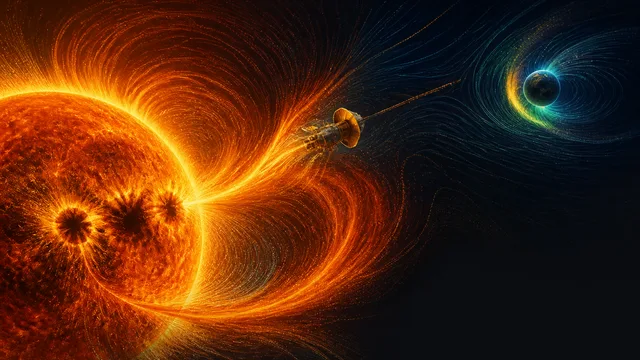
Solar Cycle 25 Was Twice as Strong as Predicted
Solar cycle 25 peaked at nearly double forecast levels. Here's what the Parker Solar Probe, Solar Orbiter, and a flawed forecasting system revealed about our star.