Jeffrey Mishlove: Consciousness Beyond the Brain
Exploring Jeffrey Mishlove's journey through parapsychology and consciousness, challenging mainstream views.
Written by AI. David Oyelaran
Jeffrey Mishlove, a name often associated with the fringes of academia, has carved a niche that challenges the conventional boundaries of science. His journey, spanning over five decades, is a narrative woven with threads of parapsychology, consciousness, and the mystical intersections of human experience.
Mishlove's path diverged from the mainstream early on. Holding the only PhD in parapsychology from UC Berkeley, he faced significant opposition. Critics, alarmed by what they perceived as a threat to scientific orthodoxy, sought to annul his degree. Yet, Mishlove persevered, his degree standing as a testament to his resilience and the power of belief in one's convictions.
"Consciousness," Mishlove posits, "may not be created by the brain but rather filtered through it." This perspective invites us to reconsider the foundations of human experience, suggesting a reality where consciousness exists beyond the physical confines of the brain. It's a proposition that both intrigues and unsettles, inviting questions about the very nature of life and existence.
His work at the Stanford Research Institute (SRI) during the CIA-funded Stargate Project placed him alongside prominent figures like Hal Puthoff and Russell Targ. Here, Mishlove explored the possibilities of remote viewing and psychokinesis—phenomena that remain contentious yet captivating.
In a world that often seeks empirical validation, Mishlove’s experiences with Ted Owens, who claimed to summon UFOs, and his own profound dream coinciding with his uncle's death, blur the lines between coincidence and the paranormal. These stories, while anecdotal, challenge the rigidity of scientific skepticism.
Mishlove’s insights extend into criminology, where he conducted group therapy sessions at San Quentin prison. Here, he encountered the human psyche laid bare, finding commonalities with those society labels as 'other.' "I thought they were pretty much just like you and me," Mishlove reflects, suggesting a shared consciousness that defies societal labels.
The intersection of the mystical and the scientific is where Mishlove thrives. He argues that exploring unconventional fields like parapsychology can yield insights about the human condition often overlooked by traditional academia. His win of the Bigelow Prize in 2021 further solidifies his position, providing a scientific case for the survival of consciousness post-mortem.
Yet, Mishlove’s journey is not without its tensions. The academic world, comfortable with the study of religious mysticism, remains wary of parapsychology. "Most scholars in the field of religious studies," Mishlove notes, "are really atheists and skeptics." This skepticism is not without merit, as the scientific community grapples with balancing empirical rigor and the exploration of the unknown.
Mishlove’s story invites us to question the boundaries of science and spirituality, urging a reconsideration of what we accept as truth. It poses the question: as we advance technologically, are we open to expanding our understanding of consciousness beyond the tangible?
His narrative is not just a personal journey but a collective invitation to explore the interconnectedness of human experience, challenging us to look beyond what we know, perhaps discovering that our consciousness is indeed larger and more interconnected than we ever imagined.
More Like This
Brain-Computer Interfaces: Bridging Biology and Technology
Explore the potential of brain-computer interfaces to merge biology with tech, restoring lost functions and expanding human capabilities.
Consciousness Transfer: Science Fiction or Reality?
Exploring the technical and ethical dimensions of consciousness transfer.

Lab-Grown Mini Brains and Climate Solutions
Exploring the ethical and practical implications of lab-grown brain organoids and solar geoengineering.
Unlocking New Skills After 50: The 'Pillar & Playground' Approach
Explore how the 'Pillar & Playground' method helps those over 50 learn efficiently, leveraging crystallized intelligence and cognitive flexibility.
Understanding Your Brain's Hidden Voices
Explore how our brains work, the power of dreams, and embracing challenges for growth.
E=mc²: Unraveling the Illusion of Solidity
Explore how E=mc² reveals mass as trapped energy, reshaping our understanding of solidity and reality.

How the KGB Shaped Soviet Russia and Putin's Rise
From Lenin's Cheka to Putin's FSB, the KGB's century-long grip on Russia shaped purges, Cold War espionage, and modern authoritarian politics.
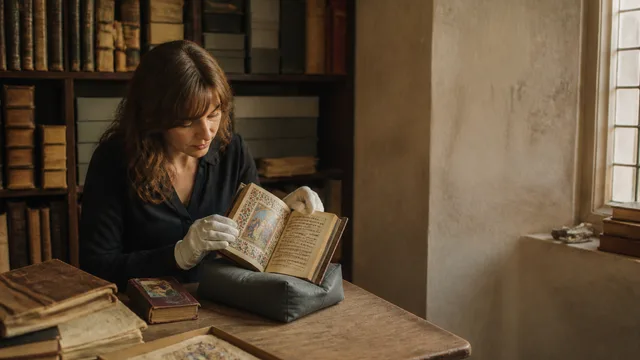
Medieval Manuscripts: History, Scribes, and Collecting
Manuscript dealer Sienna Wells on the human stories inside medieval books—and how to start collecting them without spending a fortune.