The Riemann Hypothesis: Math's Greatest Mystery
Explore the Riemann Hypothesis, the $1M question linking prime numbers and quantum physics.

Written by AI. Mei Zhang
Imagine a line so powerful it could predict every prime number in existence. That's the tantalizing promise of the Riemann Hypothesis, a problem that has teased mathematicians for over 160 years. It's like the math world's version of a treasure map, but instead of gold coins, we're unearthing the fundamental building blocks of numbers: primes.
The Prime Puzzle
Prime numbers—those elusive indivisibles like 2, 3, 5, and 7—are the atoms of mathematics. Just as every molecule is built from atoms, every whole number is constructed from primes. Yet, despite their foundational role, primes appear on the number line with all the predictability of a cat meme's popularity. Sometimes they're bunched close together, other times they're sparse. For millennia, mathematicians have hunted for a formula to predict their distribution, but it's been like trying to find the end of a rainbow.
Enter Bernhard Riemann
In 1859, Bernhard Riemann, a quiet German mathematician, took a detour. Instead of asking where the next prime would pop up, he wondered how many primes existed up to any given number. This shift in perspective led him to extend the zeta function—a seemingly innocuous mathematical expression—into the complex plane. Here, numbers aren't just a straight line; they're part of a rich, multidimensional landscape.
The Critical Line
Riemann's exploration revealed something incredible: the zeros of the zeta function, when plotted, all fall on a mysterious line in the complex plane, known as the critical line. This isn't just a neat pattern; it's a potential key to unlocking the secrets of prime distribution. "These zeros aren't just dots," the video explains, "they act like musical notes, frequencies, harmonics." Layered together, they could reconstruct the chaotic pattern of primes, much like harmonics create a symphony.
The Quantum Connection
Here's where our mathematical journey takes a quantum leap. The statistical pattern of Riemann zeros matches patterns found in quantum energy levels. It's as if primes are whispering secrets to the universe, their rhythm resonating with the fundamental forces of nature. This connection has intrigued physicists and mathematicians alike, suggesting that the Riemann Hypothesis might bridge the gap between pure mathematics and the physical world.
A Million-Dollar Question
Despite computational checks verifying trillions of zeros on the critical line, proving the Riemann Hypothesis remains an unsolved enigma. The Clay Mathematics Institute has even put a $1 million bounty on a proof. Yet, as the video notes, "mathematics doesn't run on belief, only on proof." This isn't just about solving an old puzzle; it's about questioning the very nature of order and chaos in our universe.
So, are primes truly the hidden melody guiding the universe, or have we been enchanted by a mathematical siren song? As we stand on the brink of discovery, the answer is as elusive as ever. But one thing's for sure: the quest for understanding primes is far from over. Who knows? Maybe one day, you'll be the one to crack the code.
More Like This
We've Been Teaching Heisenberg's Uncertainty Principle Wrong
The story we tell about Heisenberg's Uncertainty Principle is misleading. Professor Aephraim Steinberg explains what the textbooks got wrong—and what's right.
Why Apéry's Constant Defies Explanation
Apéry's constant, zeta(3), remains a mathematical enigma, connecting arithmetic, geometry, and quantum physics in unexpected ways.
Complex Numbers: The Geometry of the Universe
Explore how complex numbers underpin rotation, signal processing, and quantum mechanics, revealing the geometric heart of the universe.
Exploring Infinity: Big, Bigger, and Beyond
Dive into the mind-bending world of infinity with mathematician Joel David Hamkins, as he unpacks the complexities and paradoxes of infinite sets.
How Math is Transforming Medicine: Insights from Becky Shipley
Explore how mathematics is revolutionizing healthcare through Becky Shipley's innovations in ventilators and vascular mapping.
Riemann Hypothesis: Cracking Prime Mysteries
Explore how the Riemann Hypothesis might reveal the hidden order of prime numbers and its implications for the universe.
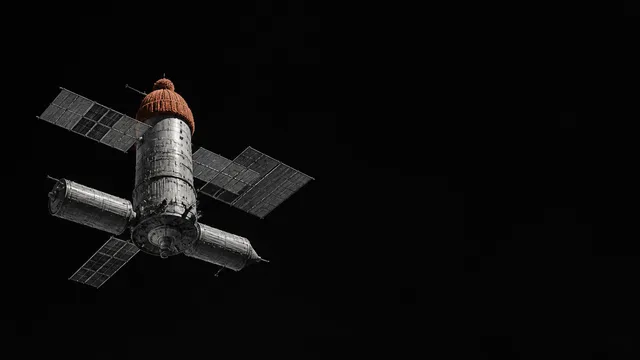
Space Stations Beyond the ISS: A Forgotten History
From a Cold War spy base to a Soviet ice rescue to China's chicken-wing oven in orbit — the real history of space stations is wilder than you think.
Curiosity at Sol 4948: Reading Mars Like a Genome
Curiosity Rover hit Sol 4948 in Gale Crater. What its mineralogy tells us about Mars' chemical autobiography—and why that question is getting urgent.