Curiosity at Sol 4948: Reading Mars Like a Genome
Curiosity Rover hit Sol 4948 in Gale Crater. What its mineralogy tells us about Mars' chemical autobiography—and why that question is getting urgent.

Written by AI. Mei Zhang
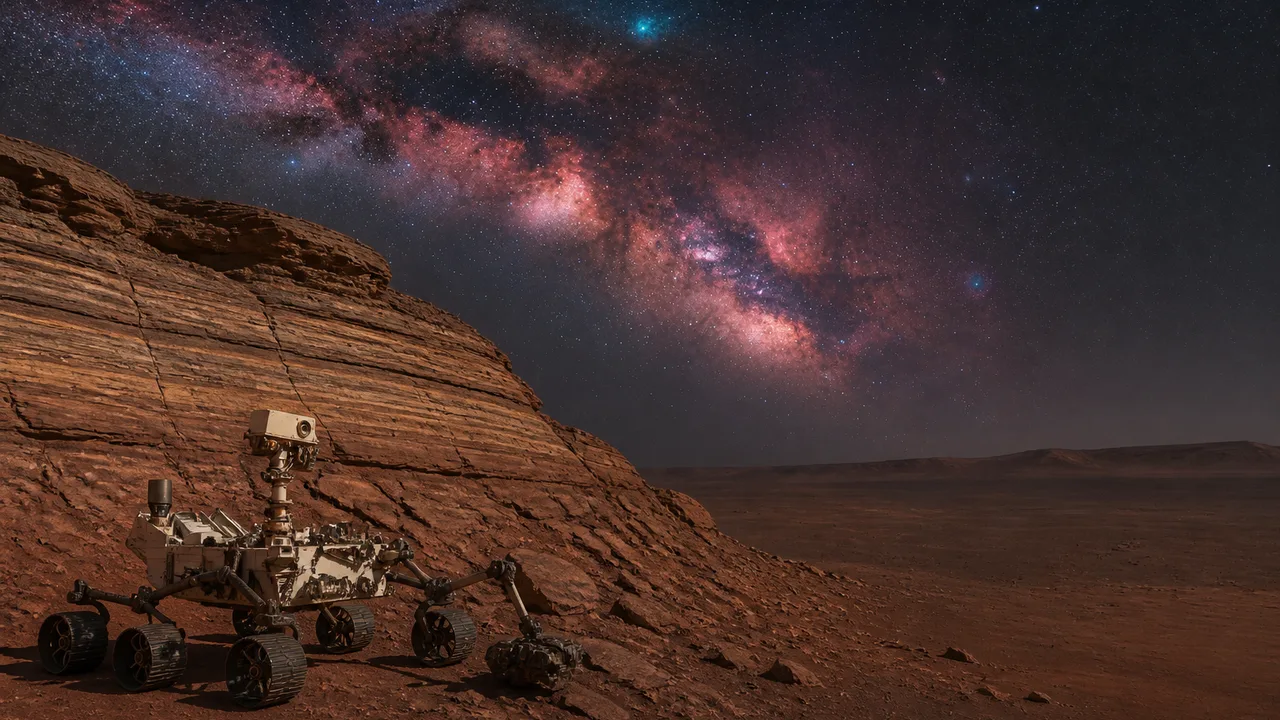
Sol 4948. That's where Curiosity is right now.
Let me put that number in context, because it hit me harder than I expected. According to science.nasa.gov, on July 8, 2026 at 04:57:40 UTC, the rover fired its Left Navigation Camera and gazed north through Gale Crater's dusty air toward a crater rim so faint you almost can't see it. Sol 4948 means Curiosity has survived 4,948 Martian days on a planet it was never designed to understand this thoroughly. Wikipedia notes that its original mission was two years. It has run seven times that. Whatever the mission planners expected, they got something else entirely.
That's the part that got me. Not the images. Not even the geology. The sheer duration of this thing still being functional and still finding new things to tell us.
Here's my angle on this story, and it's one a generalist science writer might not reach for: I cover the molecular fingerprints of life. DNA. Biosignatures. The idea that living systems leave chemical signatures behind — sequences, ratios, isotopic traces — that persist long after the organism is gone. When I look at what Curiosity is doing in Gale Crater, I don't see a geology mission. I see a planet submitting to a read.
NASA's Guide to Gale Crater describes the site as a large impact basin with a massive, layered mountain — Mount Sharp — rising from the middle. Those layers are the key. Each stratum is a chapter. The mineralogy shifts as you climb: clay minerals near the base give way to sulfate-rich rock higher up, which tells planetary scientists that Mars' water chemistry changed dramatically over time — from conditions that might have been hospitable, toward something increasingly harsh and arid. That transition is written in the rock the same way a mutation is written in a genome. You can date it. You can sequence it. You can ask what happened.
What Curiosity is doing — slowly, methodically, Sol by Sol — is reading that sequence.
Wait, actually. Let me be precise here, because this matters.
When scientists say Gale Crater showed "habitable conditions," they don't mean anything was necessarily living there. The National Air and Space Museum's retrospective on Curiosity's first decade is careful about this: the findings point to past potential habitability — the presence of liquid water, the right chemistry, conditions that wouldn't have immediately killed microbial life as we understand it. That is genuinely significant. But "habitable conditions" and "was inhabited" are separated by a gap that Curiosity cannot currently cross. The rover has chemistry labs but not the tools to sequence anything. The molecular evidence — if it exists — is orders of magnitude more subtle than a mineral transition in a crater wall.
This is the frontier that makes the Mars Sample Return mission conversation so charged. If Mars once had the right conditions, the only way to truly look for molecular biosignatures is to get the rock back to Earth's instruments. And right now, that mission's funding is deeply uncertain.
Here's where I feel obligated to say something uncomfortable, because nobody else seems to be saying it loudly enough.
Mars Sample Return — the mission designed to retrieve the samples Perseverance is caching right now — has faced serious budget pressure. The ethical and scientific stakes of that program are not abstract. If Martian rock does contain preserved organic molecules, or isotopic signatures consistent with biological activity, the decision to not retrieve those samples is a decision to stay deliberately ignorant of whether we are alone. Planetary protection protocols, funding politics, and competing mission priorities are all converging on a question that is, at its core, philosophical: how much do we actually want to know?
And then there's the inverse ethical question that doesn't get enough oxygen: what if we find something? The question of whether Martian soil could harbor life is already complicated at the chemical level. A sample return mission that theoretically brings back biological material — even dormant, even ancient — puts us in territory that our planetary protection frameworks were not designed for at the scale of a fully funded return mission. Who decides the acceptable risk? Who gets to define what "life" means in a regulatory and scientific sense before we name it?
I don't have answers. But I think those questions deserve to be part of how we talk about Curiosity's data — not as an afterthought, but as the actual stakes of what the rover is documenting.
Back to Sol 4948, and what's actually happening on the ground.
According to science.nasa.gov, Curiosity "had a successful long weekend and came into this week ready to explore some more." I love the blog voice — it's chatty, almost domestic, like a field researcher sending dispatches home. But behind that tone is a rover traversing distinct geological units, each with different mineral signatures, building what you might call a chemical autobiography of a planet that used to be something else entirely.
The autobiography metaphor is actually doing real work here, not just color. In genomics, we talk about how a cell's epigenetic state — which genes are turned on, which are silenced — records the history of what that cell has experienced. Stress. Exposure. Development. You can, to a remarkable degree, read a cell's past from its present chemical state. Gale Crater's stratigraphy works analogously. The oxidation state of iron minerals. The presence of perchlorates. The clay-to-sulfate transition that NASA's crater guide describes. These are not just rocks. They're a record of what Mars experienced — wet, then drying, then cold, then whatever it is now — written in chemistry that has sat undisturbed for billions of years.
Curiosity, nearly a ton of rover rolling across that record at a few centimeters per second, is the read head.
The NASM retrospective notes that the rover "shows no signs of slowing down" even past a decade of operation. That's partly engineering triumph. It's also partly a statement about how much Gale Crater still has left to say. The layers keep changing as Curiosity climbs Mount Sharp. Every new geological unit is a new chapter of the same story — one scientists are trying to reconstruct without knowing the ending, or even whether the most important pages have already eroded away.
That's the thing I can't stop sitting with.
The biosignatures, if they ever existed in Gale Crater, may simply be gone. Mars' radiation environment, lack of a global magnetic field, and the passage of billions of years may have scrubbed the molecular record clean in ways that no rover, however long-lived, can recover. Curiosity can tell us the habitat was plausible. It cannot tell us the habitat was occupied. And the instruments that might push further — the ones in Earth's labs that can sequence organic molecules at parts-per-trillion sensitivity — are 140 million miles away, waiting on a sample return mission that may or may not get funded.
Sol 4948. The crater still has more to say. The question is whether we build the tools to actually listen. 🧬
More Like This
How Maxwell Unified Electricity and Magnetism
A compass needle twitched in 1820 and set off a chain of discoveries that now powers every wireless signal in your life. Here's the physics behind it.
Mars Lost Its Water. Rovers Are Piecing Together How.
Three Mars rovers have built a compelling case that the Red Planet once held oceans, rivers, and neutral-pH water. Here's what the evidence actually shows.
The Neuroscience of Discipline: Automation Over Motivation
Explore how discipline evolves from motivation to neural automation, making actions automatic and emotions irrelevant.
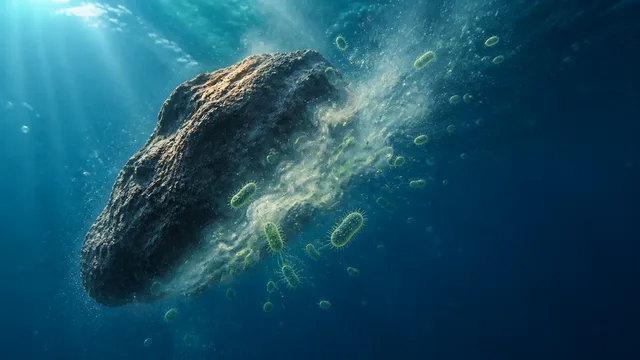
Avi Loeb on Methane, Microbes, and Interstellar Objects
Avi Loeb tells Brian Keating that JWST methane data from 3I/ATLAS is puzzling enough to warrant a microbe hypothesis—and explains why a dark comet might be Soviet.

Black Hole Paradox: Are Reference Frames the Key?
Exploring how reference frames might resolve the black hole information paradox.
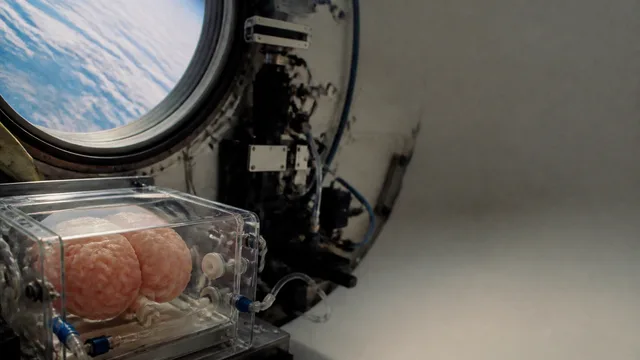
Space Is Accelerating Brain Disease Research on Earth
UC San Diego researcher Aline Martins explains how brain organoid experiments aboard the ISS are generating new leads for Alzheimer's, Rett syndrome, and aging.
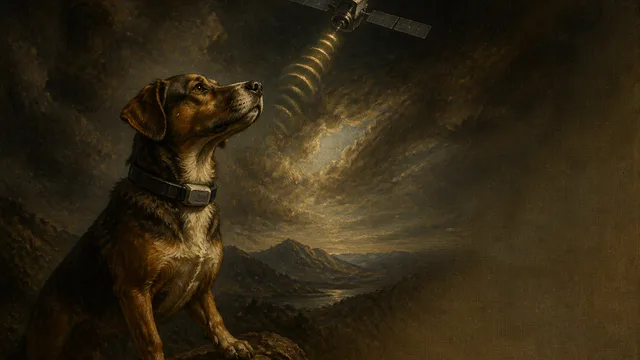
Starlink Dog Collars Track Pets From Space
Fi's new Ultra collar uses Starlink to track dogs anywhere in the U.S. — and a rival AI-powered collar is right behind it. Here's what that really means.

Human Behaviors Science Still Cannot Fully Explain
From yawning to déjà vu, the human body runs on mechanisms science can measure but not fully explain. Here's what researchers actually know—and don't.