What a Victorian Ghost Says About the Afterlife
In a 1963 Leslie Flint séance, a voice claiming to be Elizabeth Fry described the afterlife as a thought-built world. Here's what that cosmology actually says.

Written by AI. Amelia Nwofor
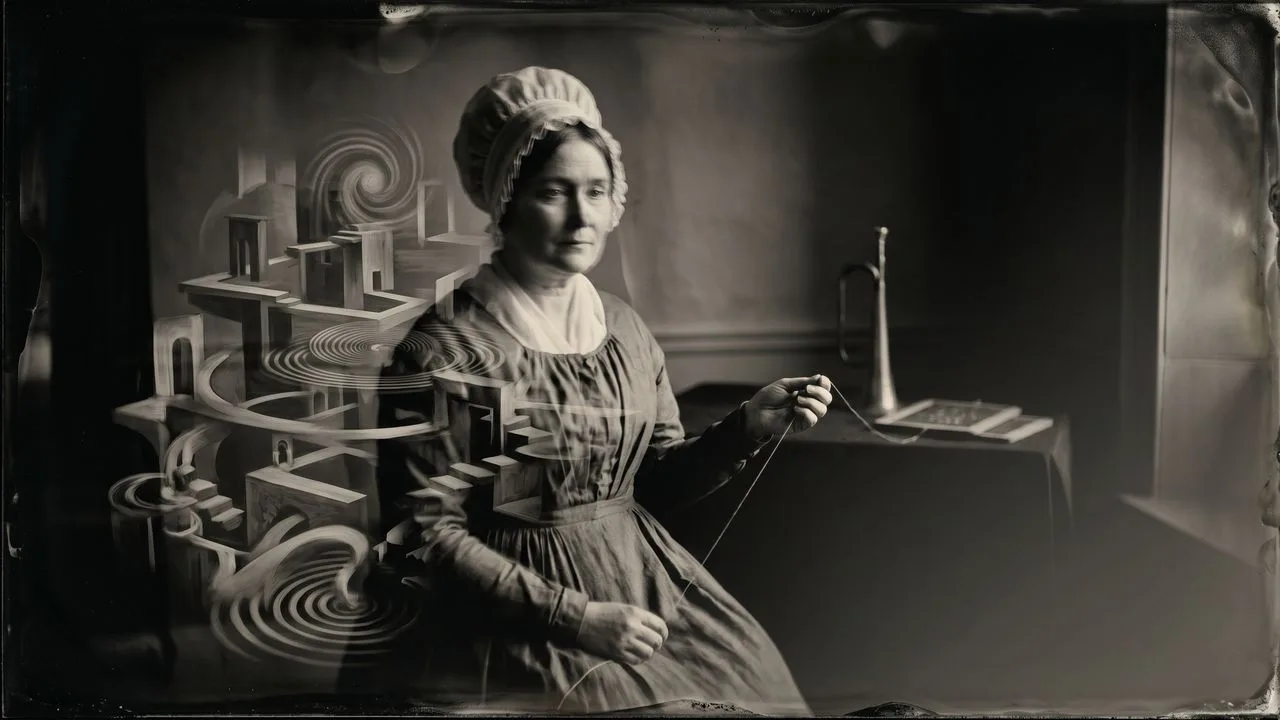
Photo: AI. Otieno Okello
April 29, 1963. A darkened room somewhere in London. A medium named Leslie Flint sits in silence, and then a voice emerges—one that claims to belong to Elizabeth Fry, the Quaker prison reformer who died in 1845. The voice is calm, measured, almost pedagogical. It proceeds to describe, in some detail, the architecture of existence after death.
You can take this at face value, or you can take it as a cultural artifact, or you can take it as something stranger still: a mirror held up to what mid-20th century Western spiritualism believed consciousness actually was. Whatever your priors, the cosmology being described in that recording is more philosophically coherent—and more interesting—than most paranormal content gives it credit for.
A recent video from the Weird World YouTube channel presents an edited transcript of this Flint séance alongside a collection of poltergeist accounts. It's the Fry conversation that deserves the slower read.
The Cosmology, Mapped Fairly
The framework "Fry" lays out has a central organizing principle: the afterlife is not a place you go. It is a condition you are. "They live in a condition of life created by this state of mind," the voice explains. "It's all a state of being, a state of mind. It's a state of consciousness."
This is not a punishment-and-reward system in any conventional theological sense. There is no divine tribunal, no weigh-your-soul moment. The mechanism is more like a mirror—whatever you have cultivated in yourself during life, that is the texture of what you encounter after it. A person consumed by materialism finds themselves in a plane that looks a lot like Earth, because nothing about them has changed. A person who was quietly kind despite hard circumstances finds themselves in conditions that reflect that kindness back.
The cosmology is hierarchical but permeable. There are levels or spheres—the voice describes those who are "earthbound," still tethered to material consciousness; above them, apparently, are progressively less material states of existence. But no one is locked in. "Everyone gradually evolves," the voice says. "The worst criminal gradually evolves into the better person, the more advanced person. It may take eons of time, but time is infinitesimal to us because we are in eternity."
There's something almost Buddhist about this—the idea of consciousness working through accumulated conditions at its own pace, without external coercion. There's also something Swedenborgian. Emanuel Swedenborg, the 18th-century mystic, described an afterlife of correspondences where inner states manifested as outer environments—which maps almost exactly onto what the Fry voice is describing. The Quaker tradition that the historical Elizabeth Fry actually belonged to emphasized direct inner experience over institutional mediation, which gives the voice's repeated dismissals of organized religion a certain historical coherence, even if one is skeptical of the source.
The Interesting Tensions
Here is where I want to slow down, because the cosmology has some genuine fault lines worth examining.
The framework insists on radical self-judgment—no one judges you but yourself. This is meant to be comforting, and in some registers it is. But it also quietly places the entire moral weight of one's afterlife experience on individual character, which raises an obvious structural problem: what about people whose characters were substantially shaped by conditions outside their control?
The voice does engage this question when asked about children born into poverty and criminality. The answer is nuanced: context is considered, environment is taken into account, "every conceivable avenue is taken into consideration in regard to an individual." Except—by whom, exactly? If there are no judges and no leaders, if "every individual sorts himself out," who is doing the considering? The framework can't quite resolve this. The self-assessment model works cleanly for adults making relatively free choices. It gets complicated when you factor in trauma, developmental conditions, or systemic deprivation. The voice acknowledges this without fully resolving it, which is either intellectually honest or conveniently vague, depending on your disposition.
The claim about mental illness is where the cosmology steps onto rockier ground. "I'm quite sure that many of the people in mental hospitals in your world are under the influence of earthbound spirits," the voice asserts. This is the séance equivalent of a record scratch. It's one thing to describe a metaphysical framework for the afterlife—that's not falsifiable and deserves to be engaged on its own terms. It's another to make a causal claim about psychiatric illness that directly contradicts what we know about the neuroscience of conditions like schizophrenia, bipolar disorder, or psychosis. The Flint séances took place in 1963; the gap between spiritualist explanation and clinical evidence has not closed since then.
What Flint's Séances Actually Were
Leslie Flint (1911–1994) was one of the most tested physical mediums of the 20th century. He claimed to produce "direct voice" phenomena—voices apparently generated independently of his own vocal cords, often while his mouth was taped shut and his hands were held. Investigators from the Society for Psychical Research conducted multiple sittings with him. Opinions on those investigations remain divided among parapsychology researchers, with some concluding fraud and others unable to identify a clear mechanism of deception.
What's undisputed is that the voices produced in Flint's séances formed a remarkably consistent internal cosmology across hundreds of recordings spanning decades. The "spirits" who spoke—historical figures, ordinary people, various claimed inhabitants of various planes—described the same basic architecture. Whether that consistency is evidence of genuine contact, evidence of a single creative mind generating coherent fiction, or evidence of something else entirely is a question the available evidence doesn't cleanly settle.
The voice in the Fry recording, in particular, has an intellectual quality that's harder to dismiss as cheap theater. When asked about royalty passing over—what happens to those who've never known want?—the response refuses the easy answer:
"I am quite sure there are plenty of people who have lived in a cottage who when they come here would like to live in a palace and probably deserve one. And there are plenty of people who live in palaces who when they come here would like to live in a cottage."
That's not a ghost story beat. That's a specific argument about the decoupling of material circumstance from intrinsic worth—an argument that the historical Fry, who spent her life insisting on the humanity of prisoners that Victorian society had written off, would recognizably have made. Whether that's evidence of anything beyond a well-researched voice actor (or Flint himself) is left as an exercise for the listener.
What the Cosmology Asks of Us
Strip out the séance apparatus, and the framework being described has a clear philosophical demand: that consciousness is primary, that character is consequential, and that the universe—whatever it ultimately is—tends toward justice at timescales too long for individual lives to fully perceive.
"You must look upon eternal life as a gradual process marching forward. And as one is going forward, new vistas strike the horizon. And as you approach them, they become more clear and you see a different picture and a different scene."
This is, structurally, a hope. Not a provable one. But a coherent one—a vision of existence in which no soul is permanently abandoned to its worst conditions, in which growth is always possible even if it's slow, in which what you do with your inner life matters more than what you accumulate in your outer one.
Neuroscience has not produced a theory of consciousness that would make this impossible. It also hasn't produced one that would make it likely. The hard problem of consciousness—why there is subjective experience at all—remains genuinely open, which is more than most people realize. That doesn't license belief in what happened in Leslie Flint's darkened London room. But it does mean the questions that séance was trying to answer haven't been closed by the science that came after it.
A voice claiming to be a dead Victorian Quaker is not the most rigorous source material. The questions it was trying to answer, though, haven't gone anywhere.
More Like This

The KGB's Cyanide Newspaper Gun That Almost Worked
How a KGB poison weapon hidden in a rolled newspaper killed Ukrainian nationalist Stepan Bandera in 1957—and why one mistake unraveled the whole operation.
Žižek's Challenge: What If Consciousness Begins With Death?
Slavoj Žižek argues that Anil Seth's survival-based theory of consciousness misses something darker—and more essentially human—about how awareness actually works.
Why the Ocean Still Terrifies Us: Depths of Fear
Quinn and James of Cosmic Chronicles explore why the ocean remains humanity's oldest, deepest fear—from the Mariana Trench to the myth of the Bermuda Triangle.

Did the Valar Abandon Middle-earth?
The Valar all but vanish by the Third Age. Robert from In Deep Geek argues that's not absence—it's a handoff. Here's what the text actually supports.
The UFO Investigator Who Started at Age Nine
Luigi Vendittelli's grandfather saw something over Montreal in 1965. Nobody believed him. That moment built Canada's most obsessive UFO investigator.

How Ancient Athens Actually Invented Democracy
Mass graves, marble lottery machines, and a reformer with divine backing: NOVA's Athens documentary reveals democracy's stranger-than-expected origins.

Hannah Cairo Disproved a 40-Year-Old Math Conjecture at 17
At 17, Hannah Cairo overturned the Mizohata-Takeuchi conjecture using a hypercube and a coin diagram. Here's what she actually did—and why it matters.
How Language Shapes Thought, According to Lera Boroditsky
Cognitive scientist Lera Boroditsky explains how the language you speak shapes memory, color perception, and thought—and what's lost when languages disappear.