The UFO Investigator Who Started at Age Nine
Luigi Vendittelli's grandfather saw something over Montreal in 1965. Nobody believed him. That moment built Canada's most obsessive UFO investigator.

Written by AI. Margaret "Maggie" Holloway
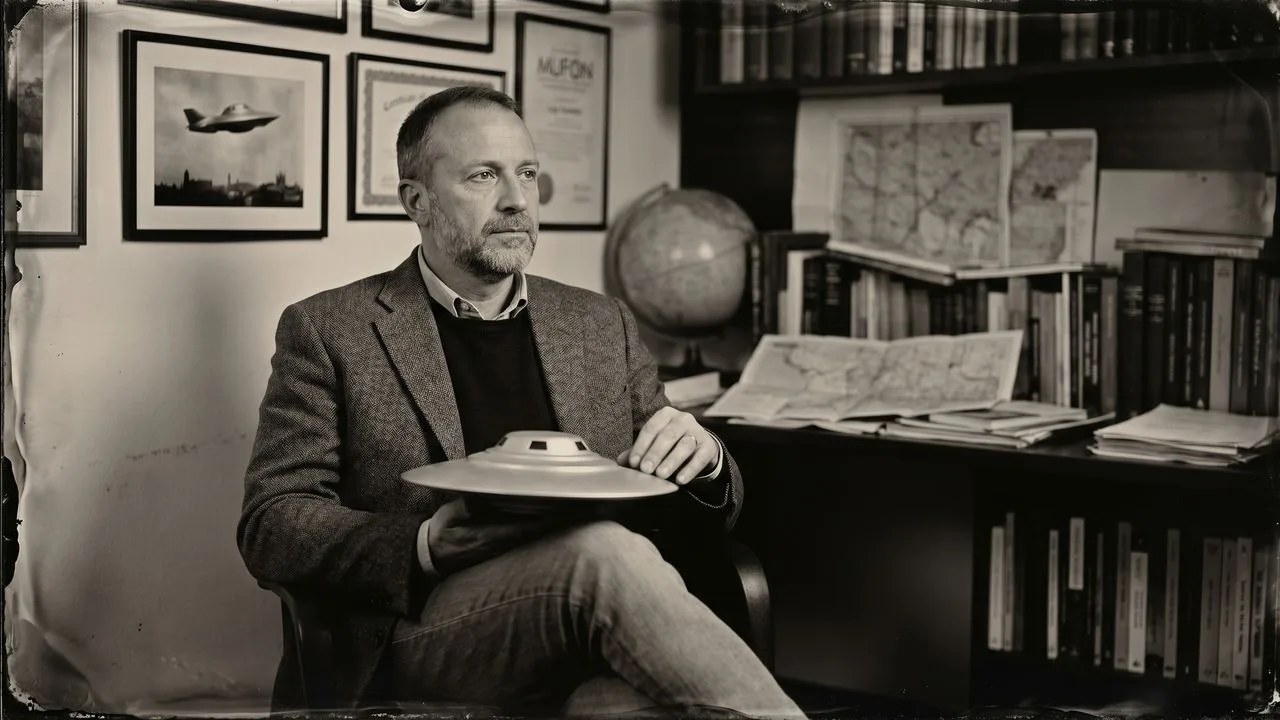
Photo: AI. Otieno Okello
In 1965, a man came running in from a balcony in Montreal, shaking. He had just watched a metallic disc — silent, perfectly circular, trailing what looked like flames — cross from one horizon to the other in what felt like seconds. His name was Vendittelli. His grandson was nine years old when he heard the story. And his grandson, Luigi, noticed something that the adults in the room apparently did not: the man was not laughing.
"He was always the one guy in the room who wasn't giggling, wasn't laughing," Luigi Vendittelli told The Why Files in a recent interview. "And I always used to look at him and go, 'Why is everybody laughing?' It didn't make sense to me."
That detail — the sadness on an old man's face while the room laughed at him — is where this story actually begins. Not at the Nevada Test Site. Not with Bob Lazar. Not with a five-year 3D reconstruction of a secret underground hangar. It begins with a boy watching his grandfather get dismissed, and deciding, quietly, that the dismissal was the problem.
The Witness Nobody Believed
To understand why Luigi Vendittelli eventually became Canada's most meticulous UFO investigator — MUFON's national director, the filmmaker behind S4: The Bob Lazar Story, now streaming on Amazon Prime — you have to first understand his grandfather, because Vendittelli clearly never stopped thinking about him.
The grandfather had survived two years as a prisoner in a Nazi concentration camp in Hanover. He was an Italian soldier captured at a train station when Germany turned on its former ally — a chapter of the Second World War that often gets swallowed by larger narratives, but was devastating nonetheless. "My grandmother would talk about the horrors of the Holocaust," Vendittelli recalled, "but she would always say, 'We were also victims.'" The grandfather was a man who had stood the entire train ride from Italy to Germany because prisoners were not permitted to sit. A man who remembered the American planes with the black stars on their wings and understood they meant liberation. A man, in other words, who knew what he knew.
"He was an Italian military and he knew about aircraft," Vendittelli said. "He's not a guy who used to lie to me or lie to anybody."
That's the scaffolding underneath everything that follows. When Vendittelli describes his decades of investigation, his obsessive research, the cold call to Bob Lazar that somehow got answered — none of it makes complete sense without this: a serious man, with serious credibility in his grandson's eyes, saw something he could not explain and was never taken seriously for it. Vendittelli spent the next several decades trying to build the kind of evidentiary architecture that might, retroactively, make people stop laughing.
The Geek in the Age Before Geeks Were Cool
What Vendittelli did next is, depending on your disposition, either touching or a diagnostic case study in how a single formative experience can organize a life.
He was nine when the trajectory was set. He was twelve when he found a MUFON pamphlet in a Plattsburgh, New York bookstore during one of the cross-border shopping trips his mother and grandmother made to take advantage of American stores — better selection, better prices, things Montreal couldn't match in the early 1980s. He was in the back seat with his sister, Michael Jackson on his Walkman, which is a very specific kind of memory: the kind that gets encoded because something important happened around it.
He filled out the MUFON application. Under "specialty," he wrote astronomy, because he had been spending his allowance on astronomy books since age nine — not because he was interested in astronomy exactly, but because he thought astronomy books would eventually tell him something about flying saucers. They largely did not, except for a few pages at the back about "the potentiality of life in the universe," which is the kind of thing that would have been unsatisfying to a twelve-year-old with a specific question. He sent in the application anyway.
The response came from Walt Andrus, MUFON's executive director, and it contained news that apparently frightened the applicant: Luigi Vendittelli was officially the youngest member in MUFON's history.
"I got scared," Vendittelli told the interviewer. "I remember going, 'Oh, maybe — now what do I have to do? Am I too young? Like, do I have responsibilities now?' I was like, 'Maybe I should call them and tell them I'm not an astronomer.'"
This is funny, and Vendittelli clearly finds it funny in retrospect. But there's something else in it: a twelve-year-old who wanted, badly, to be taken seriously in a field that society had organized itself to not take seriously. The youngest member in the organization's history, already worrying about whether he was credentialed enough.
The Stigma Has Its Own History
The 1980s were not kind to people who took UFOs seriously, and Vendittelli is specific about this. Not because the phenomenon itself changed — sightings were being reported throughout the decade — but because the cultural apparatus around it had calcified into mockery. His school principal called him "the guy who believes in aliens" from the stage at his 1989 prom, diploma in hand, while the room laughed. He graduated the same year Bob Lazar went public with his claims about working on recovered craft at a facility called S4, adjacent to Area 51.
The coincidence is worth sitting with. In 1989, one of the most consequential and contested whistleblower claims in the history of UFO research entered public consciousness. And in Montreal, a teenager was walking across a prom stage to general ridicule for caring about the same subject. The stigma and the substance were running in parallel, which is maybe how stigma always works: it doesn't need the underlying question to be settled in order to function. It just needs the question to feel embarrassing.
"It kind of killed my interest to go too far," Vendittelli admitted, "because I was getting to the age where I wanted to start dating girls and go out and have friends. I don't want to be a geek all the time."
He retreated into what he describes as investigating "in hiding." It didn't stick as a retreat — obviously, given that he eventually spent five years reconstructing the S4 facility in forensic 3D detail, tracked down a 1941 government map that reportedly shows hangar door locations, cold-called Bob Lazar and got an answer, and made a documentary that a BAFTA-winning composer from Scotland joined for free because he believed in it. But the hiding phase is real and worth noting, because it's not unique to Vendittelli. The social cost of taking this subject seriously has historically been paid by the people taking it seriously, not by the institutions declining to.
What the Documentary Actually Claims
The full scope of Vendittelli's work on S4: The Bob Lazar Story goes considerably beyond what the available transcript covers. The film involves a 3D reconstruction of the S4 facility built in collaboration with Lazar himself, a 1941 map that Vendittelli claims corroborates specific architectural details of the alleged hangar, and what the film presents as anomalous details about light behavior inside the craft — details the interview suggests Lazar described that he "couldn't have known unless he was actually there." The film also covers the Ariel School landing case, testimony from witnesses including Emily Trim, and — according to the episode description — a section on why Vendittelli believes congressional disclosure efforts may themselves be a kind of trap.
These are claims that exist in the contested territory this subject has always occupied, where physical evidence is sparse, institutional verification is absent, and the evidentiary weight rests heavily on witness credibility and documentary research. Vendittelli's approach is methodological rather than credulous — he spent years building the reconstruction from primary sources and cross-referencing claims — but methodology and proof are not the same thing, and the film will be evaluated differently by different viewers depending on what they already believe walking in.
What is not contested: a BAFTA-winning composer named James Gray, who reached out from Scotland and offered to score the film for free, was moved enough by the subject matter to do it. The resulting score draws on Verdi and has an ominous 1980s atmospheric quality that the interviewer describes as Vangelis-adjacent. That's a real thing that happened, and it's not nothing.
There's a version of this story that ends with Vendittelli as a cautionary tale: a boy shaped by a formative experience, who organized his adult life around validating it, and may or may not have found what he was looking for. There's another version where his grandfather actually saw something in 1965, nobody believed him, and his grandson spent forty years building the case that he should have been.
The grandfather is gone now. So is Vendittelli's father, who drove him to MUFON meetings at thirteen and stood in a room full of white-haired investigators and asked, with full parental alarm, what exactly was going on here. What remains is the film, the reconstruction, the map, and a nine-year-old's question that nobody else in the room thought to ask.
Why is everybody laughing?
More Like This
Nerdrotic: From Old Folsom to YouTube Empire
Gary Buechler of Nerdrotic sat down with The Why Files to discuss his memoir, Old Folsom Prison, and why Hollywood keeps failing audiences who've actually lived something.
When the Dead Were Headed for the Stars
Ancient burial sites from Peru to Egypt share a striking obsession with the cosmos. What does that convergence actually mean—and for whom?
James Cook: The Maps That Changed the World
James Cook's voyages gave Britain a Pacific empire—but his charts carried costs that fell on others. A look at the man behind the maps.

Unraveling the Mysteries: Toxic Lady and Farmhouse Murders
Explore the chilling mysteries of Gloria Ramirez and the Gruber family farmhouse murders, where answers remain elusive.

WarGames Got the Details Wrong—But the Feeling Right
How a 1983 film used real hardware and strategic Hollywood cheating to capture what early computing actually felt like—even when faking almost everything.

Exploring Mont Orgueil: A Fortress of Secrets
Discover the hidden history and strategic significance of Mont Orgueil Castle in Jersey, unearthed by Time Team's archaeological investigation.

The Invisible Inventions That Built Modern Life
From flush toilets to undersea fiber cables, the inventions that most shaped modern civilization are the ones we've stopped noticing entirely.

How William Penn's 1682 Grid Still Shapes Philadelphia
From Penn's Quaker grid to Ed Bacon's urban renewal, Daniel Steiner's video traces how Philadelphia's original plan survived — and who it cost along the way.