Terence Tao on the Six Pillars of Mathematics
Fields Medalist Terence Tao breaks down six core mathematical ideas, explains why math keeps predicting reality, and asks what AI might cost science.

Written by AI. Priya Sharma
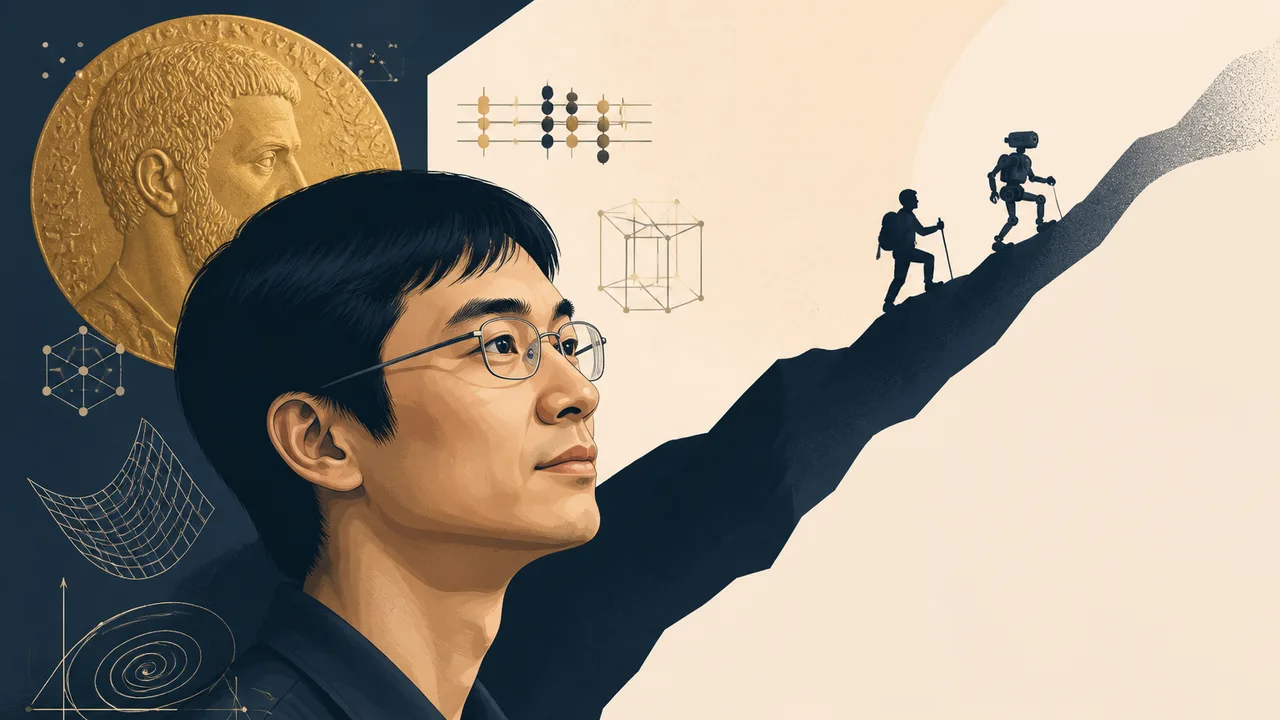
Photo: AI. Mika Sørensen
Terence Tao has never had a eureka moment. This is either deeply reassuring or mildly alarming, depending on how you feel about the man widely regarded as the greatest living mathematician. What he describes instead, in a recent Big Think interview, is something closer to a long, grinding excavation: try something, hit an obstacle, map the obstacle, find a simpler version of the problem, solve that, scale back up. Repeat for months. The answer, when it comes, doesn't feel like revelation. It feels obvious. "The feeling I get is never so much eureka but it's always, oh, how come I missed this earlier? I was so stupid."
That description of mathematical practice, unglamorous and iterative, is probably the most practically useful thing in the entire conversation. It runs directly against how mathematics is taught, which tends to reward clean final answers and penalize the exploratory wrong turns that are, in Tao's telling, the actual mechanism of discovery. This tension is worth sitting with before getting to anything else he says.
Six concepts, two thousand years of elaboration
Tao organizes his forthcoming book around six ideas: numbers, algebra, geometry, probability, analysis, and dynamics. The organizing principle is that each began as something elementary and became, through centuries of mathematicians poking at it, something almost unrecognizably sophisticated. Numbers started as notches on bones, predating the alphabet. Algebra started as a tool for solving practical equations and became a general theory of operations and structure. Geometry began as literally "measurement of the earth" and eventually handed Einstein the language he needed for general relativity.
The progression within each concept is worth tracing briefly, because Tao's account of it dismantles a common misconception: that mathematical abstraction is a kind of luxury, a retreat from practical utility into pure play. The inverse keeps happening. Complex numbers were invented to solve equations that had no real-number solutions. They turned out to be the natural language of quantum mechanics. Riemannian geometry was developed as a pure mathematical curiosity about curved spaces. Einstein needed it to write down his field equations. The sphere-packing problem, which started with a sailor wanting to stack cannonballs efficiently in a ship's hold, eventually became the mathematical foundation for error-correcting codes in digital wireless communication. Tao's own work on compressed sensing, which he describes with characteristic modesty as something he initially set out to disprove, turned a technique used ad hoc by seismologists and astronomers into a unified mathematical framework that now cuts MRI scan times and underpins sensor network design.
This pattern, which physicist Eugene Wigner famously called the unreasonable effectiveness of mathematics in the physical sciences, is the central puzzle of the conversation. Why does math developed for purely internal reasons keep turning out to be exactly what science needs, decades or centuries later? Tao offers his own hypothesis: that both mathematicians and scientists are, in the end, searching for the most concise way to describe a phenomenon, and conciseness converges. The same compact formulation that satisfies a mathematician's aesthetic criteria tends to be the one that correctly captures physical reality. It is a plausible argument. It is also, as Tao acknowledges, a hypothesis with a sample size of one: we have a single timeline of scientific development, roughly a hundred major turning points, and no comparison cases. "I would love in the future, in the far future, maybe we will meet other civilizations and we will see their history of science." Until then, he's appropriately modest about how much explanatory weight the hypothesis can carry. That willingness to name the limitation rather than paper over it is precisely what separates a good scientific argument from an appealing story.
Dynamics and the edge of predictability
The section on dynamics is where Tao's thinking gets most urgent, and most politically relevant without becoming political. Dynamics is the mathematics of change: how a system's state evolves according to simple rules, and what emergent behavior those rules produce when iterated over time. Evolution. Traffic waves. The three-body problem. Climate.
On the solar system: gravitational perturbations among planets can, over very long timescales, cause dramatic instabilities. The dynamical behavior of multi-body gravitational systems is chaotic in the technical sense, meaning small perturbations compound over time in ways that make long-range prediction impossible. (Tao characterizes the asteroid belt as a remnant of a planetary collision. The dominant scientific consensus actually places the asteroid belt's origin in material that never coalesced into a planet, largely because of Jupiter's gravitational influence. The dynamical point stands regardless: the solar system is not as stable as it looks on human timescales.)
On climate: Tao's framing is precise and careful. Human civilization developed under conditions that were, dynamically, close to a stable equilibrium. The climate absorbed perturbations and returned toward baseline. The concern now is not merely that we're making things warmer but that we may be pushing the system out of that equilibrium basin and into a region where the dynamics are less well-characterized and potentially less forgiving. "We are now actually in danger of leaving that equilibrium and into a much less stable dynamics, which is scary, but it needs to be modeled." This is not advocacy; it is a dynamical systems observation. Whether one finds it alarming depends on what one believes about the underlying physics, and Tao doesn't push further than the mathematics warrants.
The AI question, stated carefully
The third chapter of the conversation is where Tao is visibly thinking through something he hasn't fully resolved, which makes it more interesting than a confident forecast would be.
His account of how large language models work is accurate and usefully deflationary: they are extraordinarily sophisticated next-word predictors, trained on enough data that the patterns in language become sufficient to generate coherent, often correct mathematical reasoning. "It's like having someone who knows a lot but is slightly drunk and is sort of throwing out ideas, but with enough guidance, you can actually extract useful output." The charm of this description is that it refuses both the hype and the dismissal. The models are genuinely useful. They are also genuinely not doing what we think of as understanding.
Where Tao gets most interesting is on the question of what speed costs. Science, in his account, is not just about reaching conclusions. It is about the path: the wrong turns that reveal unexpected territory, the connections made between fields because a researcher got lost in the literature, the human capacity to articulate why a result is surprising and what it connects to. AI tools are, in his analogy, helicopters. They get you to the waterfall. They do not teach you the terrain.
He makes a specific and testable observation: point AI at a thousand mathematical problems, and it will solve around five percent of them. That is fifty solutions, likely more than any individual mathematician could produce in the same period. But those fifty solutions may not be the fifty anyone most wanted, and the AI cannot tell you which ones matter or why, or how they fit into the broader map of what is understood and what is not.
The Kepler example is his sharpest illustration of the speed problem. Before Kepler found that planetary orbits were ellipses rather than circles, the heliocentric model of the solar system was actually less accurate than the geocentric model, which had centuries of fine-tuning behind it. A system optimizing for predictive accuracy on existing data would have discarded heliocentrism. It took Kepler's years of failed attempts, his stubborn attachment to a beautiful but wrong theory about Platonic solids inscribed between planetary spheres, and his eventual confrontation with Tycho Brahe's observational data, to arrive at a model that was both correct and more accurate. An AI with an early data set and an optimization target would have gotten the wrong answer, confidently.
The question Tao is circling without quite landing on it is whether we can distinguish, in advance, between AI speed that reveals the right answer faster and AI speed that efficiently converges on the wrong one. Science has historically corrected itself through the friction of the process: the peer reviewer who asks an inconvenient question, the graduate student who notices the anomaly, the researcher from a different field who sees a familiar structure in an unfamiliar context. If AI removes that friction, what removes the errors?
He does not have a confident answer. Neither does anyone else, and the field will be better served by sitting with that uncertainty than by resolving it prematurely in either direction.
More Like This
Einstein's Happiest Thought, Explained From First Principles
Adam Brown unpacks general relativity's core insight—gravity as curved spacetime—and what black holes reveal about energy, time, and the limits of physics.
The Mountain Climbing Theorem Explained
Two climbers, one rule: stay at the same height. A deceptively simple constraint leads to a proof that hinges on graph theory and one critical word: finite.
Exploring Math's Role in Understanding the Universe
Delve into the need for new math to solve universe's mysteries with insights from Terence Tao on StarTalk.

Adam Becker on Why Silicon Valley's Big Bets Will Fail
Astrophysicist Adam Becker argues that the singularity, Mars colonies, and AI doom share one flaw: they all assume exponential growth never ends. It always does.
Jeff Dean at YC: Napkin Math, Bad Transistors, and the 1% Rule
Google's Chief Scientist Jeff Dean at YC Startup School 2026 on inference hardware, agent specs, the 1% startup rule, and why taste is the last scarce skill.
Terry Tao, AI, and the Fluid Dynamics Enigma
Exploring how Tao and AI tackle fluid dynamics, a puzzle crucial for tech and climate.
Triton's Strange Orbit and the Ice Giants' Secrets
Triton's retrograde orbit, nitrogen geysers, and the chaotic magnetic fields of Uranus and Neptune reveal how little we understand our own solar system.

Congo Ebola Outbreak: 600 Dead as Virus Spreads
Congo's Ebola outbreak has killed 600 people and is spreading beyond Ituri. What happens when a virus meets a system that was already broken.