Exploring Math's Role in Understanding the Universe
Delve into the need for new math to solve universe's mysteries with insights from Terence Tao on StarTalk.

Written by AI. Amelia Nwofor
Is our current mathematical framework sufficient to unravel the complexities of the universe, or do we need a new kind of math? This question, explored in a recent StarTalk episode with Neil deGrasse Tyson, comedian Paul Mecurio, and renowned mathematician Terence Tao, opens a window into the dynamic interplay between pure and applied mathematics, and their roles in scientific discovery.
It's tempting to view mathematics as a static set of principles, neatly explaining the world. However, as Tao and Tyson discuss, mathematics is both a tool and a frontier. "The math we have has become extremely good at explaining most of the universe," notes Tyson, yet he acknowledges the boundaries where our current tools falter, such as quantum spacetime.
Pure vs. Applied Mathematics
Tao, a professor at UCLA and director of special projects at the Institute for Pure and Applied Mathematics, differentiates between pure and applied mathematics. Pure mathematics is driven by curiosity, exploring patterns and abstract concepts without immediate practical applications. In contrast, applied mathematics bridges the gap between theoretical concepts and real-world problems, providing solutions that scientists and engineers can use.
The conversation highlights how these two branches are not isolated. Applied mathematics often draws from pure mathematics to develop models and solve practical problems. For instance, group theory, a field of pure mathematics, unexpectedly paved the way for innovations in MRI technology, making scans faster and more efficient.
Simplification in Mathematical Models
One of the most intriguing aspects discussed is the simplification used in mathematical models, often referred to as "toy models" or the infamous "spherical cow" model. These simplifications are crucial for managing complex systems by focusing on core elements and gradually adding complexity.
As Tao explains, "The real world is messy, and if you try to incorporate every single aspect of it, it's just too much to model." This approach allows mathematicians to isolate key variables and understand their impacts, a method that is both a strength and a limitation.
Unsolved Problems and Interdisciplinary Collaboration
The video delves into famous unsolved problems like the Collatz Conjecture, illustrating the "malice" of mathematical proofs that remain elusive despite appearing deceptively simple. These puzzles highlight the need for interdisciplinary collaboration, as modern challenges often require insights from multiple scientific fields.
Tao and Tyson also discuss how mathematics can inform our understanding of phenomena like dark matter and dark energy. Are new mathematical tools needed to progress in these areas? While there is no definitive answer, the dialogue suggests a future where collaboration across disciplines might spark the next scientific breakthrough.
The Broader Implications
Beyond the specific mathematical discussions, the episode underscores a broader theme: the power of bringing diverse perspectives together. Institutes like IPAM serve as melting pots where mathematicians, scientists, and industry experts converge, fostering innovation through shared knowledge.
As we stand on the brink of unraveling cosmic mysteries, the question remains: Will mathematics as we know it suffice, or are we on the cusp of discovering new mathematical frameworks that could redefine our understanding of the universe? This exploration of math's evolving role in science invites us to remain curious and open to the possibilities that lie ahead.
More Like This
Mold on the ISS: A Clue to Life's Cosmic Journey?
Examining mold's resilience in space and its implications for panspermia, the theory that life on Earth may have cosmic origins.
CERN's Particle Asymmetry: Cracking the Universe's Mysteries
Exploring CERN's recent findings on matter-antimatter asymmetry and their implications for understanding the universe.
Decoding Logic: Marriage Puzzles and Irrational Numbers
Explore the intersection of logic puzzles and mathematics, revealing insights into irrational numbers and everyday reasoning.
AI's Impact on Education: Terence Tao's Vision
Terence Tao discusses AI's role in reshaping education, emphasizing critical thinking over rote memorization.
Does Reality Require Us? Exploring Quantum Mysteries
Unpack the role of observers in reality, exploring quantum mechanics, entropy, and the nature of existence.

Mathematics: The Unsung Hero of Healthcare Innovation
Explore how math, AI, and interdisciplinary collaboration are revolutionizing healthcare solutions.
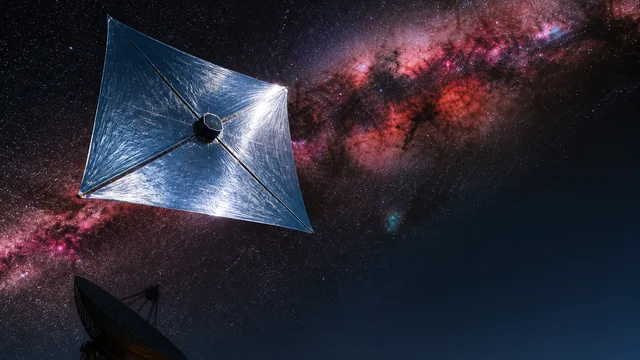
FCC Approves First Space Mirror Satellite Launch
The FCC cleared Reflect Orbital's Eärendil-1 space mirror for launch. Here's what the approval means for astronomy, connectivity, and orbital governance.
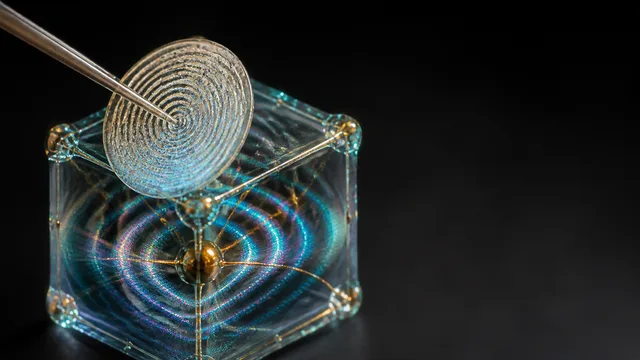
Hannah Cairo Disproved a 40-Year-Old Math Conjecture at 17
At 17, Hannah Cairo overturned the Mizohata-Takeuchi conjecture using a hypercube and a coin diagram. Here's what she actually did—and why it matters.