Triton's Strange Orbit and the Ice Giants' Secrets
Triton's retrograde orbit, nitrogen geysers, and the chaotic magnetic fields of Uranus and Neptune reveal how little we understand our own solar system.

Written by AI. Priya Sharma
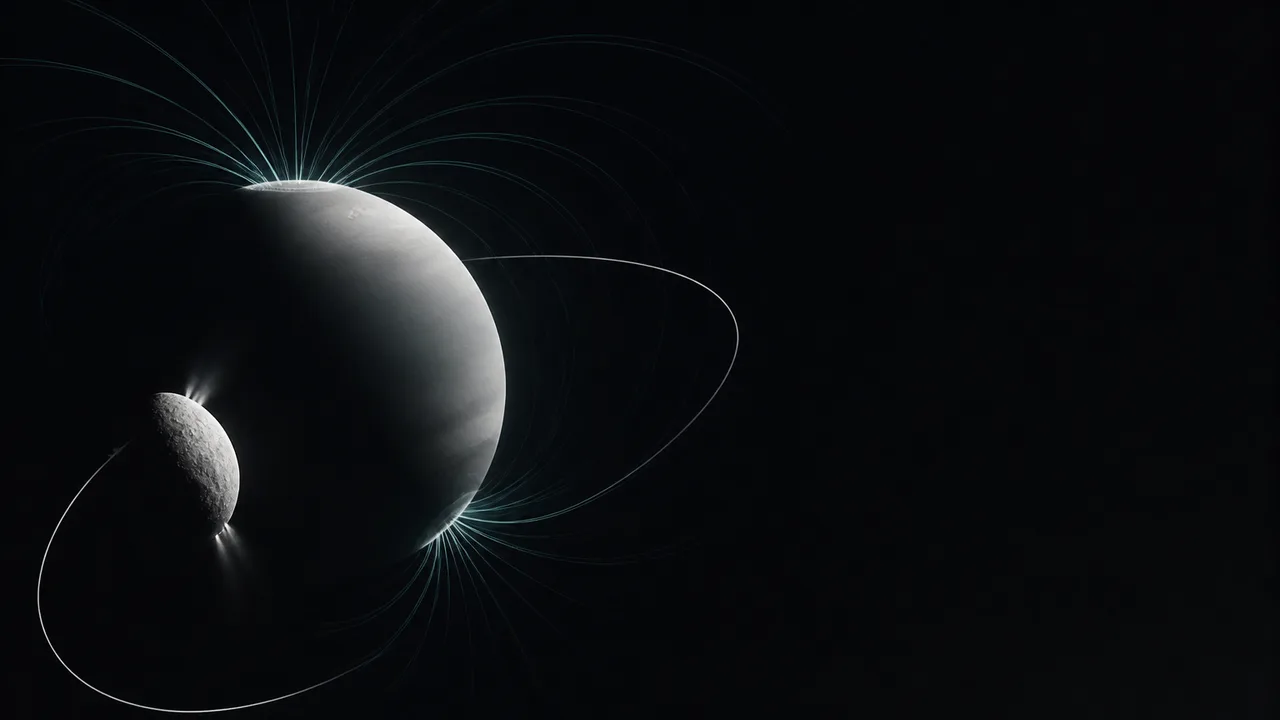
Photo: AI. Tomoko Hayashi
Neptune's moon Triton is orbiting the wrong way. Not slightly off-axis, not a minor tilt — it travels in the opposite direction to Neptune's own rotation, which is the kind of detail that makes planetary scientists reach for a whiteboard. Moons don't form that way. Moons that form with their planets orbit in the same direction, because they condense from the same rotating disk of material. A retrograde orbit is a signature of something captured — something that arrived from elsewhere and got stuck. The question that has occupied researchers for decades is not whether Triton was captured, but how. Capture is genuinely hard to explain. A free-flying object passing Neptune would need to slow down dramatically to fall into orbit rather than slingshot past. So what put the brakes on?
The Binary Hypothesis: Attractive, With Caveats
The leading answer involves a partner Triton no longer has. The hypothesis, explored in a recent Science Channel documentary on the ice giants, draws on Pluto and its moon Charon as a working analogy. Charon is large enough relative to Pluto that the two don't behave like a planet and a moon in the conventional sense — they orbit their shared center of gravity, a point that actually lies outside Pluto's surface. The documentary describes this as a "dumbbell" configuration, which is a reasonable visualization: two masses rotating around a common pivot, moving through the solar system as a single system.
The binary capture hypothesis applies this geometry to Triton's past. If Triton once had a similarly sized companion — a Charon of its own — then the pair would have been executing this same coupled rotation as they drifted through the Kuiper Belt. When Neptune's gravity began pulling them inward, the binary dance created a moment of vulnerability: one partner momentarily moving against the direction of travel, slowing the system enough that Neptune could gravitationally claim Triton while ejecting the companion into deep space. As the documentary frames it, that companion was "a sacrificial lamb that got kicked out into the depths of space in order for Triton itself to be captured into Neptune's orbit."
The model is genuinely attractive. It resolves the energy problem — how a fast-moving Kuiper Belt object loses enough velocity to be captured — without requiring an implausible collision or an ad hoc rescue mechanism. What it cannot do is be tested directly. Triton's missing companion, if it ever existed, is gone. It could be anywhere in the outer solar system, unrecognized, or it could have been ejected entirely. There is no binary partner to find and confirm. In most sciences, a hypothesis without a falsifiable prediction is a hypothesis in trouble. In planetary science, where the evidence was created four billion years ago and scattered across billions of kilometers, "unverifiable" carries a different weight — it doesn't mean wrong, but it does mean we're reasoning backward from a single outcome. The model fits the facts we have. That's not the same as explaining them.
Geysers at 30 AU: The Energy Budget Problem
Set aside the orbital mystery for a moment and consider what Voyager 2 found on Triton's surface in 1989: geysers. Active, erupting geysers, shooting nitrogen gas five kilometers into the atmosphere, with vapor trails extending hundreds of miles downwind.
"When Voyager flew past Triton, it saw the unexpected," one expert in the documentary notes. "There were jets of gas shooting out from the moon's surface. No one expected that. It's out at the far reaches of the solar system. We expected to find a cold, dead moon. What the heck is going on?"
The "what the heck" is warranted. Triton orbits roughly 30 astronomical units from the sun — thirty times the Earth-Sun distance. According to the Educator's Guide to The Inverse Square Law (astro.if.ufrgs.br), solar irradiance at that distance is approximately 900 times dimmer than what Earth receives. Running geysers on that energy budget is the planetary equivalent of boiling water with a candle.
The mechanism, as understood from a 2019 Gemini South telescope study confirmed by the Gemini Observatory (gemini.edu/news/press-releases/gemini1903), involves an unusual property of Triton's surface ice. That ice is a mixture of frozen nitrogen and carbon monoxide, and it is transparent — sunlight passes through it rather than being reflected. Beneath the ice sits a darker layer of dust and particulate material, which absorbs what little solar radiation reaches it and heats up by a few degrees. That is enough to sublimate the ice above, converting it directly from solid to gas without passing through a liquid phase. Gas pressure builds under the ice cap until something gives, and the result is a geyser.
The process has a name — solid-state greenhouse effect — and the reason it matters extends well beyond Triton. If geysers can operate on 1/900th of Earth's solar input, using only sunlight filtering through transparent ice and a few degrees of trapped heat, then the energy requirements for geological and potentially chemical activity in the outer solar system are dramatically lower than intuition suggests. Europa, which is geologically active through tidal flexing from Jupiter, gets more energy than Triton does. Enceladus, Saturn's geyser-bearing moon, sits closer to the sun and has its own tidal heating engine. The outer moons of Uranus — Miranda, Ariel — have surfaces that suggest past activity we don't fully understand. Triton pushes the boundary of where "active" is even possible on sunlight alone, and the fact that it sits right at that boundary is what makes it scientifically interesting rather than merely strange. The astrobiology implication isn't subtle: if the chemistry required for life doesn't need liquid oceans heated by a nearby star — if it just needs a solid-state pressure cooker and trace solar energy — then the habitable zone of the solar system is much larger than we drew it.
Magnetic Fields That Defy Simple Models
Triton's weirdness is arguably a sideshow to the central mystery of the ice giants themselves. Voyager 2's magnetometer data, collected during its Neptune flyby, revealed that both Uranus and Neptune have magnetic fields unlike anything in the terrestrial planets. Earth's field is a reasonable approximation of a dipole — a bar magnet aligned close to the rotation axis, with recognizable north and south poles. The ice giants' fields are neither simple nor well-aligned.
"The magnetic field lines twist and turn like a bag of writhing snakes," one expert explains in the documentary. "And the south pole of the planet is actually along the equator."
Uranus's magnetic poles are offset from its rotational axis by roughly 60 degrees. Neptune's field is similarly irregular. The leading explanation involves the internal structure of ice giants — specifically, the possibility that the magnetic field is generated not in a metallic core as in gas giants, but in a shell of highly pressurized, electrically conductive "superionic" water or ammonia at intermediate depths. A dynamo running in a shell rather than a core would naturally produce a messier, more multipolar field. It's a plausible model. It is also almost entirely inferred from remote measurements taken during a single flyby in the 1980s.
That's the problem. Voyager 2's data remains the only in-situ dataset we have for either ice giant. NASA's Decadal Survey for Planetary Science, published in 2023, ranked an Uranus orbiter and probe as the highest-priority flagship mission for the coming decade. "Flagship" means large, expensive, and slow — design, funding, and construction timelines typically span fifteen or more years. If a mission launches in the mid-2030s, planetary alignment means a journey of roughly a decade before it arrives. That puts first data in the 2040s at the earliest, and that timeline is contingent on sustained funding that has not yet been secured.
What's actually at stake if the orbiter doesn't fly is not just an incomplete picture of Uranus. It's the difference between inferring internal structure from magnetic field topology — essentially doing medicine from an X-ray taken forty years ago — and understanding directly how ice giants form, evolve, and maintain their strange internal dynamics. Ice giants are the most common planetary type observed in exoplanet surveys. We have two of them in our own solar system and almost no ground-truth data. The magnetic fields, the superionic interiors, the formation history implied by Triton's capture — none of it closes into a coherent model without better measurements. We're not filling in details. We're still doing the outline.
Triton's retrograde orbit is, in that sense, a fitting emblem for everything we don't know about the outer solar system: a moon traveling the wrong way around a planet we have barely visited, powered by geysers that shouldn't work, orbiting a world whose interior we can only guess at. The strangeness isn't decoration. It's information, waiting for the instruments that can read it.
More Like This
Pluto's Planet Status Debate, Explained
A 10-year-old's letter to NASA reignited Pluto's planet debate. Here's what the science actually says—and why the answer is messier than you'd expect.
Crafting Supercars: The Science Behind Speed and Style
Explore how supercars like Alfa Romeo 4C and Aston Martin Vanquish are meticulously crafted using cutting-edge materials and precision engineering.
Black Holes, Colliding Galaxies, and the Chaotic Universe
Astrophysicist Mordecai-Mark Mac Low joins StarTalk to unpack galaxy collisions, planets orbiting black holes, dark matter, and why the universe is messier than we thought.
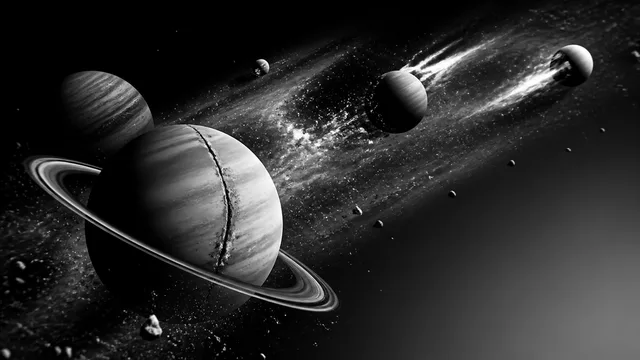
The Solar System May Have Started With Six Giant Planets
A new study suggests the early solar system had six giant planets, not four. Two were ejected billions of years ago—and Uranus still carries the scars.
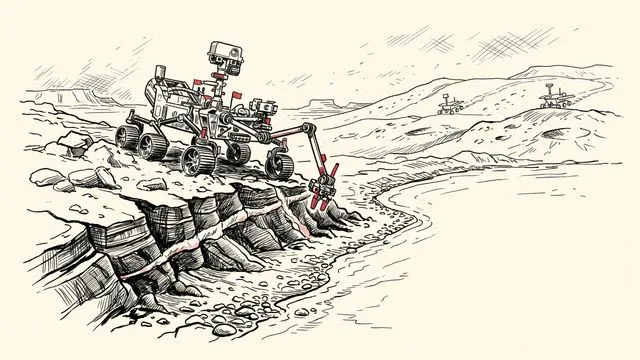
Mars Lost Its Water. Rovers Are Piecing Together How.
Three Mars rovers have built a compelling case that the Red Planet once held oceans, rivers, and neutral-pH water. Here's what the evidence actually shows.
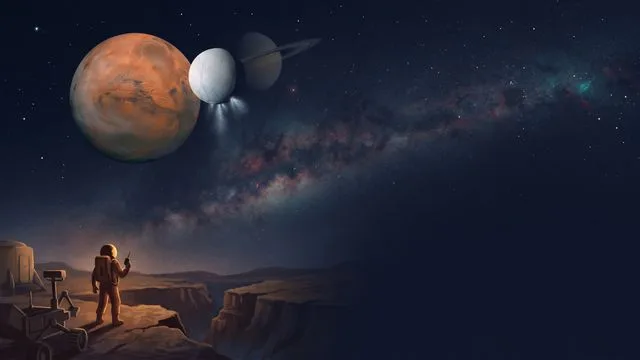
Mars, Enceladus, and the Search for Life
From Mars's vanishing water to Enceladus's hidden ocean, planetary science is reshaping our understanding of where life might exist.

Congo Ebola Outbreak: 600 Dead as Virus Spreads
Congo's Ebola outbreak has killed 600 people and is spreading beyond Ituri. What happens when a virus meets a system that was already broken.

How the Brain Decides What Is Real and What Is Not
UCL neuroscientist Nadine Dijkstra explains how the brain constructs reality, why imagination isn't hallucination, and what breaks when the system fails.