Engineering an LED Supernova: A Nuclear Approach
A nuclear engineer evaluates a DIY LED project, highlighting heat management, design intricacies, and nuclear parallels.

Written by AI. Priya Sharma
In the world of high-powered LEDs, where brightness meets engineering, heat management emerges as the critical challenge. A recent video by Tyler Fulce, a nuclear engineer, reacting to DIY Perks' LED Supernova project, underscores this pivotal issue. The project involves constructing a highly luminous LED capable of emitting over 120,000 lumens while consuming 1.5 kW of power—akin to the output of a space heater.
"When most things talk about generating that much power, the vast majority of it is going to be heat," Fulce explains. This statement mirrors the familiar refrain in nuclear engineering, where thermal management is paramount. In both fields, the failure to efficiently manage heat can lead to catastrophic outcomes.
Thermal Management: The Core Challenge
The project tackles heat dissipation using a custom-built water cooling loop. Water, known for its high specific heat, serves as an effective coolant, a choice that Fulce notes is "why it's used in reactors." However, the challenge lies not just in cooling but in maintaining portability and efficiency.
Fulce appreciates the approach of using multiple smaller power supplies to distribute thermal and electrical stress. "It's a very nuclear mindset," he observes, drawing parallels to the redundancy and distributed load management found in nuclear systems. This strategy reduces the risk of single-point failures, enhancing the reliability and longevity of the system.
Overbuilding for Reliability
The project's commitment to overbuilding components is reminiscent of practices in nuclear engineering. Fulce remarks, "It actually saves components or it has the potential to," emphasizing that reducing thermal stress can prolong the life of components. This principle, while seemingly extravagant, aligns with safety protocols in nuclear plants, where redundancy is a cornerstone.
The Aesthetic and Functional Marriage
Beyond functionality, the project also pursues aesthetic innovation. The use of brass for custom brackets not only provides durability but also adds a visual appeal. Fulce notes the "retrofuturistic vibe," likening it to a bygone era of nuclear optimism.
To ensure the LED's safety, an Arduino-based monitoring system is implemented, which tracks water flow, thermal conditions, and pump rotation. This safeguard system echoes the multi-channel monitoring used in nuclear plants to prevent critical failures. Fulce points out, "Any critical pump is going to have flow monitoring, temperature monitoring, as well as a pump rotation feedback system."
Open Questions and Future Directions
While the project demonstrates impressive engineering, questions remain. How scalable is this design for broader applications? Could these principles inspire innovations in other fields requiring precise thermal management? The project, while ambitious, serves as a testament to the intersection of DIY creativity and nuclear-grade engineering.
In examining this LED supernova, one sees more than just a powerful light source. It represents a microcosm of engineering challenges and solutions, drawing from the rigor of nuclear engineering to illuminate possibilities in seemingly unrelated domains. The project stands as a beacon of what can be achieved when meticulous design meets creative ambition.
More Like This
When Celebrities Actually Do Real Science
From Hedy Lamarr's frequency-hopping patent to Brian May's astronomy thesis, these celebrity scientists made contributions that still hold up under scrutiny.
Magnetic Mayhem: 400 Car Batteries Unleashed
Explore the electrifying effects of extreme currents as a nuclear engineer reacts to a wild experiment with 400 car batteries.
Exploring Cosmic Voids: The Universe's Empty Giants
Cosmic voids, vast regions of emptiness, hold secrets about the universe's structure and fate, revealing the interplay of dark matter and energy.

The Phase of Matter That Shouldn't Exist
A nuclear engineer explains supercritical fluids—the state of matter where the line between liquid and gas just disappears.
Exploring the Promise of Small Modular Nuclear Reactors
Small modular reactors and TRISO fuel could revitalize US nuclear energy. Examining safety, policy, and historical context.
Can Space Data Centers Beat the Heat?
Exploring the challenges of cooling data centers in space, balancing physics with environmental impact.
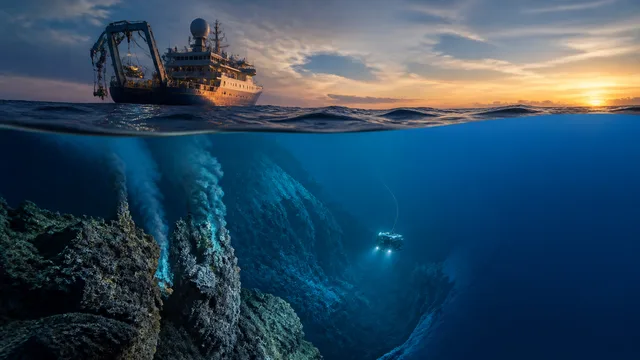
Marine Geology: What Lives on the Ocean Floor
From hydrothermal vents to the Challenger Deep, marine geology shapes ecosystems, climate, and our best guesses about where life can exist.

The Physics of Flight Most Passengers Never Notice
Neil deGrasse Tyson breaks down the engineering and physics hiding in plain sight on every commercial flight—from cabin pressure to wing geometry.