The Phase of Matter That Shouldn't Exist
A nuclear engineer explains supercritical fluids—the state of matter where the line between liquid and gas just disappears.

Written by AI. Nadia Marchetti

There's a moment in Steve Mould's video where you can watch something that shouldn't be possible: the boundary between liquid and gas doesn't just blur—it vanishes. Tyler F., a nuclear engineer with over a decade in commercial nuclear power, watches it happen in real-time and his reaction tells you everything. This isn't a trick of editing or clever lighting. It's a phase of matter most people have never heard of, behaving exactly as physics predicts it should.
Supercritical fluids exist beyond what's called the critical point—a specific combination of temperature and pressure where the distinction between liquid and gas breaks down completely. Not metaphorically. Not approximately. It actually stops existing.
The Apparatus
Mould's demonstration uses a transparent pressure vessel with 40mm-thick glass walls, rated for 80 times atmospheric pressure. Tyler notes this is "medium pressure" in nuclear contexts—pressurized water reactors operate around 150 atmospheres, supercritical water reactors closer to 250. The thick glass is necessary because glass is brittle compared to steel. You don't want catastrophic failure at these pressures.
Inside the vessel: dry ice. Solid carbon dioxide. At normal atmospheric pressure, CO2 doesn't have a liquid phase—it sublimates directly from solid to gas. That's why it's called dry ice. But seal that vessel and let the pressure build, and something changes. "Once pressure rises high enough, you enter the liquid stability region," Tyler explains, "because after all, phase depends upon both temperature and pressure."
The CO2 melts. You get liquid at the bottom, gas at the top, and a visible boundary—the meniscus—between them. Two-phase equilibrium. Both states coexist because at that specific temperature and pressure, they have the same Gibbs free energy.
What Happens When You Heat It
Mould's apparatus includes copper pipes wrapped around the vessel, connected to tanks of hot and cold water. Press a button, and you can heat the entire chamber evenly. Constant volume heating increases both temperature and pressure, pushing the system up what's called the saturation line—the boundary between liquid and gas phases on a phase diagram.
And then the saturation line just... stops.
"At that point, there's no phase transition," Tyler notes. "Instead, the fluid changes continuously between liquidlike and gas-like states."
What does that look like? The meniscus goes cloudy. Then it fades. The boundary doesn't cross over from one state to another—it dissolves. You're left with something that's neither liquid nor gas. It's supercritical fluid.
The Boat Experiment
Mould floats a tiny boat on the liquid CO2 before heating begins. The boat is denser than liquid CO2, but it floats because boats displace liquid. Basic Archimedes. The question: what happens to that boat when the liquid and gas become indistinguishable?
As the chamber heats up, the boat sinks lower in the liquid. Not because the liquid level is dropping—though it is, as some evaporates—but because the gas above it is getting denser. Buoyant force depends on density difference. As gas density approaches liquid density, buoyancy disappears.
The boat sinks before reaching the critical point. But watch what happens as it falls: a cloud of gas puffs out from inside the boat, mixing with the surrounding fluid in a way that looks nothing like steam bubbles through water. The densities are too similar. Tyler's reaction: "You can really see how close they are in density."
Even after the meniscus vanishes and the system is officially supercritical, the camera reveals something strange. Moving up and down, you can see a region that bends light differently from the top and bottom. "Those tiny density fluctuations grow large as you approach the critical point," Tyler explains. "You're going to get a lot of variance in the refractive index which gives you a milky looking light there."
Why Two Phases Exist At All
The really interesting question isn't what supercritical fluid is—it's why liquids and gases exist as separate phases in the first place. Mould frames this in terms of energy landscapes, and Tyler calls it "a great explanation" for a concept he struggled with in thermodynamics classes.
Molecules arrange themselves to minimize energy. They're attracted to each other, which creates an energy valley when they're close together. But get too close and the Pauli exclusion principle creates a repulsion force—a steep wall on the other side of the valley. That's one energy minimum: the liquid phase.
But there's another force at work: entropy. "The second law of thermodynamics, that one gets you every time," Tyler notes. Entropy favors molecules spreading out, filling the container. That creates a second energy valley: the gas phase.
Combine these two landscapes—intermolecular attraction and entropy—and you get two separate minima. Two places where molecules naturally settle. "Each phase occupies the density corresponding to each minimum," Tyler explains.
Now heat the system. Increase the temperature. The influence of entropy increases and the two valleys push together. At the critical point, they merge. Suddenly there's no distinction between liquid and gas. It's all just fluid.
The Nuclear Context
Tyler's perspective throughout is shaped by nuclear engineering, where these principles aren't academic curiosities—they're operational realities. He notes that "phase boundaries are where the operational annoyances occur. Boiling, condensation, cavitation—things that make heat transfer less stable. So operating above the critical point eliminates these issues."
Then adds: "I mean you get other issues but it's all about engineering trade-offs."
That casual caveat is revealing. Supercritical fluids solve certain problems and create others. At nuclear power plants, ensuring proper bolt torque on pressure boundaries isn't just good practice—it's a logged, independently verified parameter, especially on radioactive pressure boundaries. When you're dealing with both pressure hazards and radiological hazards, precision matters.
The coffee bean reference—decaffeination using supercritical CO2—remains unexplained in the video. Tyler's honest: "I still don't get the coffee beans thing, but I'm not a coffee drinker, so I don't know." The supercritical fluid can extract caffeine while leaving other compounds intact, but the mechanism for why viewers would put coffee beans in this particular demonstration chamber isn't clear.
The Weird Part
What strikes me about this whole demonstration is how matter can transition between states without ever crossing a boundary. Mould points out that you can move smoothly from a liquidlike state to a gaslike state by going around the critical point on a phase diagram. No distinct moment of transition. No phase change. Just continuous variation.
It violates our intuition about how categories work. Something is either liquid or gas, right? Except when it isn't. When conditions are right—or wrong, depending on your perspective—the universe just shrugs and says the distinction doesn't apply anymore.
Tyler's running commentary throughout reveals someone who has internalized these principles through engineering practice, not just textbook study. When Mould explains molecular behavior, Tyler anticipates where the explanation is headed. When something looks counterintuitive, he knows exactly which underlying principle explains it. This is what fluency looks like.
The video ends mid-sentence in the transcript, but the point has already landed: phase diagrams describe reality, and reality includes states of matter that don't fit our everyday categories. Supercritical fluids aren't theoretical. They're demonstrable, reproducible, and increasingly useful in industrial applications. They're also deeply strange, in the way that things are strange when you look closely at how the universe actually works.
More Like This
Engineering an LED Supernova: A Nuclear Approach
A nuclear engineer evaluates a DIY LED project, highlighting heat management, design intricacies, and nuclear parallels.
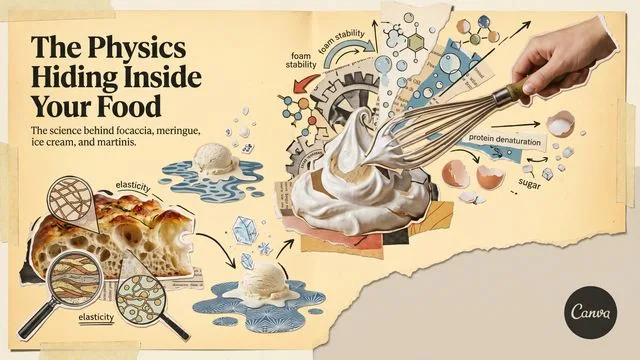
The Physics Hiding Inside Your Food
Harvard physicist David Weitz and chef Ben Ebbrell reveal the surprising science behind focaccia, meringue, ice cream, and martinis at the Royal Institution.
Magnetic Mayhem: 400 Car Batteries Unleashed
Explore the electrifying effects of extreme currents as a nuclear engineer reacts to a wild experiment with 400 car batteries.
The Thorium Reactor Hype vs. Reality Check
Copenhagen Atomics promises shipping-container reactors cheaper than gas. A nuclear engineer explains what they're not telling you about the challenges ahead.

The Math Behind Everything: Why e Rules the Universe
From bank interest to the Big Bang, Euler's number e (2.718...) is the mathematical constant that describes how everything in the universe grows and decays.
Maxwell's Demon and the Physics of Information
Physicist John Goold explains how a 19th-century thought experiment about entropy became central to quantum mechanics, computation, and the nature of information.
Do DMT Entities Point to Alien Consciousness?
Cognitive scientist Donald Hoffman claims DMT entities may be real alien minds. The math is real. Whether it proves anything about consciousness is a different question.
Viking Landers and the Unsolved Mars Life Debate
Fifty years after Viking landed on Mars, one experiment's positive result remains unexplained. Here's what the science actually shows—and what we've learned since.