The Solar System May Have Started With Six Giant Planets
A new study suggests the early solar system had six giant planets, not four. Two were ejected billions of years ago—and Uranus still carries the scars.

Written by AI. Priya Sharma
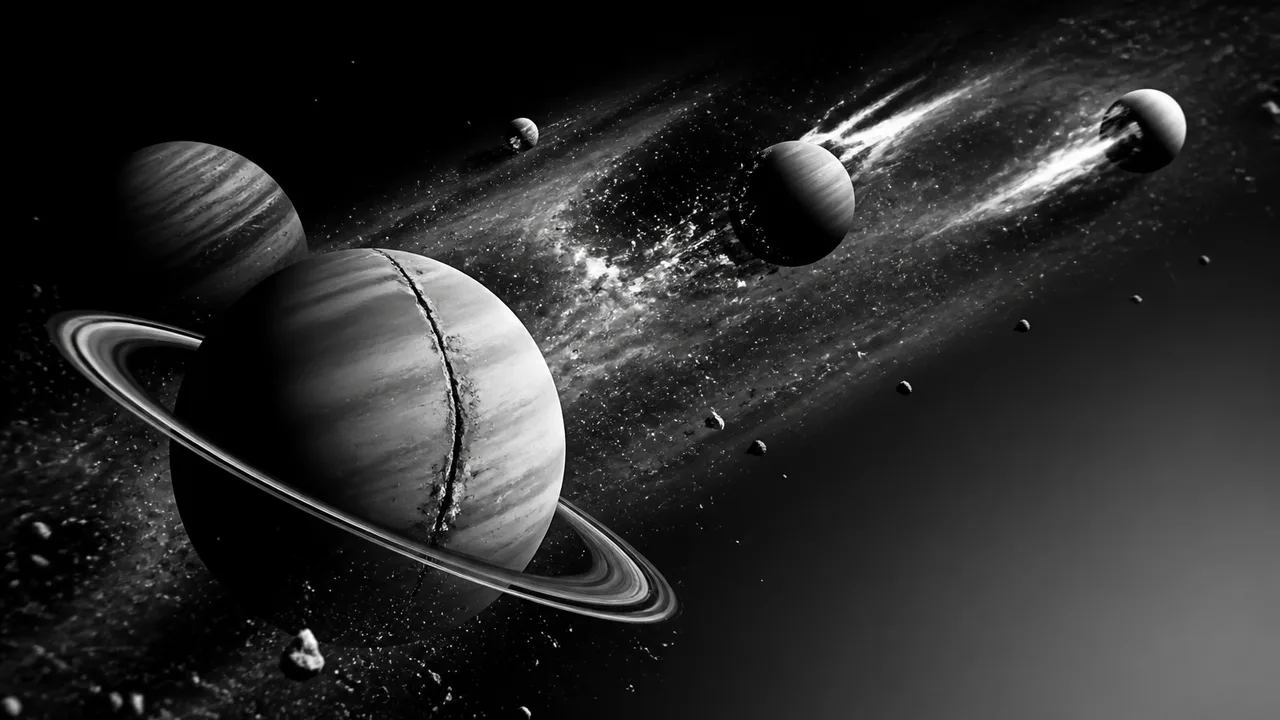
Photo: AI. Atticus Ferenczi
The school diagram has always been a lie of omission. Eight planets, neatly spaced, orbiting peacefully — a picture of a settled household. A new paper published in Icarus suggests the early solar system looked nothing like that. According to the study, our neighborhood once contained six giant planets, not four. Two of them were eventually flung out of the solar system entirely. The four that remained are the ones we know. The two that didn't make it are, in all likelihood, somewhere in interstellar space right now, cold and dark, wandering between stars with no sun to orbit.
That's not a headline designed to provoke. It's the most honest summary of what the researchers found.
Why the Standard Model of Solar System Formation Keeps Breaking
To understand why anyone would propose two missing planets, you have to understand a persistent problem in planetary science: when researchers run computer simulations of solar system formation — starting with the initial distribution of gas and dust and letting physics play out — they consistently cannot reproduce what we actually observe unless they add extra giant planets to the mix.
The methodology is worth pausing on. Scientists seed a simulation with realistic starting conditions, let the model evolve, and then check whether the output resembles our current solar system. They run this many times. The cases that look like our solar system are the ones they study. And the consistent finding is that the model needs at least one, more plausibly two, additional large planets in the outer solar system to produce results that match reality. Without them, the architecture comes out wrong.
As physicist Sabine Hossenfelder explains in her recent video covering the paper, "to match our observations, they need at least one, but better two large extra planets. Otherwise, the solar system does not come out correctly."
This isn't new territory. Planetary scientists have been wrestling with the instability of the early outer solar system for years, most notably through frameworks like the Nice model and its successors, which proposed that the giant planets formed closer together and subsequently migrated outward through gravitational interactions with a disc of smaller icy bodies. The new paper adds a specific, evidence-backed claim to that general picture: the instability wasn't just migration. It was ejection. Two ice giants started wandering, collided with or deflected off other bodies, and ultimately escaped the sun's gravitational grip.
Uranus as Exhibit A
The strongest single piece of evidence that something genuinely catastrophic happened in the early outer solar system isn't an abstract simulation result — it's Uranus itself.
Most planets rotate more or less upright relative to their orbital plane. Uranus rotates on its side, with its axis tilted roughly 98 degrees. Its poles point roughly toward the sun at certain points in its orbit. This is not a subtle anomaly. It requires an explanation. The most widely accepted one is that something very large hit Uranus at some point in its history, knocking it over.
The new paper treats this as more than an isolated event. According to Hossenfelder's account of the research, the authors propose that the impactor was one of the two lost ice giants — a body that had been destabilized by the gravitational chaos of having six giant planets packed relatively close together. When orbits become unstable in a multi-body gravitational system, the mathematical chaos can escalate quickly, sending planets onto crossing paths. One of those crossings ended badly for Uranus's orientation.
But the researchers didn't stop at the tilt. They also examined Uranus's moons, which orbit around that tilted axis — they were scrambled along with the planet. One moon in particular, Miranda, contains more ice than would be expected given standard formation models. The proposed explanation is that the collision shook the existing moons out of stable orbits; they collided with each other, broke apart, and the resulting debris field coalesced into a new generation of smaller moons with elevated ice content. The moons, in other words, are a forensic record of an ancient impact. As Hossenfelder puts it, "the authors now say this all fits together" — the tilt, the orbital geometry of the moons, and Miranda's composition all pointing toward the same violent event.
That's a coherent narrative. The question worth sitting with is how much weight coherence should carry.
The Honest Difficulty of Reconstructing the Distant Past
Hossenfelder rates the paper a three out of ten on her "hype meter" — not as a criticism of the research itself, but as an acknowledgment of the epistemological situation. "We're trying to patch together what happened in the distant past from what we see today," she says. "So all the evidence we can ever have is indirect."
That framing deserves to be taken seriously, not treated as a pro forma disclaimer. The events in question happened billions of years ago. We cannot observe them directly, replay them, or run a controlled experiment. What we can do is construct models that are consistent with current observations and check whether those models require the existence of objects we no longer see. The answer to that check, the paper argues, is yes.
There are genuine tensions here that the paper's internal coherence doesn't resolve. Computer simulations of solar system formation involve enormous parameter spaces and substantial uncertainty in initial conditions. A simulation that "needs" extra planets to produce the right output is only as persuasive as the simulation itself — if the model is missing some relevant physics, the extra planets might be filling a gap in the model rather than pointing to a gap in history. This is not a reason to dismiss the finding. It's a reason to hold it as a strong hypothesis rather than a settled conclusion, which appears to be precisely how the authors frame it.
The connection to Uranus is the more tangible evidence thread. The tilt is real. The moons are real. Miranda's ice content is real. Any theory of solar system formation has to account for all three. The new paper argues that six ice giants with a chaotic early phase accounts for them in a unified way. Competing explanations — a single large impactor that hit Uranus for unrelated reasons, separate mechanisms for the moon disruption — are not ruled out, but they require more separate assumptions.
What Happens to Ejected Planets
If two ice giants were flung out of the solar system billions of years ago, where are they now?
The honest answer is that we don't know and probably can't know. Objects of that mass, untethered from any star, would produce no reflected light — they'd be detectable only by direct infrared emission from residual internal heat, which would have dissipated significantly over billions of years, or by their gravitational influence on other objects they pass near, which is vanishingly unlikely to be documented. The interstellar medium is vast. Two rogue planets in it would be essentially invisible with current technology.
There is a broader context worth noting. Astronomers have increasingly found evidence that rogue planets — objects of planetary mass wandering without a parent star — are not uncommon in the galaxy. Several candidates have been detected through gravitational microlensing. The question of whether some of those objects are former members of planetary systems, ejected during chaotic formation phases, is an open one. The new paper adds two specific candidates to whatever the actual population is.
The solar system we inherited is apparently not the solar system that formed. It's the survivor configuration — the arrangement left standing after a period of gravitational chaos sorted the original six into four residents and two exiles. That reframing doesn't change the physics of anything orbiting the sun today, but it does change the story we tell about where we are. The neat diagram was always a snapshot. This paper is an argument about what the album looked like before someone tore out two of the pages.
More Like This
Pluto's Planet Status Debate, Explained
A 10-year-old's letter to NASA reignited Pluto's planet debate. Here's what the science actually says—and why the answer is messier than you'd expect.
Black Holes, Colliding Galaxies, and the Chaotic Universe
Astrophysicist Mordecai-Mark Mac Low joins StarTalk to unpack galaxy collisions, planets orbiting black holes, dark matter, and why the universe is messier than we thought.
Can Quantum Physics Really Send Messages to the Past?
An MIT group published a paper in Physical Review Letters claiming messages can be sent to the past. The math works. The interpretation is where things get complicated.
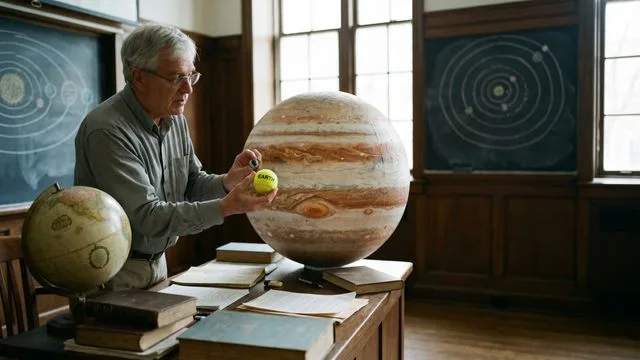
Video Shows Solar System's Vast Scale Through Walkable Model
The solar system is mostly empty space—and the numbers make that viscerally clear. Here's what happens when you shrink Earth to a tennis ball.
When Black Holes Collide: Energy, Mass, and Mystery
What really happens when two supermassive black holes merge? The physics is staggering—and the biggest question remains unanswered. Here's what we know.
Is Our Evolutionary Past Becoming Our Downfall?
Exploring how rapid modern changes might be misaligning with our evolutionary adaptations.
How the Brain Decides What Is Real and What Is Not
UCL neuroscientist Nadine Dijkstra explains how the brain constructs reality, why imagination isn't hallucination, and what breaks when the system fails.
Texas Chupacabra Sighting Explained by DNA Analysis
A Texas police dash cam captured a bizarre creature in 2008. DNA testing later revealed what it actually was — and the answer is stranger than fiction.