Can Quantum Physics Really Send Messages to the Past?
An MIT group published a paper in Physical Review Letters claiming messages can be sent to the past. The math works. The interpretation is where things get complicated.

Written by AI. Priya Sharma
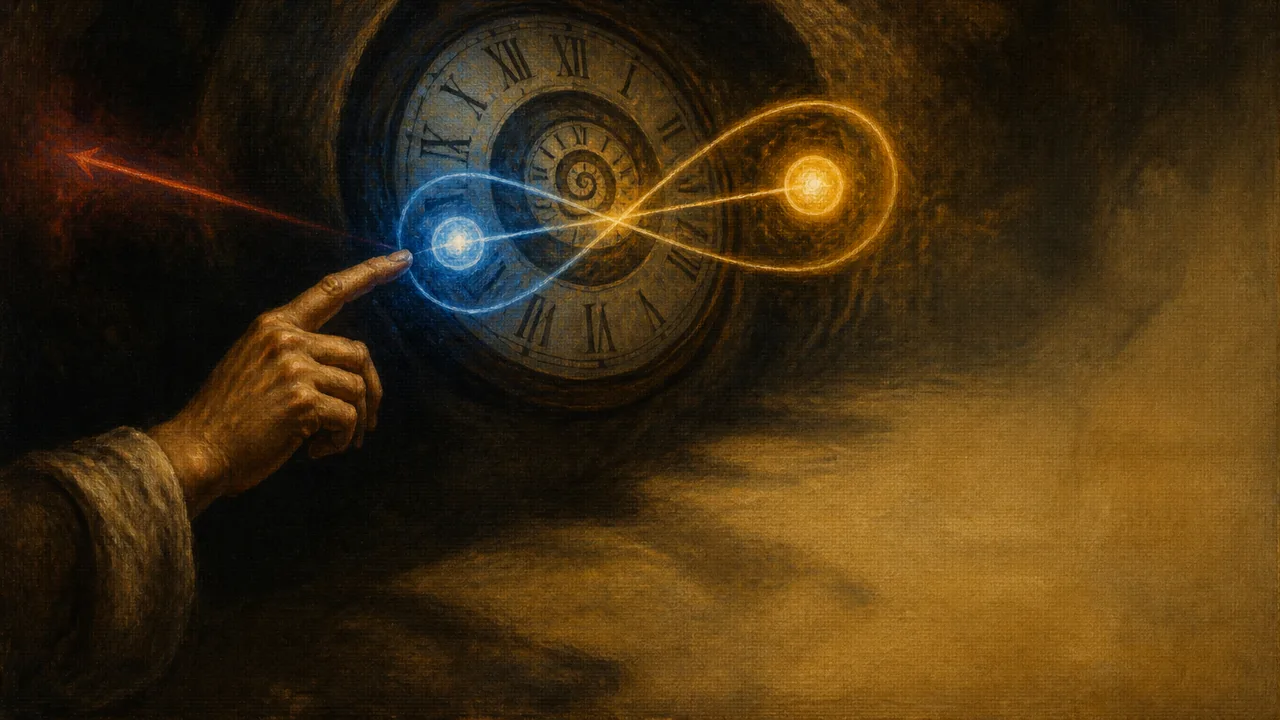
Photo: AI. Henrik Solberg
The headlines last week had a certain breathless quality to them. "We figured out a new way to send messages into the past." "Physicists say it's possible to send messages backward in time." These are the kinds of claims that, in my experience, either mean someone has done something genuinely paradigm-shifting or someone's press office has done something genuinely irresponsible. The answer here is neither, exactly—which makes the actual story more interesting than either version the headlines offered.
The paper in question is real, and it's published in Physical Review Letters, which is about as serious a venue as theoretical physics has. It comes from a group at MIT and builds on earlier work examining what happens when you try to marry quantum mechanics to Einstein's framework for spacetime. That marriage, to put it charitably, has always been strained.
The problem with causality at the quantum scale
Here's the crux of why this research exists at all. In classical physics, causality is a bedrock assumption: A causes B, B causes C, time moves forward, everyone goes home. Quantum mechanics complicates this picture in a specific and uncomfortable way. Once you accept that quantum particles exist in superpositions—doing multiple things simultaneously—and you layer on Einstein's insight that there's no absolute, universal sense of simultaneity, you arrive at an unsettling conclusion: the order in which quantum events occur can itself be uncertain.
Causality, in the quantum regime, is not a given. It's a variable.
This isn't fringe physics. Physicists have been grappling with quantum causal order for years, and experiments have probed it directly. What the MIT group has done is take that uncertainty and ask: what does it enable, informationally? Their answer, at least in theory, is that you could construct a device that receives messages from the future—or, equivalently, that a sender could inject information into the receiver's past by measuring a quantum state after the receiver was built.
The new paper extends this by showing the scheme remains viable even in the presence of noise. That detail is genuinely interesting. As physicist Sabine Hossenfelder notes in her video analysis of the paper, "if you want to send messages into the past, the noise is less of a problem than if you want to send it into the future." That's a counterintuitive and non-trivial result—the kind of thing that earns a PRL acceptance regardless of what you think about the interpretation.
The authors, incidentally, cited a 1985 paper co-authored by one "E. Brown" and "M. McFly." Physicists contain multitudes.
What post-selection actually means
The mechanism the paper relies on is called post-selection, and this is where careful reading becomes essential.
In quantum mechanics, you cannot predict the outcome of a measurement before you make it. The theory gives you probabilities, not certainties. Post-selection is a technique where, after measurement, you restrict your attention to only a specific subset of outcomes—you filter reality, in effect. The MIT scheme assumes that the universe realizes only one of the possible quantum outcomes, and that the message received in the past corresponds to whichever outcome actually occurs.
On paper, the mathematics is coherent. The question Hossenfelder raises—and it's the right question—is whether the scheme describes communication or prediction. She frames it this way: imagine your device flickers with noise, then displays "Buy Nvidia." You buy it. A year later you're wealthy. "But did you get a message from the future or is your machine just good at predicting the stock market? There's no way to tell these two things apart."
This is not a rhetorical deflection. It's an epistemological problem with teeth. The two scenarios—genuine backward-in-time communication and an extraordinarily accurate prediction engine—produce identical observable outcomes. The theory itself cannot adjudicate between them.
Hossenfelder is direct about how she weighs this: "The maths works out but their interpretation is highly questionable." She gives the paper an 8 out of 10 on what she calls the "hype meter." That's a precise and useful verdict: technically serious, interpretively overreaching.
The X-post analogy, and why it matters
To illustrate the gap between what the math allows and what the headlines claimed, Hossenfelder offers an analogy that lands hard. Imagine posting 100,000 predictions of the next major Los Angeles earthquake, covering every possible date through the year 2100. When the earthquake happens, you delete all the wrong predictions, publicize the correct one, and claim it came from a time traveler. "Works on X," she observes. "Doesn't work in reality."
What makes this analogy cutting is that it isn't just a jab at social media credulity. It captures the structural problem with the post-selection scheme as a practical matter. In the actual world, you cannot force a quantum measurement to return a specific outcome. Post-selection, as a mathematical operation, is applied retrospectively to data that already exists—you don't get to pre-select the universe. The scheme requires assuming that we live in a universe where one specific outcome obtains, and then working backward. That assumption is doing enormous load-bearing work, and the paper's framing arguably obscures that.
None of this makes the underlying physics uninteresting. It makes it a different kind of interesting than the headlines suggested.
What physicists are actually rethinking
The deeper conversation happening in this research is about the nature of time itself—specifically, whether the simple cause-then-effect model we use in everyday reasoning is a fundamental feature of reality or an approximation that breaks down at the quantum scale.
There is a growing body of theoretical work suggesting that temporal order is not primitive—that it emerges from something more fundamental, the way temperature emerges from the collective motion of molecules. Quantum causal order experiments, indefinite causal structures, and frameworks like the process matrix formalism are all probing this. The MIT paper fits within this broader project, which is genuinely ongoing and genuinely important.
The study also highlights that noise behaves asymmetrically depending on the direction of communication—past versus future—which suggests the theoretical framework has internal structure worth understanding. That's a contribution, even if the "messages to the past" framing is optimistic to the point of distortion.
Hossenfelder puts the real significance plainly: "The story is that physicists are slowly rethinking temporal relations, which I think are much more complicated than the simple cause-effect idea that we're used to."
That's the sentence that should have been in the headlines. Physicists are finding that our intuitions about time—about what "before" and "after" even mean at the quantum level—may need fundamental revision. The revision may not give us a telephone to yesterday. But it may give us something stranger and more durable: a better account of what time actually is.
Whether a theoretical device that cannot be distinguished from a perfect prediction machine counts as "sending messages to the past" is, at this point, a question about language and interpretation as much as physics. Reasonable physicists can disagree—and they do. What isn't reasonable is collapsing that disagreement into a headline that implies someone has solved the problem.
The math is compelling. The experiment is theoretical. The gap between those two facts is exactly the space where science journalism should live.
More Like This
Exploring the Enigma of Negative Time in Quantum Physics
Dive into the perplexing world of negative time in quantum physics with insights from Prof. Aephraim Steinberg.
Gödel's Time Machine: A Universe That Defies Causality
Kurt Gödel's solution to Einstein's equations reveals time loops, challenging our understanding of spacetime and causality.
Physicists Just Caught Virtual Particles Becoming Real
New experiment at Brookhaven Lab allegedly proves virtual particles exist—challenging how we understand empty space and quantum reality itself.
Is Time Fundamental? New Physics Says Maybe Not
Physicists are questioning whether time is real or emergent. A climate journalist finds the stakes unexpectedly familiar—and the implications surprisingly close to home.
The Blacksmith's Son Who Rewired the World
Faraday discovered the laws of electromagnetism with no formal training. Maxwell had to translate his truth into math before anyone believed it. Sound familiar?
Einstein Got a Gift in 1949 That Broke Physics' Rules
Kurt Gödel presented Einstein with a mathematical solution allowing time travel. Decades later, physicists still haven't found reasons to exclude it.
CERN's LHC and the Search for Hidden Dimensions
Inside CERN's Large Hadron Collider: how 600 million proton collisions per second could reveal dark matter, extra dimensions, and the Higgs boson.
Triton's Strange Orbit and the Ice Giants' Secrets
Triton's retrograde orbit, nitrogen geysers, and the chaotic magnetic fields of Uranus and Neptune reveal how little we understand our own solar system.