Is Time Fundamental? New Physics Says Maybe Not
Physicists are questioning whether time is real or emergent. A climate journalist finds the stakes unexpectedly familiar—and the implications surprisingly close to home.

Written by AI. Olivia Meng
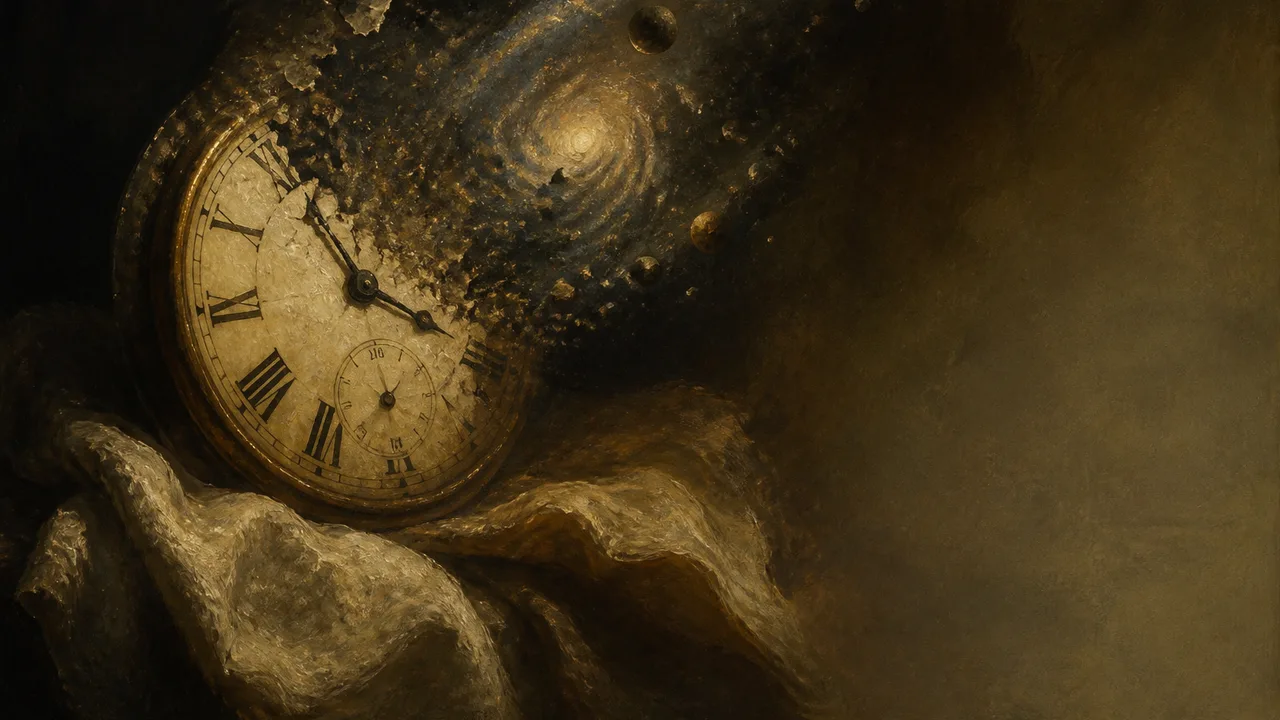
Photo: AI. Henrik Solberg
The thermodynamic arrow of time is the backbone of climate science. Every projection, every attribution study, every carbon budget calculation depends on the assumption that entropy increases in one direction — that cause precedes effect, that the atmosphere in 2100 follows from the atmosphere in 2025 in a sequence that cannot be reversed. So when physicists publish serious theoretical work suggesting that time itself may not be a fundamental feature of reality — that the directionality we experience might be a statistical artifact of deeper, atemporal structure — I find that professionally interesting in a way I did not expect.
That's where I landed after watching NASA Space News's recent video "Time Doesn't Exist? New Physics Says Reality Is Stranger Than We Thought," published this week. The channel is covering a genuine and long-standing problem in theoretical physics: the two frameworks that underpin all of modern science — quantum mechanics and general relativity — define time in irreconcilably different ways, and every attempt to unify them has produced something strange.
In quantum mechanics, time is a background parameter. It doesn't bend, stretch, or interact with matter. It's scaffolding — mathematical labeling for change. In general relativity, time is physical, woven into space-time itself, shaped by mass and energy. These definitions don't just differ. They contradict. And when physicists in the 1960s tried to write a quantum equation for the universe as a whole, time dropped out of the math entirely.
That's worth pausing on. DeWitt's 1967 paper in Physical Review — the foundational document of what became the Wheeler-DeWitt equation, with Wheeler's related contributions developing over several years — produced an equation meant to describe the full quantum state of the universe. Time does not appear in it. The video is clear that this was not a theoretical preference or a philosophical choice: it was a mathematical result. When you treat the universe as a closed quantum system, the time variable vanishes. The implication, as the video puts it, is that "time may not be something the universe contains. It may be something that arises from how physical systems behave and interact."
That's the core claim, and it's worth holding carefully. This is not a fringe position — it's a live debate in theoretical physics with a serious mathematical pedigree. But it is also not a settled conclusion. The theories are competing, not converging. Some frameworks treat time as emergent from quantum correlations. Others treat it as relational — existing only through interactions between systems. Loop quantum gravity, working from spin network formalisms, treats space-time geometry itself as quantized and emergent, though the precise mechanism is considerably more technical than any short-form summary can carry. Holographic theories describe space-time as a projection from lower-dimensional information structures. These are not the same theory. They share a family resemblance — time as output rather than input — but they disagree substantially on mechanism.
The analogy the video offers is useful: temperature. Temperature feels real, and for everyday purposes it is real. But at the particle level, it doesn't exist. It emerges from collective motion. No single particle has a temperature. The suggestion is that time may be similar — real in the way that heat is real, without being fundamental in the way that quantum fields are fundamental.
What anchors the directionality of that emergent time is entropy. Most fundamental equations in physics — with notable exceptions, including weak-force interactions that exhibit CP asymmetry — are time-symmetric. They work identically forward and backward. Nothing in the equations themselves distinguishes past from future. What produces the arrow of time, at least in thermodynamic terms, is the statistical tendency of entropy to increase. Order moves toward disorder. That's not built into the laws; it's a consequence of initial conditions and probability. The video's framing is precise: "Entropy increases statistically, producing an apparent arrow of time. But entropy does not define time itself. It describes probability distributions in physical systems. It explains direction, not existence."
This is exactly where my beat becomes relevant — and not just as metaphor. The thermodynamic arrow of time is the same structure that makes attribution science possible. When we say that a particular flood was made three times more likely by anthropogenic warming, we are making a causal claim that depends on temporal sequence and thermodynamic logic. Climate science is, in a profound sense, arrow-of-time science. It is built on entropy, directionality, and the assumption that physical states evolve in one discernible direction from one moment to the next.
The concept of deep time matters here too. One of the persistent failures of climate communication is that humans are not good at internalizing 10,000-year timescales. We understand narrative time — before and after, cause and effect, the story of what we did and what happened next. If the physics of emergent time is correct, that narrative structure is a macroscopic artifact, something that appears at the scale of complex systems and disappears at the fundamental level. Which raises a question I don't have an answer to: does understanding time as emergent help or complicate the already difficult task of communicating climate risk across geological timescales? I genuinely don't know. But I think it's the right question.
There's also a harder implication that the video gestures at without quite landing on. If causality is relational rather than absolute — if "before" and "after" are macroscopic concepts rather than fundamental features of reality — then the philosophical foundations of moral responsibility for climate change get complicated in ways that should make everyone uncomfortable. The entire architecture of climate liability, loss and damage negotiations, and intergenerational justice rests on causal chains: these emissions caused this warming, which caused this harm. That logical structure depends on time being the container the video says it might not be. I'm not suggesting this physics gives fossil fuel companies an escape route — macroscopic causality doesn't dissolve just because its foundations are emergent, any more than temperature becomes unreal because particles don't have it. But the philosophical scaffolding deserves scrutiny, and I'm surprised how rarely climate ethicists and physicists talk to each other.
What the video does not do — and this is important to name — is present experimental confirmation. The evidence accumulating through quantum correlation studies, entanglement modeling, and entropy-based frameworks is indirect. The theories are mathematically serious and increasingly well-developed, but direct verification of timeless physics remains, in the video's own framing, "difficult." The research agenda it describes — building testable models where time emerges naturally, deriving observable predictions from quantum gravity — is a program, not an achievement. The distinction between "compelling theoretical framework" and "confirmed description of reality" is exactly the distinction that separates the kind of science I trust from the kind I scrutinize.
Physics has produced beautiful, mathematically elegant structures before that turned out to be wrong, or right in ways their authors didn't intend, or right in domains they didn't anticipate. Elegance is necessary but not sufficient. What I find genuinely significant here is not that time has been proven emergent — it hasn't — but that the question is now mathematically tractable in ways it wasn't fifty years ago. The Wheeler-DeWitt equation was, for decades, more embarrassment than insight: a famous equation nobody knew what to do with. The current generation of quantum gravity and quantum information research is beginning to give it interpretive traction.
That matters. Incomplete revolutions are still revolutions in progress. The question physicists are now asking — not whether time behaves strangely, but whether it exists in the way we assume — is a different kind of question than the one they were asking before. And for a correspondent who spends her working life trying to help readers understand what kind of planet we're handing to the future, the nature of time turns out to be something other than a purely abstract concern.
More Like This
Exploring the Enigma of Negative Time in Quantum Physics
Dive into the perplexing world of negative time in quantum physics with insights from Prof. Aephraim Steinberg.
Can We Go Back to Before Time Equals Zero?
Cosmologist Dr. Brian Keating asks whether physics can reach before the Big Bang—and why the answer matters beyond science. A look at the biggest question in cosmology.
Can Quantum Physics Really Send Messages to the Past?
An MIT group published a paper in Physical Review Letters claiming messages can be sent to the past. The math works. The interpretation is where things get complicated.
Physics Says Time Has No Direction. So Why Does It Feel Like It Does?
Physicist Sean Carroll explains why the laws of physics are time-symmetric — and why that has more to say about regret and urgency than you'd expect.
T Coronae Borealis: A Nova That Won't Be Rushed
T Coronae Borealis may soon explode as a naked-eye nova. Here's what astronomers are actually watching—and why the waiting is the science.
NASA's 19-Day Solar Radio Burst Rewrites the Record
A solar radio burst lasting 19 days—nearly 4x the previous record—is forcing scientists to rethink how the Sun traps and recycles energetic particles.
Solar Cycle 25 Was Twice as Strong as Predicted
Solar cycle 25 peaked at nearly double forecast levels. Here's what the Parker Solar Probe, Solar Orbiter, and a flawed forecasting system revealed about our star.
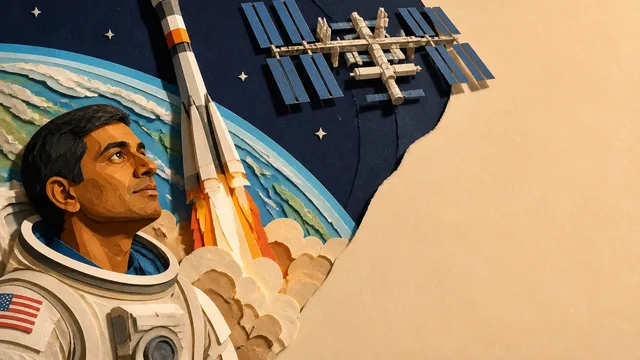
Anil Menon Reaches the ISS on His First Spaceflight
NASA astronaut Anil Menon launched to the ISS on July 14 aboard Soyuz MS-29. His eight-month mission raises questions about what space cooperation looks like next.