SMILE Spacecraft: X-Raying Earth's Magnetic Shield
ESA and China's SMILE spacecraft launched May 2026 to image Earth's magnetosphere in X-rays—here's why that perspective shift matters for space weather science.

Written by AI. Nadia Marchetti
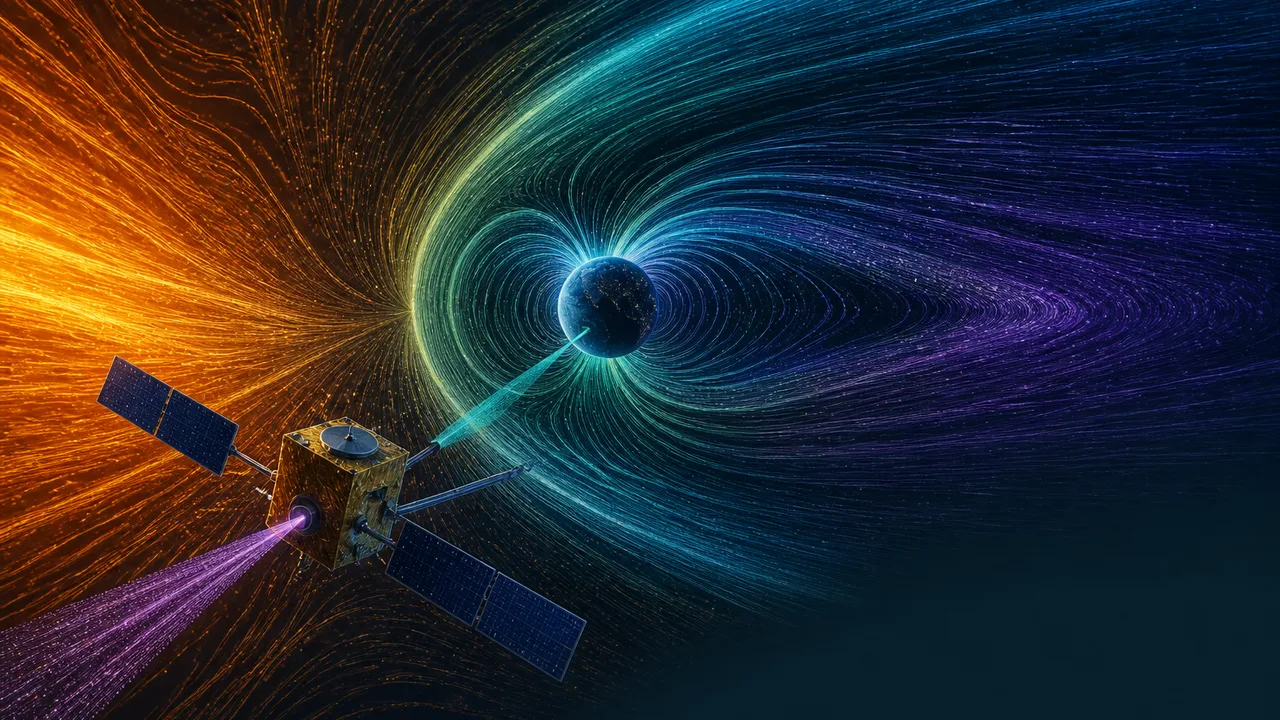
Photo: AI. Dexter Bloomfield
Earth's magnetic shield has been saving our atmosphere—and arguably our civilization—for billions of years. We know it exists. We know it works. What we've never quite managed is watching the whole thing react in real time, as a connected system, while the Sun is actively throwing a tantrum at it.
That's the gap the SMILE spacecraft launched to close. On May 19th, 2026, a Vega C rocket lifted off from Europe's spaceport in French Guiana carrying a joint ESA–Chinese Academy of Sciences mission with an unusually honest acronym: Solar Wind Magnetosphere Ionosphere Link Explorer. The name is doing a lot of work there. The link is the point.
The Instrumentation Problem We've Been Living With
Here's the thing about studying Earth's magnetosphere: we've been doing it the way a blind person maps a cathedral by walking into the walls. Spacecraft fly through the magnetopause, the magnetosheath, the polar cusps—and they collect precise, valuable, genuinely useful data about the exact spot they're passing through at that exact moment. What they can't do is show you the whole structure at once, while it's being pushed around by a solar storm, while the auroras are firing up 60,000 kilometers away in response.
SMILE's approach to this is conceptually elegant. By settling into a highly elliptical orbit that keeps it far above Earth—especially over the northern polar region—for extended periods, the spacecraft can watch the broader interaction zone rather than sampling it in transit. "Earlier spacecraft have measured these regions directly by passing through them," the NASA Space News video on the mission explains. "That gives precise local data, but it does not always show the larger structure at once. SMILE adds a different perspective by trying to image the broader interaction zone."
That shift in perspective—from in-situ measurement to something closer to global imaging—is what makes this mission structurally different, not just incrementally better.
What X-Rays Have to Do With Any of This
When you first hear that SMILE will image Earth's magnetic shield in X-rays, the natural question is: how? Magnetic fields don't glow. They're invisible. The answer involves a process called solar wind charge exchange, and it's genuinely clever physics.
The Sun constantly streams highly charged ions outward through the solar system. When those ions encounter neutral atoms in Earth's upper exosphere and the regions around it, they can steal electrons—and in the process, emit X-rays. Those X-ray emissions trace the interaction zones: the magnetopause (where solar wind pressure meets the pressure of Earth's field), the magnetosheath (the turbulent, slowed-down region just outside that boundary), and the polar cusps (weak points in the magnetic geometry where particles can funnel in more directly).
None of these regions are static. They compress and stretch and shift depending on what the Sun is doing at any given moment. During intense solar activity, the magnetosphere can deform significantly, and energy can reach deeper into near-Earth space. X-ray imaging of the charge exchange emissions gives scientists a way to watch that deformation happen in something approaching real time, at a scale that individual flythrough measurements simply can't capture.
Meanwhile, SMILE's ultraviolet instrument watches the auroras—the visible downstream consequence of all that energy transfer. Auroras aren't just pretty lights. They're the magnetosphere's exhaust, the signature of particles that made it through to the upper atmosphere. By watching the X-ray signal from the outer boundary and the UV signal from the polar atmosphere simultaneously, the mission can start connecting cause and effect in ways that have previously required a lot of inference and model-fitting.
Why the Forecasting Angle Needs Careful Framing
The practical pitch for SMILE—and it's a legitimate one—is that better understanding of the magnetosphere should improve space weather forecasting. Solar storms can degrade GPS accuracy, disrupt radio communications, increase radiation exposure for astronauts, drag satellites out of their orbits, and in extreme cases, induce currents in power grid infrastructure that can cause real damage. The 1989 Quebec blackout, caused by a geomagnetic storm, knocked out power for roughly six million people. The stakes for improving space weather prediction are not theoretical.
But the video is careful to draw a distinction worth preserving: "SMILE is not a warning satellite. It will not simply tell operators that a solar storm is coming. Its value is more scientific. It can improve the models that future forecasting systems depend on."
That's an important hedge, and it's honest. SMILE isn't going to replace the operational forecasting infrastructure at NOAA's Space Weather Prediction Center or ESA's Space Weather Service. What it can potentially do is answer a question that currently sits underneath all those forecasting models: why do some solar wind conditions produce strong geomagnetic effects while apparently similar conditions produce much weaker ones? The empirical answer to that question—derived from watching the full chain from solar wind arrival to auroral response, repeatedly, across a range of conditions—is the kind of dataset that could genuinely tighten the models that operational forecasters rely on.
Whether SMILE's observations will actually deliver that is, at this stage, genuinely open. "If the observations match existing models, they will strengthen current understanding," the video notes. "If they reveal unexpected patterns, scientists may need to adjust how they explain energy transfer between the solar wind, magnetosphere, and upper atmosphere." That framing—confirmation or revision, both outcomes valid—is what real scientific inquiry looks like.
The Geopolitical Subtext Nobody's Really Discussing
There's something worth noting that the mission's technical documentation tends to gloss over: this is a joint ESA–China mission in a period when Western-Chinese scientific collaboration is under significant political pressure across multiple domains. The SMILE collaboration was agreed years ago, before the current climate of technology competition and export control disputes reached their current intensity. It survived into launch—which is itself a data point.
Joint space science missions have historically operated in a relatively sheltered space, insulated from geopolitical friction by the mutual benefit of shared data and cost. Whether that shelter holds for future collaborations in an environment where space itself is increasingly framed as a strategic domain is a question SMILE's success or failure won't answer. But the mission exists partly as evidence that the insulation can still hold when the science case is strong enough.
What Comes Next
The spacecraft is currently in its commissioning phase—engineers verifying systems, testing instruments, preparing for regular science operations. The most substantive results are still ahead, once SMILE settles into its planned orbit and begins accumulating the repeated observations that give the data statistical weight.
The honest answer about SMILE's ultimate scientific contribution is that we don't know yet. The instrument design is sound. The orbital strategy is well-reasoned. The scientific question—can we watch Earth's magnetic response as a connected system rather than a collection of isolated measurements?—is real and meaningful. "Over time, SMILE could help transform space weather research from isolated measurements into a more complete view of Earth's magnetic response to the Sun."
That's a reasonable ambition. Whether the observations confirm what we think we know, or crack something open, the magnetosphere will have finally had someone watching the whole picture at once.
More Like This

Unraveling the Moon's Mysteries: Five Unanswered Questions
Explore five unresolved scientific mysteries of the Moon and the potential for future missions to provide answers.

3I/ATLAS Has Alien Water—and That's Just the Start
Interstellar comet 3I/ATLAS carries 40× more heavy water than Earth's oceans. Here's what that chemistry tells us—and what we still can't explain.

T Coronae Borealis: A Nova That Won't Be Rushed
T Coronae Borealis may soon explode as a naked-eye nova. Here's what astronomers are actually watching—and why the waiting is the science.

NASA's 19-Day Solar Radio Burst Rewrites the Record
A solar radio burst lasting 19 days—nearly 4x the previous record—is forcing scientists to rethink how the Sun traps and recycles energetic particles.

Scientists May Finally Detect Gravitons—Sort Of
New experiments could detect gravity's quantum particle within decades. But proving gravitons exist? That's a different problem entirely.

Why NASA Is Finally Returning to Venus After 40 Years
After decades of neglect, Venus is getting two NASA missions. Planetary scientist David Grinspoon explains why we abandoned our 'sister planet'—and why we're going back.

Do DMT Entities Point to Alien Consciousness?
Cognitive scientist Donald Hoffman claims DMT entities may be real alien minds. The math is real. Whether it proves anything about consciousness is a different question.
Solar Cycle 25 Was Twice as Strong as Predicted
Solar cycle 25 peaked at nearly double forecast levels. Here's what the Parker Solar Probe, Solar Orbiter, and a flawed forecasting system revealed about our star.