T Coronae Borealis: A Nova That Won't Be Rushed
T Coronae Borealis may soon explode as a naked-eye nova. Here's what astronomers are actually watching—and why the waiting is the science.

Written by AI. Nadia Marchetti
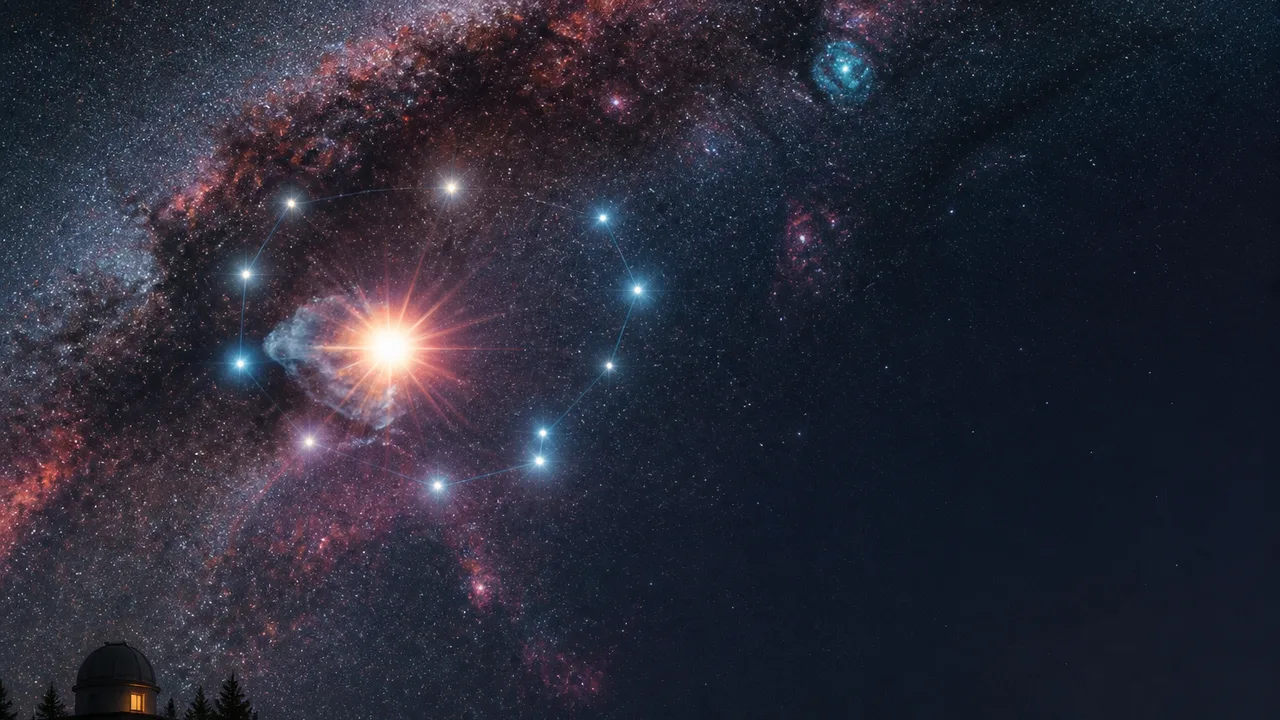
Photo: AI. Castor Belov
Somewhere in the constellation Corona Borealis, a white dwarf is stealing gas from its dying neighbor. It has been doing this for a very long time. At some point—maybe soon, maybe already, maybe not yet—the pressure will become too much, and the surface of that white dwarf will detonate in a thermonuclear flash visible to the naked eye from 3,000 light years away.
That event hasn't been confirmed yet. But professional observatories, amateur astronomers, and skywatching networks around the world are watching the exact patch of sky where it will appear. The waiting, as it turns out, is not a prelude to the science. It is the science.
T Coronae Borealis—TCRb, the Blaze Star, take your pick—is not a newcomer to spectacle. It erupted in 1866 and again in 1946, and both times it jumped from a magnitude too faint to see without equipment to roughly magnitude 2, comparable to the North Star. It appeared, briefly and dramatically, as a new point of light in a region of sky where casual observers had never noticed anything bright. Then it faded, settled down, and went quiet again.
That 80-year rhythm is why astronomers have been on high alert. The math suggests we're in another outburst window. Headlines have dutifully amplified this into variants of "the Blaze Star is about to explode," occasionally with the added confusion of reporting that it might already have exploded.
That second claim is technically not wrong, and exactly wrong at the same time.
Because TCRb sits about 3,000 light years away, whatever physical event produced or will produce the nova we're waiting for may have happened centuries ago. Light travels fast, but it takes time, and cosmic distances are unforgiving of human impatience. As one summary of the current watch puts it: "because the system is about 3,000 light years away, the physical event may already have happened long ago in space—but for observers on Earth, the only thing that matters is whether the light from that eruption has reached us and been confirmed."
This is a genuinely strange thing to sit with. The universe doesn't respect our preference for tidy present tenses.
What TCRb Actually Is
Strip away the anticipation and you have a binary star system doing something both mundane and extreme. A red giant—an aging, bloated star shedding its outer layers—orbits a white dwarf, which is the dense remnant of a star that already ran out of fuel. White dwarfs are roughly Earth-sized but carry roughly solar mass, which means their gravity is absurd. The red giant is essentially leaking, and the white dwarf is drinking.
That accreted material—hydrogen, mostly—piles up on the white dwarf's surface. The pressure and temperature climb. Nothing dramatic happens for years, decades. And then the accumulated layer reaches a threshold and undergoes a thermonuclear runaway: a nova.
It's worth being precise about what a nova is and isn't, because the language around stellar explosions tends to blur. "This is different from a supernova. A supernova is usually the final destruction or collapse of a star. A nova is not the death of the white dwarf. It is a powerful surface event. The system survives, settles down, and can begin building toward another outburst."
That last sentence carries more weight than it might seem. TCRb is not dying—it's cycling. The 1946 event wasn't a finale. It was more like a pressure valve. The system reset, began accumulating again, and is apparently approaching another threshold roughly 80 years later. That's what makes it a recurrent nova, part of a rare class of systems that do this repeatedly.
Why the Prediction Problem Is Real
The roughly 80-year pattern is suggestive, not deterministic. Predicted windows have come and gone without the expected eruption, and scientists tracking TCRb have been candid about this. The system is naturally variable—its brightness shifts in ways that don't necessarily signal an imminent eruption—which makes it genuinely hard to distinguish "nova precursor" from "normal variability."
"Does the system dim first? Does its brightness pattern change? Does the flow of material from the red giant become unstable? These are not easy questions because TCRb is naturally variable. It can change without immediately erupting."
This is an important tension in the story that the headlines tend to skip over. The excitement is real, and so is the uncertainty. Astronomers aren't watching with false confidence—they're watching precisely because the system is complex enough to be unpredictable. The roughly 80-year clock is a hypothesis, not a schedule.
There's also an important asymmetry in the evidence available. The 1866 eruption was documented but not studied with modern instruments. The 1946 event was better observed but still pre-space telescope, pre-digital photometry, pre-multi-wavelength astronomy. If TCRb erupts now, scientists will be able to capture it in visible light, ultraviolet, X-ray, and other wavelengths simultaneously, across both professional and amateur networks. The difference in data quality would be enormous.
This is why researchers aren't just waiting for a spectacle. They're waiting for a dataset that doesn't exist yet.
What Confirmation Actually Requires
One thing the current media cycle hasn't helped: the threshold for announcing a confirmed nova is higher than a viral post or a single blurry image. "The brightness has to be measured, checked and compared with the expected behavior of the system. That is why networks of professional and amateur observers are important. They can help separate a real eruption from mistaken claims."
This is where the structure of modern astronomical observation gets interesting. The event is rare enough and significant enough that amateur astronomers—people with backyard telescopes and photometry software—are genuinely part of the detection and monitoring network. Organizations like the American Association of Variable Star Observers (AAVSO) have been tracking TCRb's brightness in dense time series. If the nova begins, these observers will likely be among the first to flag the change in a documented, verifiable way.
That kind of distributed observation changes what we can know. It's not purely the province of major observatories with lengthy proposal cycles and narrow instrument windows. The Blaze Star, if it goes, will be a crowdsourced data collection event on top of everything else.
What You'd Actually See
For anyone planning to look: the experience will be quiet. No visible shockwave, no expanding cloud, no movement across the sky. A point of light will appear in Corona Borealis—the small crown-shaped constellation you can find between Boötes and Hercules, near the bright anchor stars Arcturus and Vega—where there was no obvious bright star before.
That's it. That's the show. A point where there was no point.
Peak visibility, if it matches the 1946 pattern, could last only a few days, with the star fading gradually over the following weeks. Binoculars would extend your viewing window as it dims below naked-eye threshold. Learning where to look before the announcement matters, because by the time alerts go out, the star may already be at or past peak brightness.
The experience will feel, to the naked eye, like nothing dramatic. That small perceptual fact represents a thermonuclear event on the surface of a dense stellar remnant 3,000 light years away—something no living human has ever seen from this star, in a sky that last showed it to observers in 1946 and before that in 1866.
That gap between what the eye registers and what the physics represents is, to me, what makes this particular watch worth taking seriously. The Blaze Star isn't acting strange because it's broken. It's acting exactly as its nature dictates. We're just finally paying close enough attention to notice.
The confirmed nova hasn't come. But the instruments are running, the networks are watching, and somewhere in Corona Borealis, pressure is building.
More Like This
CIA's Ghost Murmur: Quantum Sensor or Spy Fiction?
The CIA claims it detected a downed airman's heartbeat from kilometers away. The physics says otherwise. Here's what the science actually tells us.
The Rainbow Is Yours Alone—Here's What That Means
Neil deGrasse Tyson breaks down the optics of rainbows—why yours is private, why you can't reach its end, and why every rainbow is actually a circle.
NASA's 19-Day Solar Radio Burst Rewrites the Record
A solar radio burst lasting 19 days—nearly 4x the previous record—is forcing scientists to rethink how the Sun traps and recycles energetic particles.

Chaitin's Omega: The Number That Knows Everything
Chaitin's Omega encodes answers to every mathematical question—yet its digits are provably uncomputable. Here's what that actually means, and why it matters.

Heavy Spoilers Builds an Office, Ditches the Algorithm
YouTube creator Paul from Heavy Spoilers explains why he built a garden office, changed his logo, and chose depth over views in content strategy.
Scientists May Finally Detect Gravitons—Sort Of
New experiments could detect gravity's quantum particle within decades. But proving gravitons exist? That's a different problem entirely.
Do DMT Entities Point to Alien Consciousness?
Cognitive scientist Donald Hoffman claims DMT entities may be real alien minds. The math is real. Whether it proves anything about consciousness is a different question.
Viking Landers and the Unsolved Mars Life Debate
Fifty years after Viking landed on Mars, one experiment's positive result remains unexplained. Here's what the science actually shows—and what we've learned since.