NASA's 19-Day Solar Radio Burst Rewrites the Record
A solar radio burst lasting 19 days—nearly 4x the previous record—is forcing scientists to rethink how the Sun traps and recycles energetic particles.

Written by AI. Olivia Meng
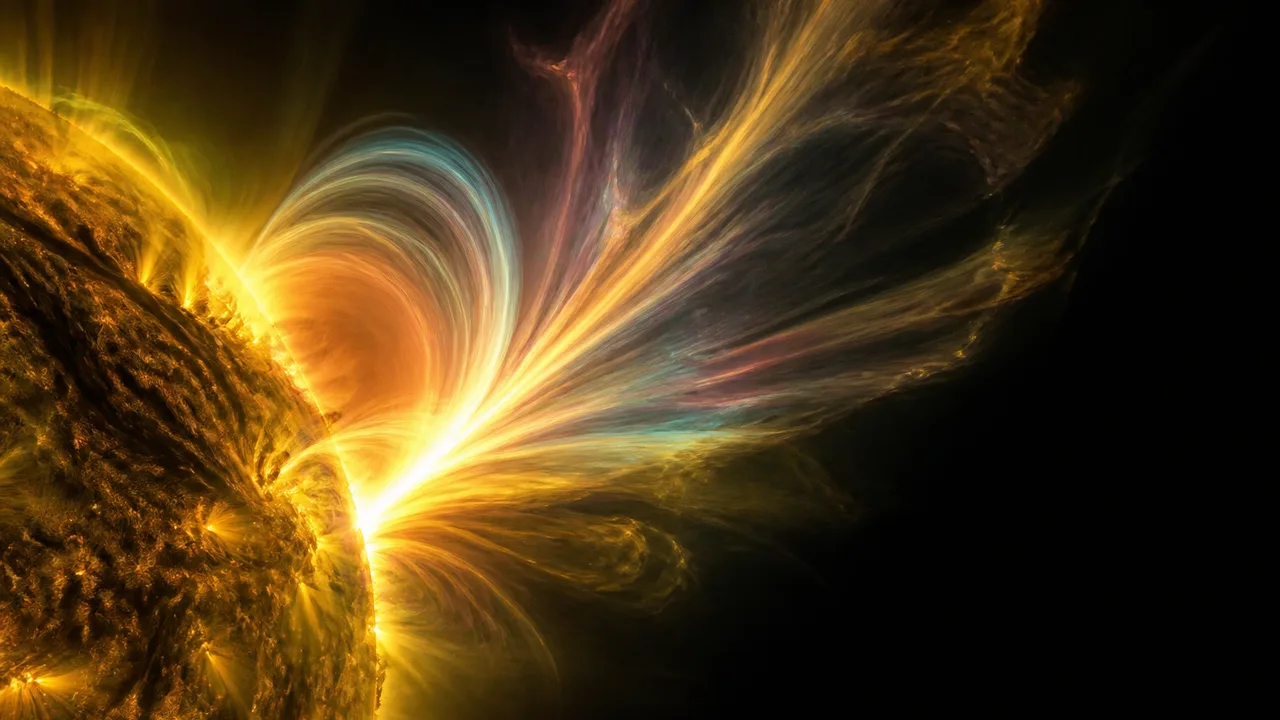
Photo: AI. Pippa Whitfield
The sun murmurs constantly. Most of the time, those murmurs follow a predictable script: a flare fires, electrons spiral through magnetic fields and emit radio waves, the signal fades within hours. Occasionally it stretches to a day or two. Scientists call these type four solar radio bursts, and the heliophysics community has catalogued enough of them to know roughly what to expect.
In August 2025, the sun ignored all of that.
Instruments picked up what initially looked like a routine type four burst. Then it kept going. Days passed. The signal refused to fade. By the time it finally went quiet, it had been running for 19 consecutive days—shattering the previous record of roughly five days and, more importantly, demanding an explanation.
The research, published in The Astrophysical Journal Letters, traces the event to a helmet streamer: a towering, cusp-shaped magnetic structure in the solar corona that's familiar from total solar eclipse photographs but not typically associated with this kind of sustained radio activity. What the scientists found, pieced together from four separate spacecraft, amounts to a new picture of how the sun can lock energetic particles in place and keep them radiating long after the triggering event has passed.
The Mosaic Problem
There's a methodological wrinkle worth understanding before getting to the physics. No single spacecraft had a continuous view of this event. As the sun rotated, the source region drifted in and out of sight of NASA's STEREO and Wind spacecraft, the Parker Solar Probe, and ESA/NASA's Solar Orbiter—each catching a few-day slice of what turned out to be the same long-lived burst.
That fragmentation is exactly why events like this get misread or missed entirely. Without the analytical step of stitching those partial views together, researchers would have seen several ordinary, apparently disconnected bursts. With it, they saw something else: "one extended episode of trapped particles radiating steadily from the same patch of solar atmosphere."
The team used a new direction-finding technique applied to STEREO data to pinpoint the radio emission's origin. That triangulation led back to the helmet streamer—and opened the more interesting question of why.
What a Magnetic Bottle Actually Does
A helmet streamer is an arch of closed magnetic field lines in the corona, capped by a sharp point that trails outward toward the solar wind. Under normal circumstances, energetic electrons injected into such a structure can spiral along field lines and radiate radio waves—but they eventually escape or lose energy and the emission stops.
The August 2025 event suggests that under the right conditions, a helmet streamer can behave less like a conduit and more like a container. As the researchers describe it, the structure "acted like a gigantic magnetic bottle confining electrons fed by a series of coronal mass ejections and turning a routine solar outburst into a 19-day marathon."
Three separate coronal mass ejections—large expulsions of magnetized plasma—erupted from the same region during the burst. Each one appears to have done double duty: dumping fresh electrons into the streamer's magnetic trap while simultaneously disturbing the local field enough to re-energize the existing population. The result was a self-sustaining cycle. "The streamer provided the long-lived magnetic scaffolding while the CMEs fed or re-stirred the electron population, turning a single outburst into a sustained stop-and-start marathon."
This reframes where the scientific attention should go. A burst of this duration isn't primarily a story about a powerful initial explosion. It's a story about magnetic infrastructure—about how effectively surrounding coronal structures can store, recycle, and slowly bleed off energetic particles over timescales that dwarf the triggering event itself.
The Forecasting Connection
The radio waves themselves aren't dangerous. But the magnetic environments that produce them are directly relevant to space weather, and that's where this discovery earns its practical weight.
Energetic solar particles—the kind associated with CMEs and active coronal regions—can degrade satellite electronics, disrupt GPS and communication signals, and pose genuine radiation risks to astronauts operating beyond Earth's magnetosphere. The current state of space weather forecasting is better than it was a decade ago but still limited in its ability to predict which solar regions will stay active after an initial eruption fades. The conventional assumption has been that once the most visible event is over, the danger diminishes. This burst complicates that assumption.
"A solar event does not always end when the first eruption fades," the researchers note. "The surrounding magnetic structure may continue to evolve. And that continuing activity can be important for understanding future risks."
If helmet streamers can sustain elevated particle activity for nearly three weeks, then post-eruption monitoring of those structures—using radio observations as a proxy—could become a meaningful tool in forecasting. The practical value depends on a question the current research doesn't fully answer: can scientists identify the conditions that produce these sustained bursts before they develop, or only after they've already started?
What Remains Open
The paper, available through IOP Science, is careful about what it claims. The researchers have a compelling mechanism—streamer as magnetic bottle, CMEs as periodic recharge—but they're candid that this is a single event. Whether the conditions that produced it are rare or simply underdetected is genuinely unknown.
That uncertainty has a tractable path forward. Scientists plan to revisit historical solar radio observations with improved analysis techniques, looking for long-duration type four bursts that were previously dismissed as clusters of unrelated short events. Given that the multi-spacecraft perspective required to recognize the August 2025 burst as a single continuous phenomenon is a relatively recent capability, it's plausible that similar events exist in the archive, waiting to be re-read.
Modeling is the other frontier. Building a physical simulation that reproduces the 19-day duration—accounting for the streamer geometry, the timing and energy of the three CMEs, and the electron population dynamics—would let researchers test whether the mechanism is as well-understood as it currently seems, or whether there are features of this event that don't yet fit any model cleanly.
There's also a broader architectural question lurking here. The discovery reinforces the value of the current multi-spacecraft observing network: STEREO, Parker Solar Probe, Wind, and Solar Orbiter operating simultaneously from different vantage points. Without that ensemble, this event would have remained invisible as a phenomenon. The same is likely true of other events yet to be recognized. As humanity's dependence on satellite infrastructure deepens and crewed missions beyond low Earth orbit become more frequent, the question of whether that observational architecture is sufficient—or whether it needs to expand—deserves more public attention than it typically gets.
The sun kept a radio signal running for 19 days. The more unsettling possibility is that it's done this before, and we simply weren't listening in the right way to notice.
More Like This
How the Asteroid Impact Ended the Dinosaur Era
Explore the catastrophic asteroid impact that ended the dinosaurs, its immediate aftermath, and the long-term environmental changes.
Could Life on Earth Have Arrived via Asteroids?
Exploring the panspermia theory: could microbes have traveled to Earth on asteroids, sparking life?
Jupiter's Storms Run Deeper Than Anyone Expected
NASA's Juno probe reveals Jupiter's storms plunge 1,800 miles deep—and the sun isn't powering them. Here's what scientists think is going on inside.
Subcritical Reactors: Nuclear Power's Safety Fix?
A new generation of subcritical reactors promises to make nuclear meltdowns physically impossible. But can they deliver on cost, scale, and timeline?
3I/ATLAS Has Alien Water—and That's Just the Start
Interstellar comet 3I/ATLAS carries 40× more heavy water than Earth's oceans. Here's what that chemistry tells us—and what we still can't explain.
NASA's Nuclear Mars Spacecraft: What SR-1 Freedom Means
NASA approved SR-1 Freedom, a nuclear electric spacecraft targeting a 2028 launch. Here's what the mission actually tests—and what it doesn't solve.
Solar Cycle 25 Was Twice as Strong as Predicted
Solar cycle 25 peaked at nearly double forecast levels. Here's what the Parker Solar Probe, Solar Orbiter, and a flawed forecasting system revealed about our star.
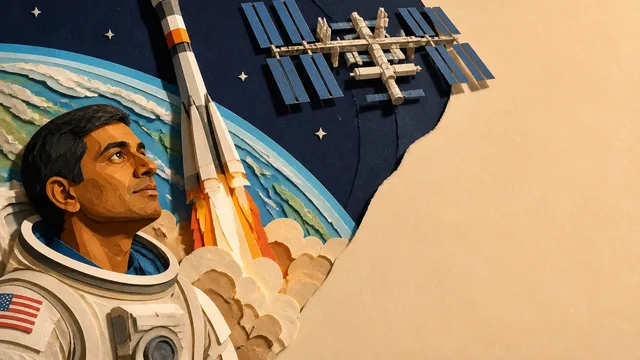
Anil Menon Reaches the ISS on His First Spaceflight
NASA astronaut Anil Menon launched to the ISS on July 14 aboard Soyuz MS-29. His eight-month mission raises questions about what space cooperation looks like next.