NASA's Nuclear Mars Spacecraft: What SR-1 Freedom Means
NASA approved SR-1 Freedom, a nuclear electric spacecraft targeting a 2028 launch. Here's what the mission actually tests—and what it doesn't solve.

Written by AI. Priya Sharma
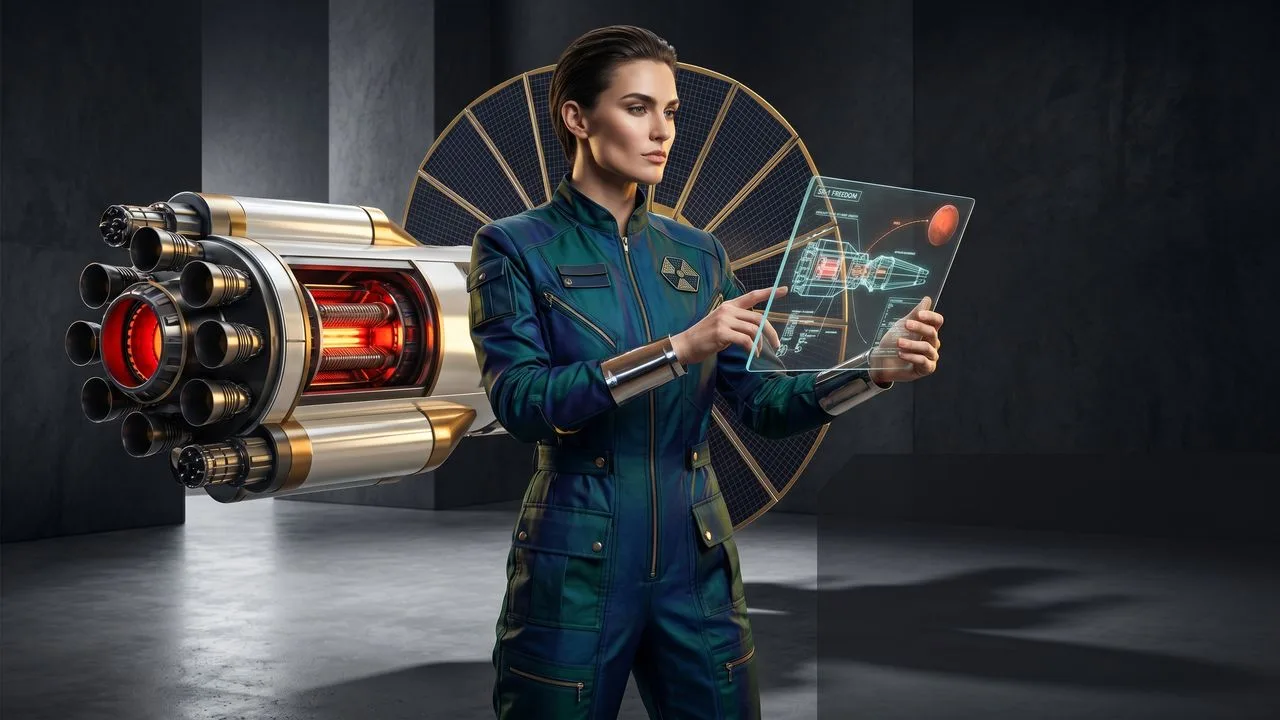
Photo: AI. Ines Cienfuegos
There is a version of this announcement that writes itself: NASA goes nuclear, Mars is next, humanity's multiplanetary future inches closer. The press cycle practically assembles on its own. What's harder—and more useful—is understanding what NASA actually approved, what it hasn't approved, and why the distinction matters.
The mission is called Space Reactor 1 Freedom, or SR-1 Freedom. It targets a launch before the end of 2028. It will not carry astronauts. It will not land on Mars. What it will do, if it flies, is run a full-scale fission reactor in deep space and use the electricity that reactor generates to power ion thrusters—a propulsion approach called nuclear electric propulsion, or NEP. The payload is something called Skyfall: a collection of small Mars helicopters designed to scout terrain that wheeled rovers can't safely navigate. But per the mission's own framing, the helicopters are secondary. The spacecraft is the experiment.
That framing is worth sitting with, because it clarifies the stakes. This isn't a Mars mission in the popular sense. It's a technology demonstration with Mars as the destination. The distinction isn't pedantic—it's the difference between measuring this mission against what it's actually designed to test and measuring it against the vastly larger ambition its announcement inevitably summons.
What nuclear electric propulsion is (and isn't)
The physics of interplanetary travel create a problem that chemical rockets handle badly. Chemical propulsion is excellent for what engineers call "delta-v on demand"—the violent, brief burns that lift a spacecraft out of Earth's gravity or perform orbital insertions. But sustained deep-space travel on chemical propellant is a mass problem: every kilogram of fuel you need to accelerate adds mass that requires more fuel to accelerate. It compounds. Missions get heavier, more expensive, harder to design.
Nuclear electric propulsion sidesteps this by separating the energy source from the propellant. The reactor generates electricity; that electricity powers ion thrusters that expel charged particles at extremely high velocities. The thrust produced is small—measured in millinewtons rather than the meganewtons of a rocket engine—but it operates nearly continuously, building velocity over months rather than minutes. "Tiny thrust, enormous endurance," as the SR-1 mission framing puts it. The fuel efficiency, measured as specific impulse, is dramatically higher than chemical alternatives.
This makes NEP well-suited for cargo: slow, steady, mass-efficient. It is not suited for crew transport, where minimizing transit time is, as the mission's proponents correctly note, "a medical strategy." The longer humans spend in the radiation environment of deep space and in the muscle-and-bone-atrophying conditions of microgravity, the more physiological damage accumulates. For crewed Mars missions, a different nuclear approach—nuclear thermal propulsion, which heats hydrogen propellant directly for a more efficient rocket exhaust—is the more relevant technology. SR-1 Freedom doesn't test that.
What the architecture SR-1 proponents envision looks something like this: slow nuclear electric freighters haul habitats, food, power systems, and return hardware to Mars ahead of schedule, while faster (possibly nuclear thermal) crewed vehicles follow on shorter, leaner trajectories. "Imagine a layered Mars campaign built around that split," the mission's framing suggests. It's a coherent vision. It's also several missions and probably two decades away from realization, contingent on SR-1 Freedom working, followed by considerably more development work.
The engineering and regulatory stack
Flying a fission reactor is not analogous to the radioisotope thermoelectric generators that have powered deep-space probes for decades. RTGs—like those on Voyager or Cassini—use the heat from radioactive decay. They have no moving parts, no chain reaction, no criticality to manage. A fission reactor is a different category of system entirely.
SR-1 Freedom's reactor would need to "go critical"—initiate and sustain a controlled fission chain reaction—only once in deep space, away from Earth. That's the intended design: the reactor stays subcritical during launch and early flight, limiting the radiological risk from a launch vehicle failure. Once on its trajectory, it switches on, drives a closed Brayton cycle power conversion system to generate more than 20 kilowatts of electricity, and runs ion thrusters "almost non-stop" while radiators dump waste heat to the vacuum of space.
Each element of that chain—reactor stability, power conversion, thermal management, radiation shielding for the spacecraft's own avionics, fault management with no crew to intervene—has to function reliably for years at distances where round-trip communication takes minutes to tens of minutes. "It's a chain of systems that all have to behave for years, hundreds of millions of kilometers from home," the mission's proponents acknowledge. That's not hyperbole. It's an accurate description of what deep-space autonomy actually demands.
Then there's the regulatory dimension. Nuclear launch approvals in the United States require an interagency safety review process that, for a mission of this class, climbs to the White House. This is not bureaucratic obstruction—it reflects a legitimate calculus about launch failure scenarios, atmospheric reentry of nuclear material, and the international optics of launching fission reactors. The process is real, it takes time, and "any delay in that chain can quietly push a 2028 launch window into 2029 or beyond."
It's worth noting that the United States has launched nuclear reactors in space before—the SNAP-10A flew in 1965—but not in the modern regulatory environment and not at this power level. The Kilopower project, which forms the technological basis for SR-1 Freedom's reactor, completed ground tests in 2018 at Los Alamos, producing around 1 kilowatt. SR-1 Freedom would operate at more than 20 times that output. The ground tests are encouraging precedent, not proof of flight readiness.
What success would actually mean
If SR-1 Freedom launches on schedule, reaches deep space, activates its reactor, and runs its ion thrusters for an extended period, the payoffs are layered. The first is empirical: real operational data on how a fission reactor and its associated systems degrade over time in the actual deep-space environment. Radiation, thermal cycling, and the accumulated stresses of long-duration operation are difficult to fully replicate on the ground. The gap between ground test and flight experience is where spacecraft fail.
The second payoff is institutional. "Regulators, engineers, and suppliers who have done this once and can do it again faster" is how the mission's proponents frame it. This is historically how aerospace technology matures—the first instance is the hardest, the most expensive, the most fraught with unknowns. Subsequent instances benefit from established supply chains, trained personnel, and a regulatory framework that has already processed the hardest questions.
The third is reach. SR-1 Freedom's proponents gesture toward outer planet missions and "deep space power grids that solar panels alone could never support." Solar power degrades with distance from the Sun at the square of that distance; at Jupiter, you receive roughly 4% of the solar flux available at Earth orbit. Nuclear power doesn't care about distance from the Sun. For missions beyond the asteroid belt, it's not an efficiency improvement—it's arguably a prerequisite.
The open question
None of this means the mission will fly on schedule, perform as designed, or translate into the nuclear fleet its most enthusiastic advocates envision. NASA's record on ambitious technology demonstration missions is genuinely mixed. Schedules slip. Budgets contract. Political priorities shift. The gap between "approved" and "launched" has swallowed more than a few promising concepts.
What SR-1 Freedom represents, at this moment, is a specific and meaningful test: whether a fission reactor can operate reliably in deep space under real conditions. That's a narrower question than "will nuclear propulsion transform Mars exploration"—and it's the right question to be asking first. The answer, when we eventually get it, will tell us something that no amount of modeling or ground testing can: whether the physics and engineering we're counting on actually behave in the environment where they need to work.
The mission SR-1 Freedom will not send humans to Mars. But if it works, it becomes the first sentence of a much longer story—one where we still don't know the ending.
More Like This
How Gravity Assists Propel Spacecraft Efficiently
Exploring gravity assists in space travel: a technique to boost spacecraft speed by leveraging planetary motion.

Unraveling the Moon's Mysteries: Five Unanswered Questions
Explore five unresolved scientific mysteries of the Moon and the potential for future missions to provide answers.
Subcritical Reactors: Nuclear Power's Safety Fix?
A new generation of subcritical reactors promises to make nuclear meltdowns physically impossible. But can they deliver on cost, scale, and timeline?

The Rainbow Is Yours Alone—Here's What That Means
Neil deGrasse Tyson breaks down the optics of rainbows—why yours is private, why you can't reach its end, and why every rainbow is actually a circle.

Could Space be the Future for AI Deployment?
Elon Musk predicts AI deployment in space within 36 months, but is this vision realistic?

How Fractals Moved From Math Curiosity to Tech
Fractals aren't just beautiful—they're inside your smartphone antenna, your microchip cooling system, and your eye exam. Here's how the math became engineering.
Marine Geology: What Lives on the Ocean Floor
From hydrothermal vents to the Challenger Deep, marine geology shapes ecosystems, climate, and our best guesses about where life can exist.

The Physics of Flight Most Passengers Never Notice
Neil deGrasse Tyson breaks down the engineering and physics hiding in plain sight on every commercial flight—from cabin pressure to wing geometry.