How Gravity Assists Propel Spacecraft Efficiently
Exploring gravity assists in space travel: a technique to boost spacecraft speed by leveraging planetary motion.

Written by AI. Priya Sharma
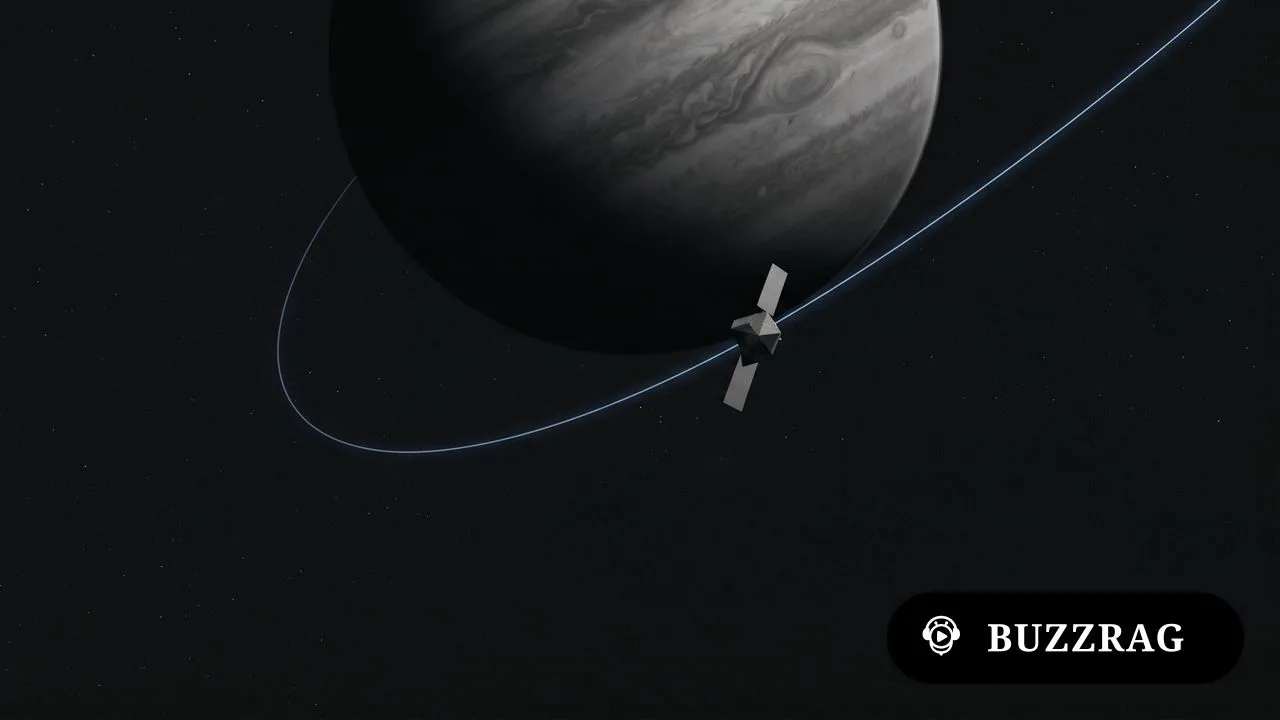
Photo: AI. Tomoko Hayashi
In the realm of space exploration, gravity assists stand out as a remarkable technique that allows spacecraft to gain significant velocity without expending fuel. This maneuver harnesses the motion of planets to transfer momentum to spacecraft, effectively providing a speed boost that can be likened to receiving tens of tons of rocket fuel for free.
The Mechanics Behind Gravity Assists
Fundamentally, a gravity assist involves a spacecraft flying close to a moving celestial body, such as a planet, to alter its path and speed. This method exploits the gravitational pull of the planet, but crucially, it's not the planet's gravity that provides the energy. Instead, the momentum is transferred from the planet's own motion around the sun to the spacecraft. As the video presenter from The Action Lab notes, "Gravity isn't a source of energy. Using gravity to do any work or get anything moving is always paid for in advance."
To illustrate this, consider a spacecraft approaching a planet. If the planet were stationary, the spacecraft would speed up as it approached, but would slow down to its initial speed as it moved away, as no net energy would be gained. However, because planets are moving at substantial velocities around the sun, a spacecraft can gain speed by effectively "borrowing" some of the planet's kinetic energy.
The Art of Timing and Direction
Executing a successful gravity assist requires precise timing. The planet must be in the correct position, and the spacecraft's trajectory must be calculated so that the resultant path aligns with mission goals. As the presenter explains, "You only gain speed in the direction the planet is moving. Your overall velocity vector gets turned toward that direction."
This directional limitation means that while gravity assists are powerful tools, they are not universally applicable for all trajectory adjustments. The maneuver must be meticulously planned to ensure that the spacecraft ends up on the desired path post-assist.
Historical and Practical Applications
The concept of gravity assists was first uncovered by Michael Minovich, a UCLA student working at NASA in the 1960s. His discovery revolutionized space travel, with missions like Voyager 1 and 2 utilizing gravity assists to gather enough speed to exit our solar system. These missions demonstrated that, theoretically, a spacecraft could achieve speeds up to twice the orbital speed of the assisting planet relative to the sun.
However, there are limits. While planets like Earth orbit the sun at speeds up to 30 km/s, and Mercury at around 47 km/s, the sun itself moves at about 220 km/s through the galaxy. Despite this, we cannot use the sun for a gravity assist in the same manner since we are already moving with it, leaving no relative motion to exploit.
The Oirth Effect: An Additional Speed Boost
Another intriguing concept related to gravity in space travel is the Oirth effect. This phenomenon suggests that firing rockets when a spacecraft is already moving at high speeds can yield greater energy efficiency. The faster the spacecraft moves, the more energy is transferred from the fuel to the craft. If executed correctly, this maneuver, especially near massive bodies like the sun, can lead to substantial increases in speed, potentially reaching 100 to 200 km/s when leaving the solar system.
The Future of Space Travel
Gravity assists, along with the Oirth effect, represent humanity's ingenuity in using celestial mechanics to our advantage. By understanding and exploiting the motion of planets, we can conserve fuel and extend the reach of our spacecraft further into the cosmos. As we continue to refine these techniques, the possibility of venturing beyond our galaxy, while still distant, becomes a tantalizing prospect.
Ultimately, gravity assists remind us that while space travel requires overcoming immense challenges, it also offers opportunities to harness the very forces that define our universe.
More Like This
Could Space be the Future for AI Deployment?
Elon Musk predicts AI deployment in space within 36 months, but is this vision realistic?

Unlocking New Skills After 50: The 'Pillar & Playground' Approach
Explore how the 'Pillar & Playground' method helps those over 50 learn efficiently, leveraging crystallized intelligence and cognitive flexibility.
Artemis II's Clever Safety Maneuvers, Explained
NASA's moon mission uses vintage hardware and ingenious orbital mechanics to give astronauts an escape route at every stage. Here's how it works.
Can Objects Fall Faster Than Gravity?
Exploring phenomena where objects appear to fall faster than gravity due to constraints and mechanics.
Exploring the Cosmic Balance: Lagrange Points
Discover how Lagrange points revolutionize space exploration, offering energy-efficient paths and potential for space construction.

Zeeman Effect: Unveiling Magnetic Mysteries
Explore the Zeeman effect's role in physics, from solar studies to MRI tech.
Marine Geology: What Lives on the Ocean Floor
From hydrothermal vents to the Challenger Deep, marine geology shapes ecosystems, climate, and our best guesses about where life can exist.
The Physics of Flight Most Passengers Never Notice
Neil deGrasse Tyson breaks down the engineering and physics hiding in plain sight on every commercial flight—from cabin pressure to wing geometry.