Exploring the Cosmic Balance: Lagrange Points
Discover how Lagrange points revolutionize space exploration, offering energy-efficient paths and potential for space construction.

Written by AI. Amelia Nwofor
In the vastness of space, where gravity reigns supreme, there exist peculiar points known as Lagrange points. Named after Joseph-Louis Lagrange, these celestial sweet spots are where gravitational forces of two large bodies, like Earth and the Moon, and centrifugal force balance perfectly. Imagine a cosmic tug-of-war where the rope never moves.
Neil deGrasse Tyson, in a recent StarTalk episode, delves into this fascinating topic alongside co-host Chuck Nice. They explore how these points are not just theoretical curiosities but are actively shaping our approach to space exploration.
Stable vs. Unstable Equilibrium
To grasp Lagrange points, one must first understand the difference between stable and unstable equilibrium. Tyson explains this with a simple analogy: an unstable equilibrium is like balancing a marble at the peak of a hill—any slight nudge sends it tumbling down. Conversely, a stable equilibrium is akin to placing the marble in a valley; it returns to the center no matter which way it's pushed.
In the Earth-Moon system, there are five Lagrange points (L1 through L5). L1, L2, and L3 are points of unstable equilibrium, while L4 and L5—forming an equilateral triangle with the Earth and Moon—are stable, making them ideal for maintaining spacecraft positions with minimal energy.
The Practical Marvel of Lagrange Points
These gravitational balance points are more than just academic concepts. "At the L4 and L5, you could haul construction equipment there and leave it," Tyson notes, emphasizing their potential as staging grounds for future space colonies or stations. The stability at these points allows for the storage of materials or even the construction of larger structures in space.
The James Webb Space Telescope, for instance, is stationed at L2, benefiting from this delicate gravitational balance to maintain its position with minimal fuel consumption. It's a testament to how understanding these points can translate into significant technological and logistical advantages.
Trojan Asteroids and Beyond
The Sun-Jupiter system also features these points, where L4 and L5 host the Trojan asteroids. These ancient rocks, trapped in a gravitational embrace, offer a natural laboratory for studying the early solar system. Tyson highlights that these points "are the bottom of a hill," emphasizing their stability.
The Future of Space Travel
Looking ahead, the utility of Lagrange points extends to trajectory optimization. Instead of relying solely on massive fuel tanks, future missions may exploit these gravitational highways to traverse the solar system more efficiently. Tyson describes this as "the cosmic scenic route," where cargo can take longer, energy-efficient paths, while crewed missions opt for faster, direct routes.
The conversation around Lagrange points is a reminder that our cosmic neighborhood is full of potential waiting to be harnessed. As we continue to explore, these gravitational gateways could be pivotal in our quest to reach further into space, a journey not just defined by fuel capacity but by the ingenuity of our trajectories.
In the end, the question isn't just about reaching these points but how cleverly we can use them to redefine what's possible in space exploration.
More Like This
Mold on the ISS: A Clue to Life's Cosmic Journey?
Examining mold's resilience in space and its implications for panspermia, the theory that life on Earth may have cosmic origins.
Space Developments: Tech Triumphs and Challenges
Exploring recent space missions, tech innovations, and their broader impacts on humanity's cosmic ambitions.
Exploring Black Holes and Asteroids with StarTalk
Neil deGrasse Tyson delves into black holes, asteroids, and more in StarTalk's latest Cosmic Queries episode with Chuck Nice.
Leadership and Legacy: The ISS Change of Command
Explore the symbolic ISS Change of Command, highlighting international cooperation and leadership in space.
Why Parsecs Puzzled Neil deGrasse Tyson
Neil deGrasse Tyson unpacks why the parsec is an awkward unit in science, even embarrassing for an astrophysicist.

Does Reality Require Us? Exploring Quantum Mysteries
Unpack the role of observers in reality, exploring quantum mechanics, entropy, and the nature of existence.

Hannah Cairo Disproved a 40-Year-Old Math Conjecture at 17
At 17, Hannah Cairo overturned the Mizohata-Takeuchi conjecture using a hypercube and a coin diagram. Here's what she actually did—and why it matters.
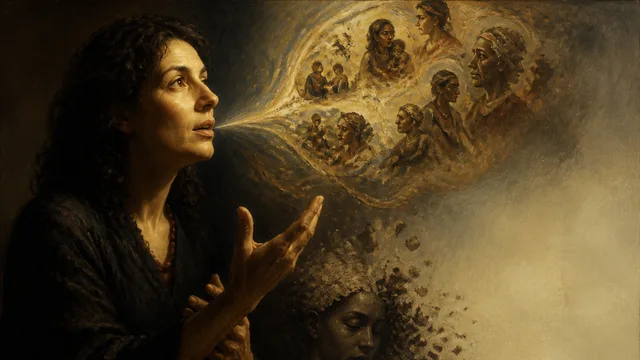
How Language Shapes Thought, According to Lera Boroditsky
Cognitive scientist Lera Boroditsky explains how the language you speak shapes memory, color perception, and thought—and what's lost when languages disappear.