Physics Says Time Has No Direction. So Why Does It Feel Like It Does?
Physicist Sean Carroll explains why the laws of physics are time-symmetric — and why that has more to say about regret and urgency than you'd expect.

Written by AI. Vanessa Torres
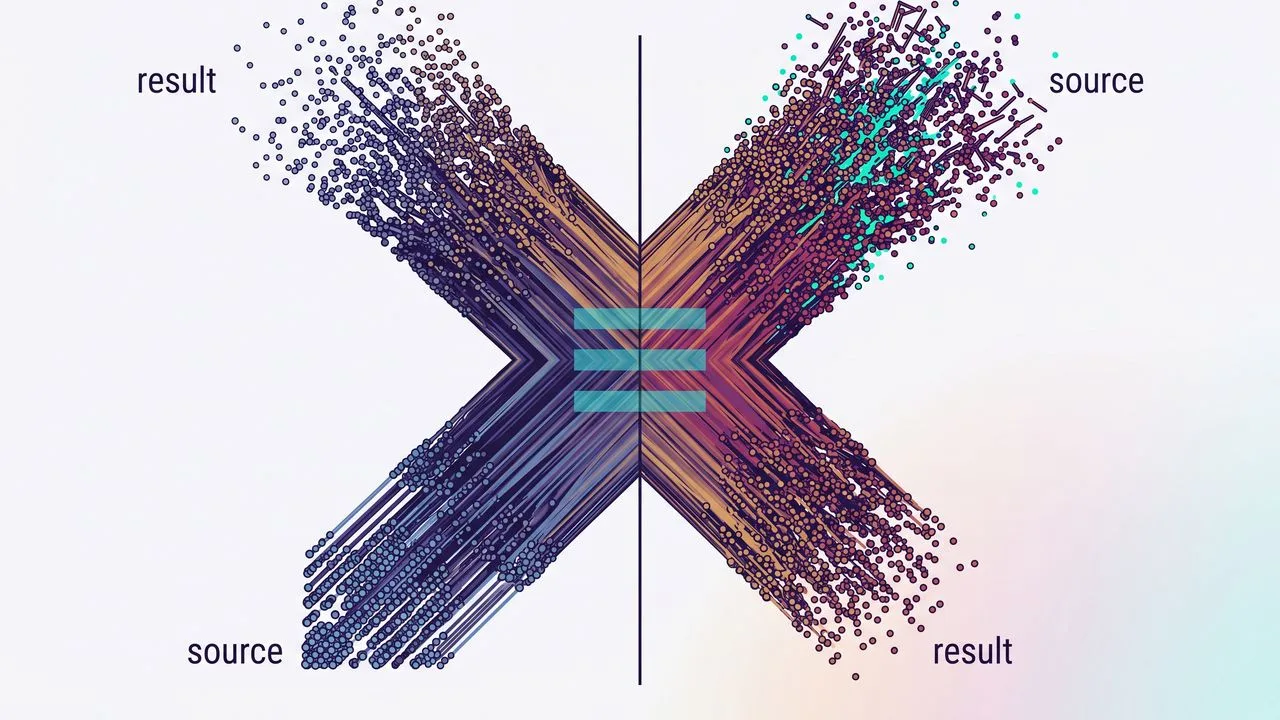
Photo: AI. Dexter Bloomfield
At some point in your forties or fifties, time stops feeling like a neutral resource and starts feeling like a creditor. The career you meant to pivot out of. The parent whose memory is quietly dissolving. The strange math of having more years behind you than ahead. You're not imagining it — the pressure is real. What I didn't expect was to find that physics, of all things, had something useful to say about it.
Not comforting, necessarily. But useful.
Physicist Sean Carroll, who holds a joint appointment in physics and philosophy at Johns Hopkins and hosts the Mindscape podcast, recently sat down with Big Think to talk about the nature of time. It's the kind of conversation that starts abstract and lands somewhere personal — whether Carroll intends that or not.
The thing he wants you to understand first: the fundamental laws of physics don't care which direction time runs.
"These fundamental laws work forward and backward in time," Carroll explains. "Knowing everything about the universe at one moment predicts the past as well as the future. What we think of as the fundamental laws of physics do not have a directionality to time. They treat the past and future the same."
Newton knew this. Einstein knew this. The equations don't have an arrow. Run them in reverse and they still work. The universe, at its most foundational level, is completely indifferent to whether you're moving toward Tuesday or away from it.
So why does it feel so obviously, stubbornly otherwise?
The spacetime detour (stay with me)
To get to the good part, you have to sit with Carroll through a brief history of how our understanding of time actually changed — because the shift from Newton to Einstein is where things get genuinely strange, and also where the practical implications start to emerge.
Newton's universe had absolute space and absolute time: fixed, universal, agreed upon by everyone. When you snapped your fingers, there was — in theory — an objective answer to what was happening simultaneously on the other side of the galaxy. That felt obvious. It also turned out to be wrong.
The crack appeared in the 1800s when James Clerk Maxwell wrote down his equations for electromagnetism, and they kept insisting that the speed of light was the same for every observer — regardless of how fast they were moving. That should have been impossible. If you're running toward a light beam, you should measure it as faster. Maxwell's math said no. Physicists spent decades trying to explain it away.
Einstein didn't explain it away. In his 1905 paper on special relativity, he just accepted it as true and worked backward to figure out what that implied. The answer: space and time aren't separate things. They're two aspects of one four-dimensional fabric — spacetime — and different observers moving at different velocities carve it up differently. There's no objective answer to what's happening "right now" somewhere far away, because "right now" is observer-dependent.
A few years after Einstein's 1905 paper, his former mathematics professor Hermann Minkowski made this geometric picture explicit — spacetime as a single unified structure — and Einstein, characteristically, was not immediately impressed. Carroll recounts that when Minkowski proposed the geometric framework, Einstein essentially dismissed it as unnecessary mathematical elaboration. He changed his mind. He needed it to build general relativity.
General relativity went further: gravity isn't a force. It's the curvature of spacetime itself, bent by the presence of mass and energy. Which produces the genuinely vertiginous implication that time doesn't pass at a uniform rate for everyone. The stronger the gravitational field you're sitting in, the less time you accumulate compared to someone floating in the relative quiet of interstellar space.
This is what Carroll calls the twin paradox. Two people, same age, same starting point. One stays home. One travels at near-light speed and returns. When they meet again, the traveler is younger — not because "time slowed down" for them exactly, but because they took a different path through spacetime and accumulated less of it. Carroll is precise about this distinction in a way I appreciate:
"What is the rate at which time moves? It is one second per second. You're being tricked by your use of the English language."
Your experience of time isn't running slow. You're just traveling a shorter route.
Interstellar depicted gravitational time dilation using Kip Thorne — a Nobel Prize-winning physicist — as executive producer and science consultant. Carroll notes the physics was largely responsible in most of the film, though it's worth flagging that Thorne himself has acknowledged various simplifications and liberties throughout, not only in the final act.
Now the part that actually lands
All of that — relativity, curved spacetime, twins aging differently — is the setup. The thing Carroll keeps returning to is this: if the laws of physics have no preferred direction for time, why do we?
Why do I remember yesterday and not tomorrow? Why do I have a photograph of myself at 24 but no photograph of myself at 64? Why does every cup of coffee cool down instead of spontaneously heating up?
The answer Carroll gives is entropy — a concept from 19th-century thermodynamics that means, loosely, disorder. Entropy increases over time because there are vastly more ways for a system to be messy than to be organized. If you drop a glass, it shatters into a hundred pieces. You never watch a hundred pieces of glass spontaneously assemble into a whole one.
But — and Carroll is emphatic about this — the reason entropy increases in a particular direction isn't written into the laws of physics. It's because the universe started in an extraordinarily low-entropy state. Extremely ordered. Extremely unusual. And it's been spreading out, randomizing, ever since. Our memories, our records, our aging, our sense that time has a direction at all: "This is all because entropy is increasing in one direction rather than the other."
The universe was born tidy. The arrow of time is just the mess spreading.
Nobody knows why the universe started so ordered. Carroll is frank about this: "This is a mystery to cosmology." There's no physical law requiring it. It's — for lack of a better word — a cosmic accident. A statistical anomaly at the Big Bang that we are still, billions of years later, working through the consequences of.
I'll be honest: when I first sat with this, my reaction was less "fascinating" and more a slow raising of the eyebrow. You're telling me that the most visceral truth of my existence — the feeling that time is moving, that I'm aging, that some things are behind me and some are ahead — is not fundamental to the universe? It's an emergent property of a particularly tidy initial condition? My anxiety about being "behind" or "running out of time" is, at the deepest level of physics, a narrative I'm projecting onto a neutral four-dimensional structure?
I'm not saying Carroll is wrong. I'm saying that's a lot.
But I keep coming back to what it actually does to the architecture of regret and urgency — two things that quietly run a lot of people's professional lives and personal choices. The whole system of "I should have done this sooner" or "I'm running out of time to do that" is built on the assumption that time's direction is a feature of reality, not an artifact of entropy. The laws of physics don't know you're behind schedule. The universe has no opinion on whether your career pivot happened at 42 or 52.
That's not a license for passivity. Carroll isn't telling you nothing matters. He's describing how things actually work at a level that most of us never get to look at. And there's a difference between the felt urgency of a life — which is real and worth taking seriously — and the punishing, hustle-culture version that treats every year you didn't move fast enough as a permanent deficit.
The physics doesn't back up the deficit model. Time isn't running out in any direction the universe recognizes. You're accumulating it at exactly one second per second, same as everyone else, on whatever path through spacetime you happen to be taking.
Whether that path has been a straight line or not is, per Einstein, not actually the problem you thought it was.
More Like This
The Deeper Geometry Behind the Pythagorean Theorem
Explore why the Pythagorean Theorem appears in unexpected places, from geometry to relativity.

When Physics Breaks: What Black Holes Reveal About Reality
Physicist Juan Maldacena explains where our understanding of spacetime collapses—and what quantum mechanics might tell us about what happens next.

Is Physics Really in Charge? Ellis vs. Carroll Explained
George Ellis argues physics doesn't decide outcomes—context does. Here's why his debate with Sean Carroll's reductionism is more consequential than it sounds.

Conway's Constant and the Power of Slow Attention
A children's counting game hides a degree-71 polynomial. What John Conway's slow, patient method reveals about how real insight actually works.

Why Too Many Choices Make You Worse at Everything
Behavioral economics has known for decades that unlimited choice backfires. David Epstein's new book explains why—and who benefits from pretending otherwise.

Verlinde vs. Jacobson: Does Gravity Emerge From Nothing?
Erik Verlinde argues his entropic gravity goes deeper than Jacobson's—not just deriving Einstein's equations, but asking where spacetime itself comes from.

Freelance Consulting vs. Employment: How the Money Works
Freelance consultants earn significantly more than employees—but not for the reason most people think. Here's how the money actually moves, and what it costs you.

How to Apply for Jobs Strategically in Cybersecurity
TCM Security's free course breaks down the job application process for cybersecurity roles—from job boards and Google Alerts to OSINT worksheets and cover letters.