The Blacksmith's Son Who Rewired the World
Faraday discovered the laws of electromagnetism with no formal training. Maxwell had to translate his truth into math before anyone believed it. Sound familiar?

Written by AI. Mei Zhang
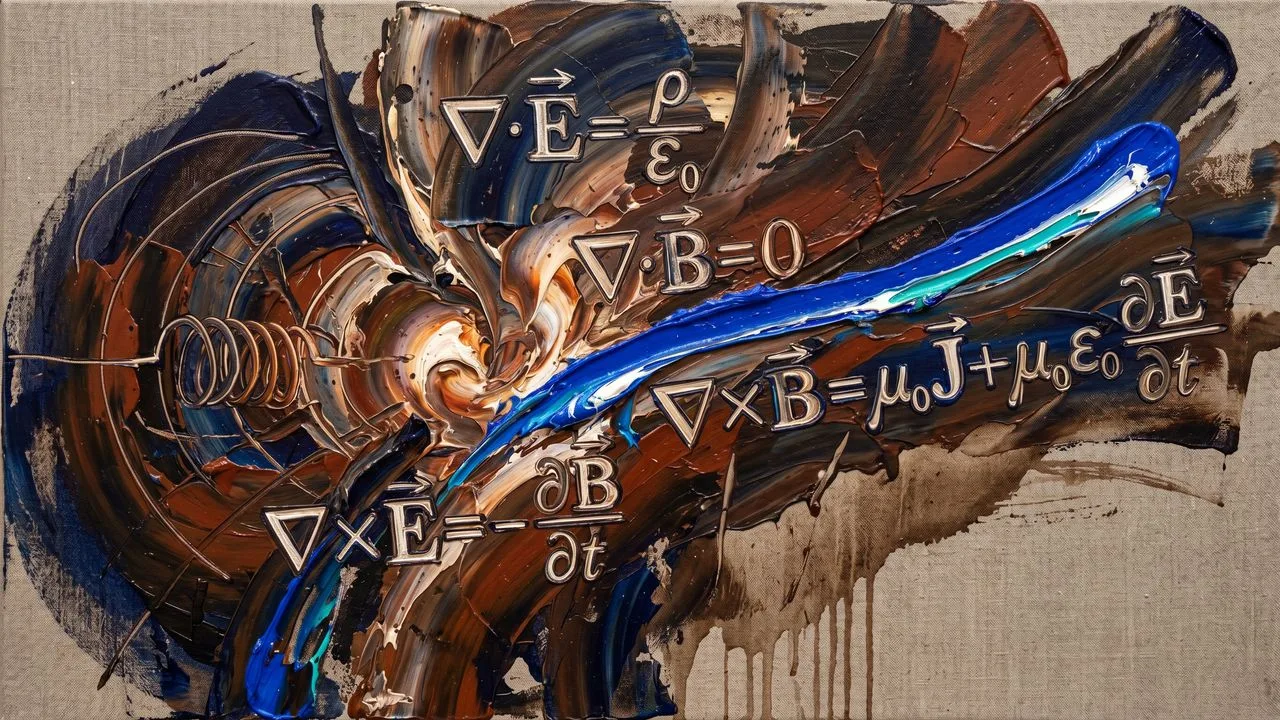
Photo: AI. Saskia Aaltonen
Michael Faraday's father was a blacksmith. Faraday himself left school early, became a bookbinder's apprentice, and taught himself science by obsessively reading every book that came through the shop. He couldn't afford tickets to Humphrey Davy's lectures at the Royal Institution — accounts of exactly how he obtained them vary across historical sources, but he got in, took meticulous notes, bound them into a volume, and sent the whole thing to Davy with a letter asking for a job. That's not a networking story. That's a person clawing through every wall the class system put in front of him.
He eventually got the job. And over the next few decades, working with his hands and his eyes and an almost religious commitment to being guided by observed facts rather than inherited theory, Faraday made some of the most consequential experimental discoveries in the history of physics. He built the first electric motor. He discovered electromagnetic induction — that a changing magnetic field generates an electric current. He built the first dynamo. He proposed, with no mathematical scaffolding, that the universe was threaded through with invisible lines of force, that light itself might be one of their vibrations.
The physics community mostly dismissed the lines-of-force idea. Not because it was wrong. Because Faraday couldn't write it in their notation.
I think about this a lot in biotech, where I watch researchers from non-elite institutions publish real results that get ignored for years while the same finding from a Harvard lab becomes a press release. The gatekeeping mechanism changes — in Faraday's era it was mathematical fluency in a specific 19th-century formalism; today it might be institutional affiliation or the right co-authors — but the underlying dynamic is identical. Truth doesn't get a platform just by being true. It needs a translator with the right credentials.
Faraday's translator was James Clerk Maxwell.
Maxwell was everything Faraday wasn't, institutionally speaking. Born into a comfortable Edinburgh family in 1831, educated at one of the best schools in Scotland, Cambridge-trained, and publishing papers by his early teens — the sources note this timeline deserves some caution, since records from that era are imprecise, but even a generous estimate puts him among the most precocious scientists of his generation. When he turned his attention to Faraday's experimental work, he didn't just admire it. He decided to do what his mathematical training had uniquely equipped him to do: give Faraday's qualitative intuitions a rigorous quantitative form.
In an 1855 paper titled On Faraday's Lines of Force, Maxwell wrote to a friend, "I am working away at electricity again. I hope to see my way through the subject and arrive at something intelligible in the way of a theory." That hedge — intelligible — is doing a lot of work. He was trying to make Faraday's ideas legible to people who had decided they weren't.
His strategy was elegant in a specific way I find genuinely charming: he didn't try to explain electromagnetism directly. He reached for an analogy. Imagine an incompressible fluid — water is the textbook example — flowing outward from a source, with its speed falling off as 1/r². Electric and magnetic forces were already known to obey a similar inverse-square relationship. So Maxwell mapped Faraday's field lines onto the fluid's flow lines, and suddenly the math wrote itself. The divergence of the electric field equals charge divided by a constant. The divergence of the magnetic field is zero (because magnetic monopoles don't exist — there's no magnetic equivalent of a lone electric charge). Two equations down, two to go.
But those first two only handled static fields and steady currents. Changing fields — the whole beating heart of Faraday's law of induction — didn't fit. Maxwell set the work aside.
Six years later he came back with something stranger and more ambitious: a 1861–62 multi-part paper called On Physical Lines of Force. He'd invented a mechanical model of the electromagnetic field — tiny rotating vortex cells packed through all of space, with even tinier ball-bearing particles wedged between them to keep the cells spinning without friction. The vortex cells represented magnetic fields. The ball-bearing particles, if they were electric charges moving in channels, would generate currents. The whole apparatus was, Maxwell was careful to say, not a literal description of nature: "I do not bring it forward as a mode of connection existing in nature. It is, however, mechanistically conceivable."
The model sounds almost absurdly Rube Goldberg-esque, and Maxwell knew it. But it gave him something he couldn't get from pure abstraction: it forced him to think about what happened in the space between conductors — in perfect insulators, in vacuum. He reasoned that even there, a brief, shifting displacement of charge was possible, even if no steady current flowed. He called this the displacement current, and it gave him his fourth equation.
Then he did something that stopped me in my tracks when I first understood it properly. He asked: how fast do waves propagate through this vortex medium? He calculated the ratio of two known experimental constants — the electromagnetic and electrostatic units of charge — and got a number. That number was the speed of light.
Maxwell wrote, "We can scarcely avoid the inference that light consists in the transverse undulations of the same medium, which is the cause of electric and magnetic phenomena."
Scarcely avoid the inference. That is a man trying very hard not to sound like he's shouting. Light isn't just related to electricity and magnetism. Light is electricity and magnetism — a self-propagating oscillation of the two fields, rolling through space at a fixed speed. Every photon hitting your retina right now, the radio waves carrying your Wi-Fi signal, the X-rays in a hospital, the gamma radiation from a distant supernova — all the same phenomenon, differentiated only by frequency. The displacement current insight that unlocked this result came not from a clean experimental measurement but from Maxwell noticing a mathematical inconsistency and patching it — which is its own kind of remarkable.
Einstein later called this discovery "the greatest change in our conception of reality since Newton," attributing it jointly to Faraday and Maxwell (though that specific phrasing is widely cited, and the exact original source is difficult to pin down with certainty). When asked whether he stood on Newton's shoulders, Einstein reportedly replied: "No, I stood on the shoulders of Maxwell."
What I keep returning to, though, is the asymmetry of credit — and what it reveals about how scientific knowledge actually gets certified.
Faraday arrived at the conceptual core of electromagnetic field theory through experimental intuition and relentless empirical observation. He knew, functionally, that space could store and transmit energy through fields. He said so. The math community dismissed it as vague natural philosophy because he couldn't dress it in their formal language. It took Maxwell — Cambridge-trained, credentialed, fluent in the notation — to make the establishment take the idea seriously. Not because Maxwell understood the physics better than Faraday. Because Maxwell had access to the institutional keys that Faraday didn't.
I'm not saying anything conspiratorial here. Mathematical formalism isn't just gatekeeping — it's a genuine epistemic tool, and Maxwell's equations are more powerful than Faraday's verbal descriptions, in the same way that a sequenced genome is more actionable than a clinician's intuition about a patient's hereditary risk. Precision matters. Rigor matters. But there's a real cost when the mechanism for achieving precision is systematically inaccessible to people without elite educational pedigrees. Faraday's experimental truth sat there, essentially correct, for decades before the right translator showed up. How many times does that happen and the translator never comes?
Faraday himself, late in life, was luminously clear about his own uncertainty. Writing about the nature of electric current, he noted: "By current, I mean anything progressive, whether it be a fluid of electricity or two fluids moving in opposite directions, or merely vibrations, or, speaking still more generally, progressive forces." A man with no formal physics education, describing with perfect intellectual humility a phenomenon that the electron theory wouldn't explain for another fifty years, and he knew he was describing something real even if he couldn't name it precisely.
That's not a failure of knowledge. That's experimental genius operating at the edge of what the available conceptual vocabulary could express.
Maxwell's equations are the compression of that genius into a form the world could finally use. ⚡
More Like This
Unraveling the Golden Ratio's Mathematical Magic
Explore how the golden ratio's unique irrationality connects math, nature, and fractals.
The Broken Circuit That Revealed Light Is Electromagnetic
How James Clerk Maxwell solved a capacitor paradox and discovered that light is electricity and magnetism dancing together through empty space.
Is Physics Really in Charge? Ellis vs. Carroll Explained
George Ellis argues physics doesn't decide outcomes—context does. Here's why his debate with Sean Carroll's reductionism is more consequential than it sounds.
Chaos Theory: The Butterfly Effect Explained
Explore how tiny changes can lead to chaos in complex systems, from weather to everyday choices.
Casimir Inc Raised $12M on Quantum Vacuum Claims
Casimir Inc claims its microchip harvests unlimited energy from the quantum vacuum. The physics says otherwise—and $12 million is riding on that gap.
How Instagram Rewires Your Brain
Explore how Instagram manipulates brain chemistry and impacts mental health, especially in adolescents. Discover potential solutions.
Space Stations Beyond the ISS: A Forgotten History
From a Cold War spy base to a Soviet ice rescue to China's chicken-wing oven in orbit — the real history of space stations is wilder than you think.
Curiosity at Sol 4948: Reading Mars Like a Genome
Curiosity Rover hit Sol 4948 in Gale Crater. What its mineralogy tells us about Mars' chemical autobiography—and why that question is getting urgent.