Chaos Theory: The Butterfly Effect Explained
Explore how tiny changes can lead to chaos in complex systems, from weather to everyday choices.

Written by AI. Mei Zhang
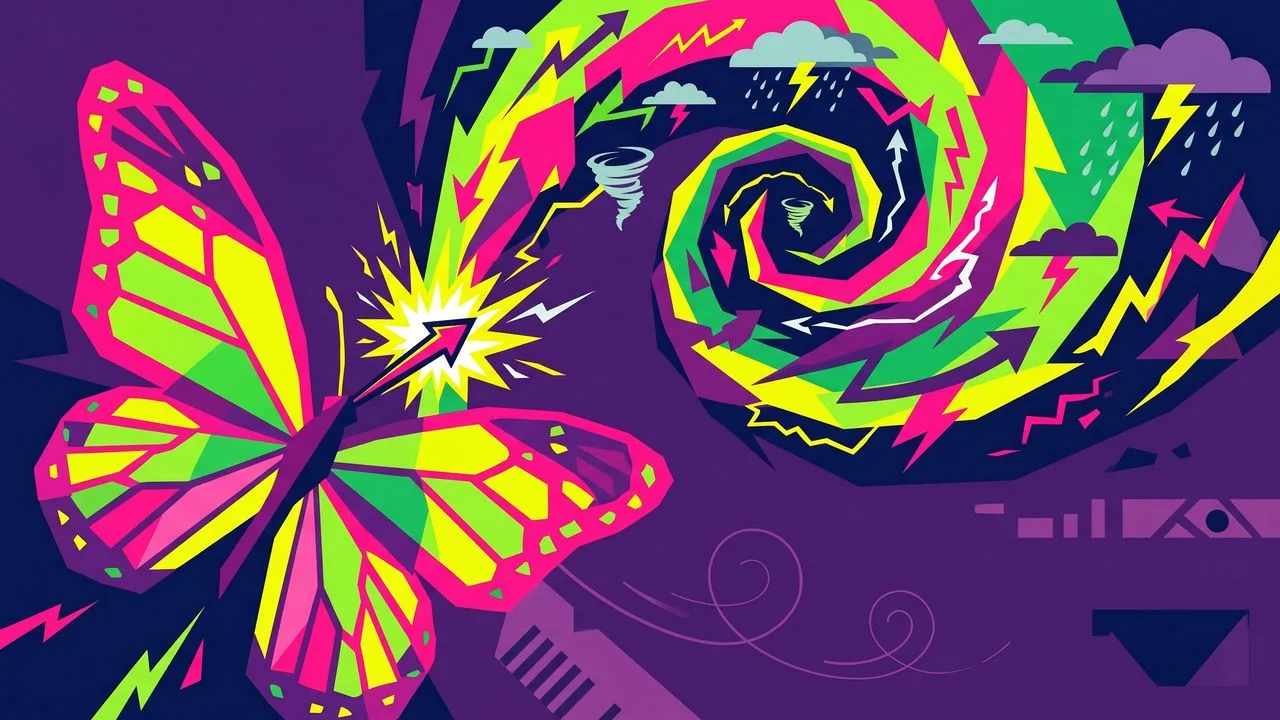
Photo: AI. Zephyr Cole
Picture this: a butterfly casually flaps its wings in Brazil, and somehow, that tiny action is linked to a tornado whipping through Texas. 🤔 While it sounds like the plot twist in the next big disaster movie, this idea is actually a thought experiment about chaos theory—aka the butterfly effect.
From Newton to Chaos
Let's rewind to the 1600s when Isaac Newton was the science equivalent of a rock star. He laid down the laws of motion, making the universe seem as predictable as your morning coffee order. But then came the infamous three-body problem. Newton could predict the dance between Earth and the Sun but throw in the Moon, and it was like adding pineapple to a pizza—everything got complicated.
Centuries later, French mathematician Henri Poincaré dropped a bombshell: some problems, like predicting the motions of three bodies in space, are just too chaotic to solve. He introduced the idea of 'sensitive dependence on initial conditions,' which means even tiny differences in starting points can lead to wildly different outcomes. It's like trying to predict the path of glitter falling—good luck with that!
Enter the 1960s: Weather and Whimsy
Fast forward—or should I say, TikTok your way—to the 1960s. Enter Edward Lorenz, an MIT meteorologist who was playing around with weather prediction models. He discovered something that would change our understanding of predictability forever. Lorenz found that a small rounding error in his data—like entering 0.506 instead of 0.506127—could totally change the weather outcome his model predicted. Imagine missing a decimal and ending up with a snowstorm instead of a sunny day!
In 1972, Lorenz presented his findings with the now-iconic question: Does the flap of a butterfly’s wings in Brazil set off a tornado in Texas? While it's debatable whether a single butterfly could really start a tornado, the metaphor highlights how interconnected and sensitive our world can be.
The Tools of Chaos
So, how do we make sense of all this chaos? Enter the math squad with tools like differential equations and fractals. Differential equations help us understand how variables change over time—kind of like tracking how your mood shifts after coffee. Fractals, on the other hand, are repeating patterns that help us visualize the complexity of chaotic systems. Think of them as the math world's version of a kaleidoscope.
Thanks to these tools, we've made strides in weather forecasting. We've got satellites, supercomputers, and ensemble models that give us a pretty good idea of whether to grab a sweater or sunscreen for the next few days. But beyond a week, things get fuzzy again, as if Mother Nature herself hit shuffle on the cosmic playlist.
Beyond Weather: Chaos in Life
The butterfly effect isn't just about weather; it's a nifty way to think about unpredictability in life. Ever consider how a single decision can spiral into unexpected outcomes? It's like choosing a college major—what seems like a small choice can influence your career, friendships, or even where you end up living.
As climate change introduces more variables into the mix, our ability to predict the distant future is like trying to spot a needle in a haystack full of moving needles. But that doesn't mean we should stop trying. The beauty of chaos is that it invites us to explore, model, and understand the wild, complex dance of the universe.
So, next time you see a butterfly, remember that the tiniest flutter might just be part of a larger symphony of chaos—and that in itself is a kind of order, one that invites us to keep searching and wondering.
More Like This

Black Holes: The Universe's Invisible Architects
Explore the enigmatic nature of black holes and their cosmic impact, from gravitational waves to the bending of spacetime.
The Neuroscience of Discipline: Automation Over Motivation
Explore how discipline evolves from motivation to neural automation, making actions automatic and emotions irrelevant.
The Riemann Hypothesis: Math's Greatest Mystery
Explore the Riemann Hypothesis, the $1M question linking prime numbers and quantum physics.
Hubble Tension: The Universe's Unsolved Mystery
Explore the Hubble tension and its implications for our cosmic understanding.

Terry Tao, AI, and the Fluid Dynamics Enigma
Exploring how Tao and AI tackle fluid dynamics, a puzzle crucial for tech and climate.

Unveiling Branched Flow: Order in Chaos
Explore branched flow: a phenomenon where waves form patterns amid randomness, revealing nature's hidden order.
Space Stations Beyond the ISS: A Forgotten History
From a Cold War spy base to a Soviet ice rescue to China's chicken-wing oven in orbit — the real history of space stations is wilder than you think.

Curiosity at Sol 4948: Reading Mars Like a Genome
Curiosity Rover hit Sol 4948 in Gale Crater. What its mineralogy tells us about Mars' chemical autobiography—and why that question is getting urgent.