Hubble Tension: The Universe's Unsolved Mystery
Explore the Hubble tension and its implications for our cosmic understanding.

Written by AI. Nadia Marchetti
Imagine you're in a bustling bazaar, with traders shouting prices and haggling over goods. Now, picture if every trader had a different scale for what a kilogram weighed. That's where cosmology finds itself today—standing at the intersection of theory and observation, scales in hand, trying to measure the universe's expansion rate. This isn't just an academic squabble; it's a cosmic mystery that Nobel laureate Adam Riess and his peers are determined to unravel.
The Cosmic Bazaar: A Tension in Measurements
The "Hubble tension" is not just a catchy phrase but a genuine conundrum that could reshape our understanding of the universe. At its core, it's a discrepancy between two critical measurements of the universe's expansion rate, known as the Hubble Constant. One measurement derives from the universe's earliest light, the cosmic microwave background, while the other comes from observing nearby galaxies. Ideally, these two numbers should match within a margin of error, but they don't. Instead, they're like two merchants in that bazaar, each insisting their scale is right.
"The best end-to-end test of the universe is to look at the cosmic microwave background, which tells you the state of the universe shortly after the Big Bang," Riess explains. Yet, as he points out, this test, much like measuring the height of a child now to predict their adult stature, should align with current measurements. But as our tools have become more precise, the mismatch has grown, reaching levels that demand our attention.
Tools of the Trade: Telescopes and Techniques
Our modern tools, the Hubble Space Telescope and its successor, the James Webb Space Telescope, have given us eyes sharper than ever before. They've allowed us to peer into the universe with unprecedented clarity, akin to upgrading from a magnifying glass to a microscope. These advancements have made it possible to measure the Hubble Constant with increasing precision, highlighting the tension even more.
In this celestial toolkit, parallax plays a vital role. It's a method that uses the Earth's orbit to measure the distances to nearby stars, forming the first rung of what's known as the "distance ladder." This ladder allows astronomers to calibrate the brightness of specific stars, like Cepheid variables, to measure distances to galaxies where supernovae occur.
"The problem might be with the story we tell ourselves that connects the two," Riess muses. "Maybe dark matter and dark energy are more complicated." It's this narrative—the Lambda-CDM model—that could be flawed, suggesting there's something we've yet to understand about the universe's fabric.
A Cosmic Paradox: Seeking Resolution
There's a certain beauty in this tension. It's a reminder that science thrives on contradictions, on the slivers of doubt that push us to explore further. Riess sees this as a potential doorway to discovery, akin to how unresolved questions about the universe's expansion in the 1990s led to the revelation of dark energy.
So, what's the next step? Riess and his colleagues are searching for measurements that can bridge the gap between these two scales. They seek a cosmic measuring stick that can span the vast chasm between the early universe and the present day, providing a consistent reference point.
"What you would like is to be able to measure something in between," Riess notes, envisioning a solution that could finally connect these two disparate scales.
The Journey Continues
As the scientific community grapples with this tension, one thing remains clear: there's a discovery waiting in the wings. Whether it's a new understanding of dark matter and dark energy, or a refinement of our cosmic models, the Hubble tension invites us to keep asking questions.
In the world of unexplained phenomena, where we often tread the line between skepticism and belief, this tension is both a challenge and an opportunity. It's a cosmic puzzle that, when solved, could redefine our understanding of the universe.
More Like This
Rethinking Cosmic Acceleration: A Local Illusion?
Exploring the debate on whether the universe's acceleration is a local phenomenon, challenging the concept of dark energy.
Dark Energy: New Dimensions in Cosmological Models
Exploring how dark energy challenges our understanding of the universe and its evolution over time.
The Most Sensitive Dark Matter Detector Might Find Nothing
LUX-ZEPLIN sits a kilometer underground, waiting for dark matter. But success might look like silence—and that would tell us something huge.
Exploring Cosmic Time Delays and Dark Energy
Time delay cosmography may unveil dark energy mysteries, resolving Hubble tension with new cosmic insights.
Restoring Notre Dame's Timeless Acoustics
Exploring the science behind restoring Notre Dame's iconic acoustics post-2019 fire.
Exploring Cosmic Voids: The Universe's Empty Giants
Cosmic voids, vast regions of emptiness, hold secrets about the universe's structure and fate, revealing the interplay of dark matter and energy.
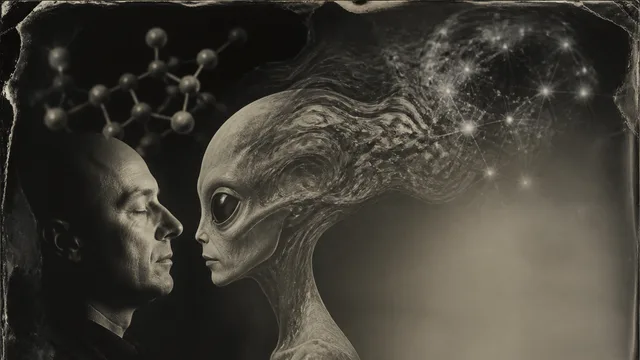
Do DMT Entities Point to Alien Consciousness?
Cognitive scientist Donald Hoffman claims DMT entities may be real alien minds. The math is real. Whether it proves anything about consciousness is a different question.
Viking Landers and the Unsolved Mars Life Debate
Fifty years after Viking landed on Mars, one experiment's positive result remains unexplained. Here's what the science actually shows—and what we've learned since.